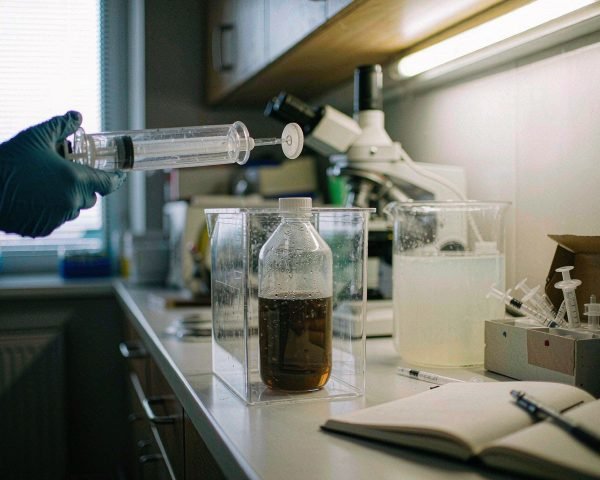

There’s a moment every lab person knows: the syringe plunger stops moving halfway through a dirty sample, your thumb does the remaining work, and the membrane comes out looking like a shingle. That’s the moment a glass fiber prefilter would have earned its ten cents.
Answer: Use a glass fiber prefilter when your sample is visibly turbid, particulate-heavy, or known to clog a membrane quickly (dissolution samples, environmental extracts, food matrices, cell lysates). Skip it for clean, low-solids samples, where the prefilter only adds hold-up, adsorption, and cost without helping.
What a Glass Fiber Prefilter Actually Does
A glass fiber layer is a depth medium, not a screen. Instead of catching particles on a flat surface, it traps them through the thickness of a fibrous mat, which means it holds far more solids before it blocks.
Stack it ahead of your final membrane and the division of labor is simple: the prefilter eats the big and abundant particles, the membrane polishes to its rated pore size. The result is faster flow, less hand pressure, and a membrane that survives the whole sample instead of dying at the first milliliter. Chrom Tech’s guide to glass prefilters sums it up: prefilters capture larger particles before they reach the main membrane, improving flow rate and extending filter life.
Two formats exist. Integrated units (glass fiber bonded above the membrane in one housing) and the two-filter-in-series approach, where you push through a plain glass fiber filter first, then the membrane. Integrated is faster and cleaner; in-series costs less per unit and lets you pick the membrane independently.
The Samples That Need One
The pattern is always the same: high solids, sticky solids, or both.
- Dissolution testing. Tablet excipients shed throughout the run; prefilters are standard practice here.
- Environmental extracts. Soil and sediment leachates carry fines that blind 0.45 µm membranes in seconds.
- Food and beverage samples. Pulp, protein, and fat; Phenomenex’s filter selection chart specifically recommends a GF prefilter for samples with large particulate or fibrous matter.
- Biological samples. Cell lysates and protein-rich matrices.
- Ethanol and botanical extracts, where waxes and plant debris load the membrane fast.
If your lab runs any of these routinely and you’re discarding half-clogged filters, the prefilter pays for itself in membrane count alone. Our article on why syringe filters clog covers the mechanisms in more depth.
The Samples That Don’t
Here’s the counterintuitive part: for clean samples, a prefilter makes things worse.
The glass fiber layer adds wetted surface area and trapped volume. Merck Millipore’s performance data on prefilter-equipped filters is the cautionary measurement: prefilter-containing filters bound 15-25% of a drug compound in the first milliliter filtered, while identical membrane-only filters showed no binding at all. Their guidance cuts both ways: use membrane-only filters for easy samples, use prefilter versions for hard ones, and discard the first few milliliters when a prefilter is in play.
Translation for a normal bench: pushing a clean standard through a glass fiber prefilter buys you nothing and risks binding your analyte on fresh fiber. Our article on early-filtrate losses and minimum wetting volume covers how much sample those first milliliters can quietly eat.
The Decision Rule
One question settles it: does the sample clog, or has it ever clogged a membrane?
- Clogs routinely, or you can see particles: prefilter, no debate.
- Clogged once, on one batch: keep a box of prefilters on the shelf and use them when it happens.
- Never clogs: membrane-only, smaller diameter if your volumes are small.
When in doubt, split the difference with a technique choice: prefilter a test aliquot and compare recovery and flow against direct filtration on the same sample. Ten minutes of A/B testing beats a box of wrong filters.
A Bench Story: The Dissolution Rack
A QC lab I worked with ran dissolution on twelve vessels at a time, six time points, twice a week. Every sample went through a 0.45 µm membrane, and the filters were dying at sample three of six. The bench accepted this as weather.
The fix took one box of glass fiber prefilters and a ten-minute demonstration. Prefilter first, membrane second: samples finished in one pass, membranes survived whole runs, and hand pressure dropped enough that the analysts stopped comparing forearm workouts. Total added cost per sample: a few cents.
The reason it worked is the one this article keeps circling. The tablets were shedding excipient solids that no 0.45 µm membrane was ever designed to absorb. The prefilter didn’t improve the membrane. It protected it.
Practical Notes for Using Prefilters Well
- Pick pore rating by job. Glass fiber prefilters commonly run from about 1-10 µm effective retention. Match it to your dirtiest expected particle, not your membrane.
- Condition before you count. With integrated prefilter units, push and discard a small aliquot so the fiber saturates before your collected fraction. This is where the Merck binding data comes from, and a discard step neutralizes it.
- Validate the stack. A prefilter changes hold-up and adds a surface your analyte might touch. Our filter lot validation protocol applies to any change in filtration stack, including lot changes.
- Watch hold-up on small volumes. Prefilter units trap more liquid than bare membranes. Under ~500 µL of sample, weigh whether the prefilter’s sample cost exceeds its time savings. Our hold-up volume guide puts numbers on it.
- Don’t stack out of fear. Two prefilters don’t protect twice; they halve your recovery.
Conclusion
A glass fiber prefilter is insurance with a deductible: it costs a little sample, a little hold-up, and a little money, and in exchange your membrane survives dirty matrices it otherwise couldn’t finish. Use it when the sample is visibly loaded, condition it before collecting, and skip it when the sample runs clean. Match the tool to the dirt, validate the stack once, and filtration stops being the slowest step of your prep. For the clogging mechanisms behind all this, read our syringe filter clogging guide, and for the murkiest end of the spectrum, our cloudy filtrate troubleshooting guide is the next stop. A box of prefilters on the shelf is the cheapest insurance a dirty sample can buy.
Frequently Asked Questions
What pore size is a typical glass fiber prefilter?
Effective retention usually falls between about 1 and 10 µm, well above a 0.22 or 0.45 µm final membrane. The prefilter’s job is bulk solids, not final clarity.
Does a prefilter change my analyte recovery?
It can. Glass fiber adds adsorption surface, and studies have shown 15-25% binding in the first milliliter for some compounds on prefilter-equipped filters. Condition the filter, discard a validated initial volume, and your recovery returns to normal.
Can I use filter paper instead of a glass fiber prefilter?
For very coarse pre-straining, sometimes. Filter paper is slower, sheds more fibers, and absorbs more sample than glass fiber, which is why lab filtration stacks standardize on GF media ahead of membranes.
Should I buy integrated prefilter syringe filters or two filters in series?
Integrated units are faster, cleaner, and less handling error; in-series costs less and lets you choose the membrane freely. High-throughput benches usually settle on integrated; occasional dirty samples do fine with a GF filter ahead of the membrane.