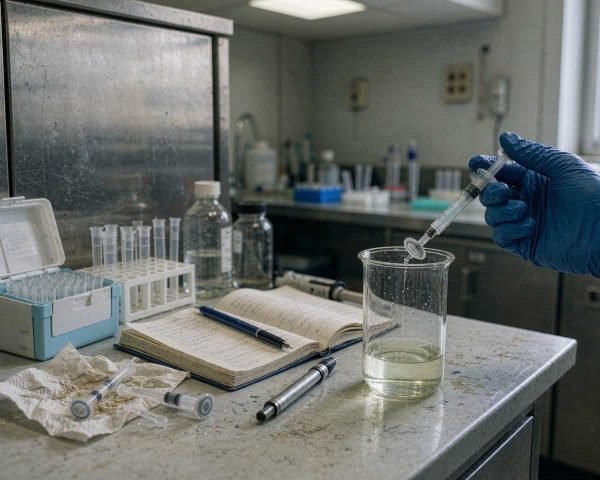

Halfway through filtering a dirty extract, the plunger stops moving. You push harder, the syringe bulges, and now you’re choosing between losing the sample or losing the filter. Every lab knows this moment. The filter didn’t fail randomly; something about the sample, the membrane, or the technique caused it.
Quick answer: Syringe filters clog because particulates and colloids build up on the membrane surface until flow stops. The main causes are a pore size too fine for the sample’s particle load, skipped prefiltration, viscous samples, membrane-solvent mismatch, and excessive pressure. Prefiltering, choosing the right membrane, and using a larger filter area prevent most clogs.
Here’s what’s going on inside that little plastic housing, and how to keep your thumbs comfortable.
What’s Actually Happening When a Filter Clogs
A membrane is a thin polymer sheet full of tortuous pores. In theory, particles smaller than the pores pass through and larger ones stay behind. In practice, particles don’t line up politely on the surface. They bridge pore openings, pile into a cake layer, and cut your effective area within the first few milliliters.
Flow decays as the cake grows. Cytiva, which makes the Whatman GD/X range, describes this as back pressure building until high-particulate samples stall a syringe filter entirely. Once the cake forms, pushing harder doesn’t help; it just stresses the membrane and your fingers.
That’s the mechanism. The causes below are the ways labs feed it.
Cause 1: The Pore Size Is Too Fine for the Load
Reaching for a 0.22 µm filter for everything feels safe. It’s the finer rating, so it must be better, right? On a clean aqueous standard, sure. On a soil extract or a protein precipitate, a 0.22 µm membrane clogs within the first milliliter.
The PES membrane clogging behavior is predictable: aggregated material in thawed plasma or serum, for example, blocks a fine microfiltration membrane almost immediately. If your goal is clarification before HPLC and your sample carries visible turbidity, start with 0.45 µm and only drop to 0.22 µm when sterility or fine particulate removal actually matters.
We cover the trade-offs in detail in our 0.22 vs 0.45 micron pore size guide.
Cause 2: The Sample Was Never Prefiltered
This is the biggest one in environmental and bioanalytical work. A single fine membrane asked to handle sludge, soil particles, or cell debris does the job of a depth filter badly.
The fix is staged filtration. A glass fiber prefilter, or a stacked filter with a coarse layer over the final membrane, traps the big stuff first. Crawford Scientific’s filtration guide notes that a prefilter layer can multiply the sample volume a filter handles before clogging, especially for viscous or particulate-laden samples.
I run environmental water samples through this pattern weekly: coarse glass fiber first, then 0.45 µm, and the final filter lasts twenty times longer. Skipping the prefilter to save 30 cents per sample cost me an afternoon of redoing a 40-vial batch once. Never again.
Cause 3: The Sample Is Too Viscous
Viscosity is a flow tax. Protein solutions, oils, glycerol-containing buffers, and concentrated digests all push slower through the same pore size. Slower flow means more contact time for particles to settle onto the membrane, which accelerates clogging.
Options that actually work: dilute the sample if your method allows, warm it modestly (viscosity drops with temperature), or move to a larger diameter filter. A 33 mm filter has far more area than a 13 mm one, and area is what buys you volume before the cake forms. Our syringe filter size guide matches filter diameter to sample volume.
Cause 4: Membrane and Solvent Don’t Agree
Some clogs are chemical. Push an aqueous-only membrane into an organic solvent and the polymer can swell or precipitate, shrinking pore size before any sample touches it. Cellulose acetate in strong acids, regenerated cellulose in some organics, and nylon with aggressive halogenated solvents all have known limits.
Precipitation is sneakier. If your sample matrix drops proteins or salts when it meets the diluent, that precipitate forms on the membrane mid-push. The filter gets blamed; the chemistry was the culprit. If a sample consistently clogs around the same volume, test the diluent compatibility before ordering different filters.
A quick bench test settles it in two minutes. Push a milliliter of clean diluent through the filter first. If that flows freely but the sample stalls, the problem is particulates. If the diluent itself barely moves, the membrane and solvent are fighting, and no amount of prefiltration will save you. I keep a PTFE, a PES, and a nylon filter at the bench for exactly this triage, and the two-minute test has rerouted more method development conversations than any chromatogram.
Cause 5: You’re Pushing Too Hard
The natural response to slow filtration is more force. Past a point, that force compacts the particle cake into an impermeable layer, deforms the membrane support, or bursts the housing at the seams.
Steady, moderate pressure filters faster in total time than intermittent pushing. If resistance climbs suddenly, stop, swap to a fresh filter, and reconsider the pore size instead of wrestling the plunger.
The burst failure deserves a warning of its own. A housing that lets go under hand pressure sprays your sample across the bench, and if that sample is a biological matrix or a neat standard, you now have a cleaning job and a lost sample. Firm, even thumb pressure is enough for any properly matched filter and sample. If it isn’t, the sample is telling you to change something upstream.
A Prevention Routine That Works
For dirty samples, my default sequence looks like this:
- Centrifuge if the load is heavy; it’s cheaper than any filter.
- Prefilter through glass fiber or a coarse 1.2 µm membrane.
- Final-filter through 0.45 µm (or 0.22 µm only when the method demands it).
- Use a filter diameter matched to your volume, not the smallest one on the shelf.
- Draw a small air bubble into the syringe first; the air purge empties the housing and saves a few hundred microliters of sample.
There’s a point where a syringe filter is simply the wrong tool. Above roughly 50 mL of turbid sample, or when you’re filtering dozens of vials a day by hand, switch formats: vacuum filtration with a 47 mm membrane, or a syringeless filter vial that skips the syringe entirely. The per-unit cost looks higher until you price in the labor. Membrane Solutions’ plasma prefiltration protocol shows the same staged logic applied to biological samples, and it scales the same way for environmental work.
Labs that adopt this routine stop treating filters as single-use sacrifice items and start getting their rated throughput out of them.
Conclusion
Syringe filter clogging is a surface-area and particle-load problem, not a quality problem, and it responds to planning more than to force. Match the pore size to your actual goal, prefilter anything turbid or biological, respect viscosity, keep membrane and solvent compatible, and press steadily instead of hard. The five causes above account for nearly every stalled filter I’ve seen in fifteen years around sample prep, and the fixes cost pennies compared to repeated work. If your samples are already clean but you’re losing analyte instead of flow, the problem may be filter breakthrough rather than clogging, so it’s worth knowing both failure modes. And if clogging keeps costing you runs, our list of seven syringe filter mistakes that ruin samples covers the upstream habits that prevent it.
Frequently Asked Questions
Can I unclog a syringe filter and reuse it?
No. Once the cake layer forms, backflushing rarely restores flow and risks pushing particles into your filtrate. Syringe filters are single-use devices; swap to a fresh one and fix the upstream cause instead.
Should I use a bigger pore size or a bigger filter diameter?
Depends on the failure. If flow stops early on a relatively clean sample, a larger diameter adds membrane area and usually fixes it. If the sample is genuinely dirty, pore size and prefiltration matter more than diameter.
Why does my filter clog even though the sample looks clear?
Dissolved solutes can precipitate when they hit the membrane or the diluent, and colloids below visible size still bridge fine pores. Try a different membrane chemistry or a 0.45 µm rating, and check whether your diluent is causing precipitation.
What is a prefilter and do I need one?
A prefilter is a coarse layer, often glass fiber, placed upstream of the final membrane to catch large particles. If you filter serum, soil extracts, or anything visibly turbid, a prefilter will dramatically extend your final filter’s life.
Does pushing harder make filtration faster?
Not really. Extra force compacts the particle layer and can burst the membrane or housing. Steady moderate pressure gets more total volume through before the filter dies, and it’s kinder to your thumb.