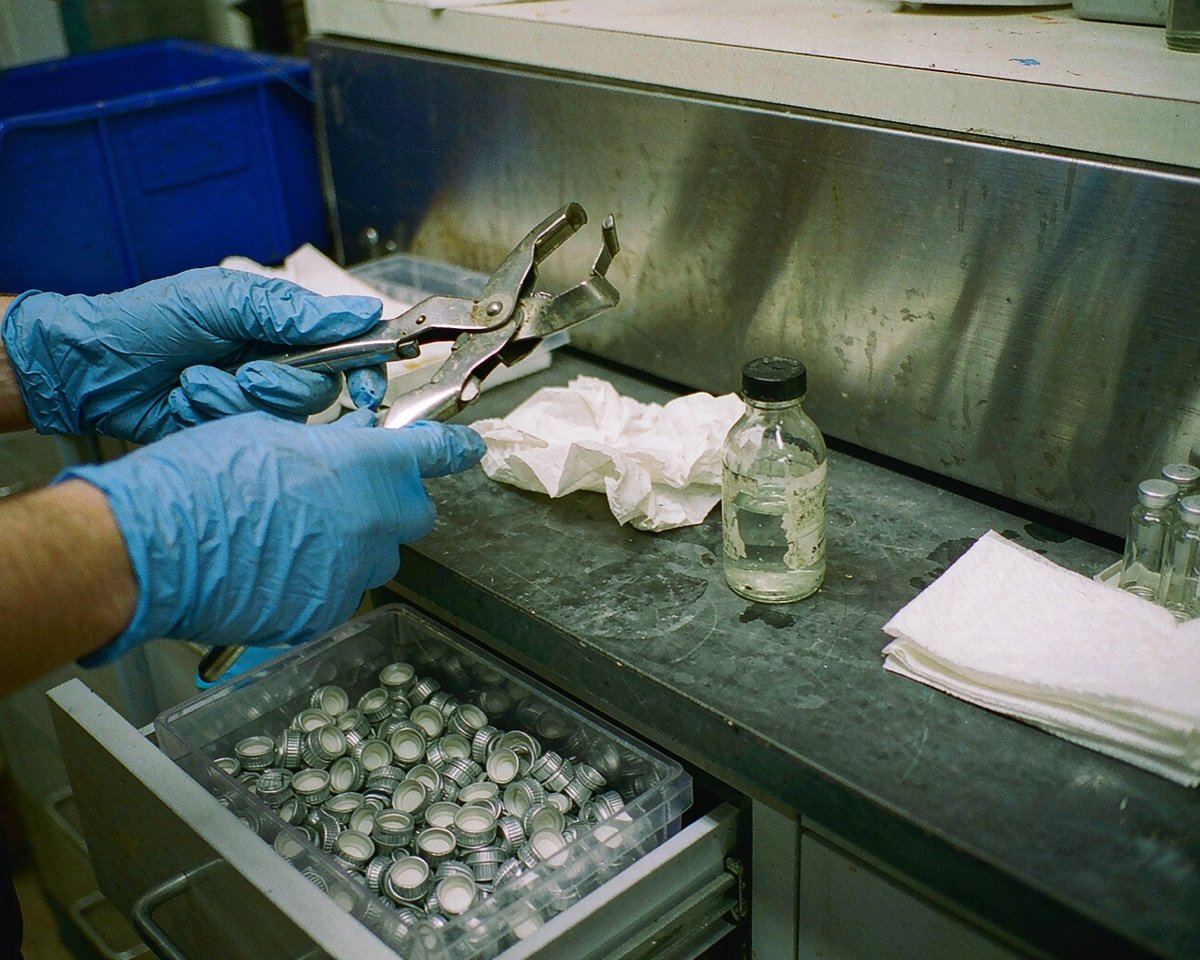


GL25, GL32, GL45. Three thread codes, three bottle sizes, and one very common ordering mistake: caps that don’t fit the bottles you already own.
Match thread to capacity: GL25 covers tiny 10-50 mL bottles, GL32 is the 50 mL neck, and GL45 runs from 100 mL up to 5 L and beyond. If you buy bottles and caps in the same GL family, everything interchanges.
What “GL” Actually Means
GL is a standardized glass bottle thread, born in Germany (the letters trace back to *Gewinde*, the German word for thread) and codified under DIN 168. DWK Life Sciences introduced its GL-thread DURAN bottles in 1972, and the design spread so completely that a GL45 cap from one manufacturer threads onto another brand’s GL45 bottle. That interchangeability is the entire reason to care about the code.
The thread designation is a diameter. GL45 means a 45 mm thread at the neck finish, GL32 is 32 mm, GL25 is 25 mm. Pitch and profile are standardized too, so the seal geometry works across brands.
One distinction that trips people up: GLS 80 is not part of the same family scaling. It is the wide-mouth 80 mm thread used on 10 L and larger bottles and for powder storage. Different job, different code.
GL25: The Small-Format Thread
GL25 lives on small bottles, roughly 10 to 50 mL depending on the manufacturer. DWK’s own range puts 25 mL bottles on GL25 necks, sometimes 10 mL as well (DWK bottle range).
You meet GL25 when you work with expensive reagents, standards, and small-volume buffers. The narrow neck suits controlled pouring of costly solutions where a 45 mm opening would invite spills.
The catch is ecosystem depth. Fewer accessories exist for GL25 than for GL45. Bottle-top filters, multi-port caps, and dispensing gear are overwhelmingly designed around GL45, so if you anticipate those accessories, prefer a bottle line that gives you the bigger thread.
GL32: The In-Between Neck
GL32 is the standard thread on 50 mL bottles. Fisher’s DURAN amber bottle selection table shows the pattern clearly: 25 mL in GL25, 50 mL in GL32, and 100 mL upward in GL45 (Fisher Scientific listing).
In practice GL32 is the least commonly discussed of the three, and that is fine. Its role is narrow: a 50 mL bottle is the right size for working standards, small buffer batches, and bench-scale reagent aliquots. If your lab uses those, keep a few GL32 caps in stock, because ordering a “spare cap” assortment that contains only GL45 pieces is a classic small mistake.
GL45: The De Facto Standard
GL45 is where nearly every serious lab workload lives. The thread covers bottle capacities from 100 mL up to 5 L in the DURAN line, and it dominates three jobs: media and reagent storage, HPLC mobile phase reservoirs, and autoclaving.
Why did GL45 win? Several reasons stacked up:
- 100 mL to 1 L bottles cover the everyday volume range for buffers and mobile phase.
- The 45 mm opening accepts stir bars, spatulas, and powder funnels without a funnel fight.
- The accessory ecosystem is the deepest in the industry: pour rings, GL45 bottle-top filter adapters, multi-port caps for HPLC reservoirs, and safety coated versions.
- Autoclave caps rated to around 140 °C are standard equipment.
Our GL45 media bottle guide goes deep on sizes and buying criteria if this is the thread you are shopping for. And if you run HPLC, the GL45 mobile phase cap with its dip tube and vent ports is the piece that turns a storage bottle into a reservoir.
A Practical Selection Table
| Bottle capacity | Thread you’ll get | Typical use | |—|—|—| | 10-25 mL | GL25 | Standards, costly reagents | | 50 mL | GL32 | Working standards, small batches | | 100-250 mL | GL45 | Fresh mobile phase, small buffers | | 500 mL-1 L | GL45 | Daily buffers, media | | 2-5 L | GL45 | Bulk media, large solvent storage | | 10 L+ | GLS 80 | Bulk powders, large volumes |
Memorize the middle row of that table and you will avoid 90% of cap-mismatch orders.
Matching Caps, Rings, and Accessories
Three buying notes from someone who has unpacked a few of these boxes.
Caps and pouring rings are usually sold separately from bottles, and the color coding is worth using deliberately. DURAN’s screw caps come in blue, green, yellow, and gray with matching pour rings, and labs that assign a color per buffer type cut down cross-contamination mix-ups (Fisher GL45 cap listing). A yellow cap on every sodium phosphate stock sounds trivial until it prevents someone autoclaving the wrong bottle.
Also check whether your cap has a plug seal or a lip seal. Plug seals are the classic design for liquid-tight storage; lip seals pour cleanly. Both work; they just optimize different jobs.
And confirm autoclave ratings if your bottles go through steam sterilization. Glass handles it, but the polypropylene cap and pour ring have temperature limits, and exceeding them quietly deforms the seal. Our guide on sterilizing reagent and media bottles covers the safe cycle setup.
When Thread Choice Actually Matters Most
Two moments in lab life are where the GL code earns attention.
The first is equipping an HPLC. Mobile phase reservoirs are almost universally GL45, and the reservoir cap you choose (vented, multi-port, with or without a filter) determines whether your pump pulls clean solvent or floats particulates.
The second is scaling up a biotech or QC workflow. A protocol developed with 50 mL GL32 bottle aliquots eventually becomes a 1 L GL45 batch process. If you standardize on GL45 bottles and accessories from the start, scaling up means buying bigger bottles, not a whole new cap and accessory ecosystem.
Conclusion
The GL thread code is one of the small standards that quietly makes lab life work: buy any GL45 bottle and any GL45 cap, and they seal. GL25 belongs to small-format standards and reagent work, GL32 to the 50 mL working-size bottle, and GL45 to everything from 100 mL buffers to 5 L media. If you are stocking a new lab, weight your order toward GL45 and keep a handful of GL25 and GL32 caps for the small bottles. Material matters as much as thread, so pair the size decision with our guide to amber vs clear reagent bottles, and stick to Type 1 borosilicate for anything that touches the autoclave Get the thread right once and every future bottle purchase becomes boring, which is exactly what you want.
Frequently Asked Questions
Are GL45 caps interchangeable between brands?
Yes. GL45 is a standardized DIN thread, so a GL45 cap from one manufacturer seals a GL45 bottle from another. Verify the seal type (plug vs lip) and temperature rating, but the thread itself is cross-compatible.
What size bottle uses a GL32 thread?
GL32 is the standard thread on 50 mL laboratory bottles. Some manufacturers also use it on 60 mL formats, but 50 mL is the near-universal mapping.
Can GL45 bottles go in the autoclave?
The borosilicate glass bottle can, and GL45 is the standard choice for autoclaving media. Loosen or use a rated autoclave cap, keep the polypropylene cap within its temperature limit (typically around 140 °C), and vent per your autoclave’s liquid cycle.
What does GLS 80 mean on a large bottle?
GLS 80 is the wide-mouth 80 mm thread used on bottles of roughly 10 L and above, and on containers for bulk powders. It is a separate family from the GL25/32/45 scale and is not interchangeable with them.
Why do HPLC reservoir caps use GL45?
Most mobile phase bottles come in 1 L or 2 L GL45 formats, so accessory makers built vented and multi-port reservoir caps around that thread. The standard cap geometry also accepts solvent delivery tubes and air filters without custom fittings.