
# What Consumables Does Vitamin Analysis in Food Labs Need?
Vitamins are the most fragile analytes you will ever run. Riboflavin, retinol, and ascorbic acid all degrade under conditions your metal residues would shrug off. So the consumables you pick for vitamin analysis matter more than most people realize.
Short answer: amber 2 mL glass vials, 0.22 µm filters matched to your solvent (PTFE for organic extracts, PVDF for aqueous), low-adsorption vials for trace B-vitamins, and amber bottles for mobile phase carrying ascorbic acid.
Get those four choices right and most vitamin methods run clean. Get one wrong and you can lose half your recovery before the autosampler even injects. Here is how each choice plays out on a real bench.
Why Vitamins Punish Careless Sample Prep
Every vitamin has a weakness. Vitamin C oxidizes the moment it meets oxygen or a stray metal ion. Retinol and vitamin E are stripped from food matrices by saponification, which is harsh chemistry by design. Riboflavin is photosensitive, and not mildly so. One study measured its photodegradation half-life in solution at under eight minutes in direct light. On a sunny bench, your riboflavin standard can be visibly weaker before you finish labeling the vials.
That fragility shapes every consumable decision below. The goal is simple: nothing between extraction and injection should add light, oxygen, or adsorptive surfaces to your analyte’s day.
Extraction and Saponification Consumables
Fat-soluble vitamins (A, D, E, K) almost always start with saponification. You digest the sample with KOH in ethanol, usually 30 minutes at 75 to 80 °C, then extract into hexane or ether. Agilent published an application note showing this same chemistry feeding an SFC/UHPLC method for both fat- and water-soluble vitamins, which tells you how universal the workflow has become.
What does that stage demand from your consumables?
Amber glass extraction bottles. KOH at 80 °C will etch cheap soda-lime glass and cloud it permanently. Use Type 1 borosilicate, amber if the bottle will sit anywhere near a window.
Your centrifuge tubes need to survive the solvents, too. Hexane and ether attack some polypropylene over long contact. Check the compatibility chart before you pour a hot saponification digest into a bargain tube.
Antioxidants as reagents, not afterthoughts. Methods for vitamin A and D add ascorbic acid or BHT into the saponification mix itself, precisely because the heat accelerates oxidation. That means your reagent bottles and dispensing vessels are handling ascorbic acid solutions daily, which matters for the storage section below.
Water-soluble vitamins are gentler. Acid or enzymatic hydrolysis, then straight to filtration. But the published B1/B2 methods still pass every extract through a 0.45 µm PVDF syringe filter before the vial goes into the autosampler. Filtration is non-negotiable either way.
Filtration: Match the Membrane to the Solvent
The membrane chemistry question trips up more labs than the pore size question. Both matter, but solvent compatibility is where filters quietly fail.
Here is the short version:
| Membrane | Best for | Watch out for |
|---|---|---|
| PTFE | Organic extracts (hexane, ethyl acetate) after saponification | Blocks aqueous samples unless prewetted |
| PVDF | Aqueous B-vitamin extracts, low extractables | Avoid strong bases and DMSO |
| Nylon | General aqueous samples, ascorbic acid extracts | Adsorbs proteins, some strongly basic compounds |
| Regenerated cellulose | Aqueous-only work | Fails in organic solvent |
Post-saponification vitamin D or E extracts in hexane belong on PTFE. Aqueous thiamine or riboflavin hydrolysates run beautifully through PVDF, which is exactly what the rice vitamin methods use. Ascorbic acid extracts in meta-phosphoric acid filter fine through 0.22 µm nylon, and published methods for vitamin C in banana do exactly that.
If you want the full decision tree, I broke down the tradeoffs in our guide to nylon vs PTFE vs PVDF vs PES filters.
One caution from the Thermo Fisher filtration guide worth repeating: an incompatible membrane can swell or leach, and those leachables land exactly in the low-UV wavelength range where several vitamins are detected. A ghost peak at 245 nm is a bad afternoon.
Vial Choice for Light-Sensitive and Oxidizable Vitamins
This is where vitamin analysis diverges hardest from, say, metals work.
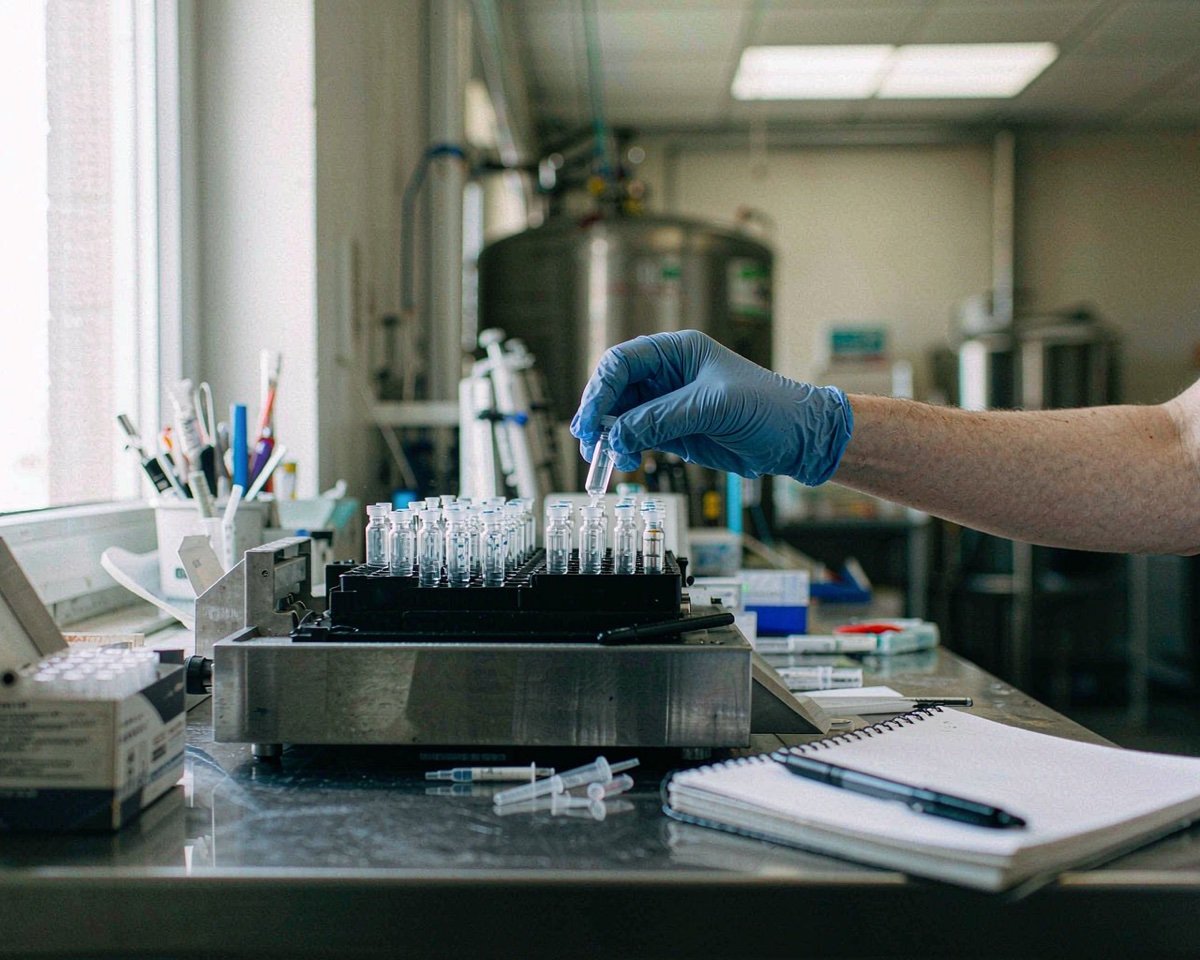
Amber glass, always, for riboflavin and retinol. Clear glass transmits the wavelengths that shred these molecules. Amber glass blocks most of the actinic range below 450 nm, which covers the riboflavin absorption bands. If you must use clear vials for fluorescence reasons, wrap them in foil and keep them in the dark. For a full comparison, see our post on clear vs. amber glass vials.
Fill level matters more than you think, too. A half-empty vial has a large headspace, and headspace means oxygen. Vitamin C standards in a mostly empty vial degrade measurably faster than the same solution in a full one. Fill vials as full as your autosampler safely allows, or use conical inserts to shrink the dead volume.
Low-adsorption surfaces for trace work. At the low ng/mL levels you see in fortified cereals or beverages, adsorption to glass and septa stops being theoretical. Waters documented this problem and the inert-surface fix for water-soluble vitamins directly. If your recovery checks come back low with no other explanation, the vial wall is suspect number one.
Here is the cheat sheet I keep taped above my bench:
| Vitamin | Main enemy | Consumable implication |
|---|---|---|
| Vitamin C | Oxidation | Full vials, minimal headspace, acidic diluent |
| Riboflavin (B2) | Light | Amber vials, amber everything, work fast |
| Vitamin A / E | Light + saponification loss | Amber vials, PTFE filtration of hexane extracts |
| Vitamin D | Light + trace levels | Amber low-adsorption vials, insert if volume is short |
| B1 / B6 | pH, adsorption | PVDF filtration, fresh standards |
Mobile Phase and Reagent Storage
Vitamin C appears in two roles in these methods: as an analyte and as an antioxidant additive in mobile phases and extraction solvents. Either way, aqueous solutions containing it degrade in the bottle.
A story with stakes here. A few years back I helped a beverage lab chase a drifting vitamin C assay. Their calibration curve looked fine in the morning and read 6% low by late afternoon. The cause was embarrassingly simple: the mobile phase sat in a clear glass bottle on the bench top next to the window, and daylight was eating the ascorbic acid in the mobile phase all day. They moved it into an amber GL45 bottle and covered the solvent line, and the drift vanished. Two days of reanalysis and one very tense audit finding, fixed by a bottle swap.
So: amber bottles for any mobile phase or extraction reagent that touches a light-sensitive vitamin. Small fill sizes so you prepare fresh daily rather than nursing a five-liter batch all week. And if your reservoir sits near a window, cover the line too, because solvent tubing transmits plenty of light.
Quality Checks: Standards and Recovery
Two habits protect your data.
Store stock standards in amber vials at -20 °C, aliquoted. Every freeze-thaw cycle and every hour under bench light costs you a little signal. Working standards get prepared fresh, ideally the morning of the run, in the same diluent your samples use.
Run matrix spikes. Vitamin recovery is the single best early warning that a consumable has gone bad. When a new filter lot starts binding your B6, or a vial shipment arrives with different glass treatment, a spiked sample catches it before your QC data does. A low recovery with everything else unchanged points straight at the consumable you changed most recently.
Conclusion
Vitamin analysis is less about fancy instruments and more about protecting unstable molecules from light, oxygen, and surfaces. The short shopping list: amber 2 mL vials with good septa, low-adsorption vials for trace B-vitamins, 0.22 µm filters matched to your solvent system, amber media bottles for mobile phase and antioxidants, and borosilicate amber glassware for the saponification bench. None of it is exotic. All of it is cheap compared to the reanalysis a wrong choice triggers. If you are building out a broader food testing workflow, our complete guide to food testing lab consumables covers the rest of the bench beyond vitamins.
Frequently Asked Questions
Can I use clear vials for vitamin C?
Sometimes. Vitamin C’s main enemy is oxygen, not light, so a clear vial filled to the neck and analyzed the same day is usually fine. But if your extracts sit in the autosampler for hours, or the lab bench gets direct sun, amber costs almost nothing extra and removes one variable.
Why do my riboflavin standards keep going low?
Almost always light exposure. Riboflavin photodegrades rapidly in solution, and its half-life under strong light is measured in minutes. Switch to amber vials, store standards in the dark at 4 °C or below, and prepare working standards fresh on the day of the run.
Can I use the same filter type for hexane extracts and aqueous extracts?
Not usually. Hydrophobic PTFE handles hexane-based fat-soluble vitamin extracts but blocks water unless you prewet it with alcohol. Hydrophilic PVDF is the safer single choice for aqueous B-vitamin extracts. If your lab runs both workflows, stock both membranes.
Do I really need amber bottles for mobile phase?
If the mobile phase contains ascorbic acid, yes. Ascorbic acid solutions degrade under lab lighting within hours, which shows up as retention or response drift across a long sequence. An amber GL45 bottle is a one-time purchase that eliminates the problem entirely.
How full should HPLC vials be for vitamin work?
As full as your autosampler allows without needle contact issues. Headspace is an oxygen reservoir, and oxidizable vitamins pay for it. For small-volume extracts, conical inserts let you fill effectively while presenting enough liquid for the needle.