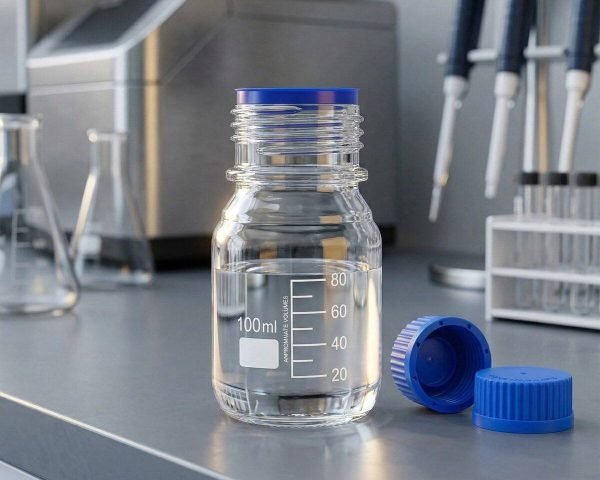

There’s a moment in almost every lab where you’re holding two bottles that look identical except for color, and you have to pick one. Amber or clear — it feels like a coin flip, but it’s actually a chemistry question. Pick wrong and your light-sensitive reagent quietly degrades on the shelf until it ruins a batch of results you can’t easily explain.
The short answer: choose amber glass when your reagent is light-sensitive, and clear glass when it isn’t and you want to see what’s inside. Amber bottles block the ultraviolet and short-wavelength visible light that drives photodegradation, while clear bottles give you full visibility for general storage.
Let’s break down when each one earns its place, so you stop guessing.
What Amber Glass Actually Does
Amber isn’t just a color — it’s a light filter built into the glass. The amber tint absorbs the ultraviolet (UV) and blue wavelengths that break down photosensitive compounds, and it does this for the life of the bottle, not just until the label fades.
The technical standard is worth knowing. Amber borosilicate reagent bottles are specified to transmit less than 10% of light between 290 nm and 450 nm — the exact region where most photodegradation happens. The DURAN amber laboratory bottle spec states it plainly: the protection against UV light meets international USP/EP standards, and a fused external amber layer shields light-sensitive contents from photodegradation for the bottle’s entire working life.
That “fused external layer” detail matters. The amber color is only on the outside, so the internal glass surface keeps its normal inert properties. You get light protection without changing how the glass interacts with your reagent.
A good way to remember what needs amber: MBP’s media bottle guide notes that amber filters light below roughly 450 nm, which is why things like ethidium bromide, crystal violet, bilirubin standards, and riboflavin (vitamin B2) solutions get stored in amber. If the reagent spec says “protect from light,” that’s your cue.
When Clear Glass Is the Better Call
Clear glass isn’t the “worse” option — it’s the right one for a huge amount of everyday work. Its job is visibility: you can check the fill level, watch for color changes, spot sediment or precipitation, and confirm purity without ever opening the bottle.
That last point matters more than it sounds. Every time you open a reagent bottle, you introduce contamination risk. If the bottle is clear, you can inspect it without breaking the seal. For general buffers, salt solutions, and non-reactive solvents, that convenience is worth more than any light protection you don’t need.
Clear borosilicate is also the default for teaching labs and demonstrations, where seeing the contents is half the point. And it’s the right choice for stock solutions you’ll consume quickly, where the reagent isn’t on the shelf long enough for photodegradation to matter.
The Common Denominator: Borosilicate 3.3
Before you agonize over color, make sure the glass itself is right. Both amber and clear reagent bottles should be borosilicate glass 3.3, the same material that makes them thermally and chemically tough.
Borosilicate 3.3 has a low coefficient of thermal expansion, which is what lets a bottle go from a 140 °C autoclave to a cool bench without cracking. It also resists acids, bases, and organic solvents far better than soda-lime glass, and it won’t leach minerals into your reagents. The Glass Bottle Supplies reagent guide puts it well: borosilicate 3.3 “will not leach minerals into your reagents,” and the “3.3” refers to its coefficient of linear thermal expansion of 3.3 × 10⁻⁶ K⁻¹.
If a bottle is labeled to meet ISO 4796-1 (the standard for laboratory glass bottles) and ASTM E438 Type I, you’re dealing with the real thing. The DURAN amber bottle is a good reference here too — it’s USP/EP Type I borosilicate 3.3, which is the gold standard you want for anything that touches your actual chemistry.
What Needs Amber (and What Doesn’t)
Let me give you the practical list, because this is where most labs waste money either direction — buying amber when clear would do, or worse, storing something light-sensitive in clear.
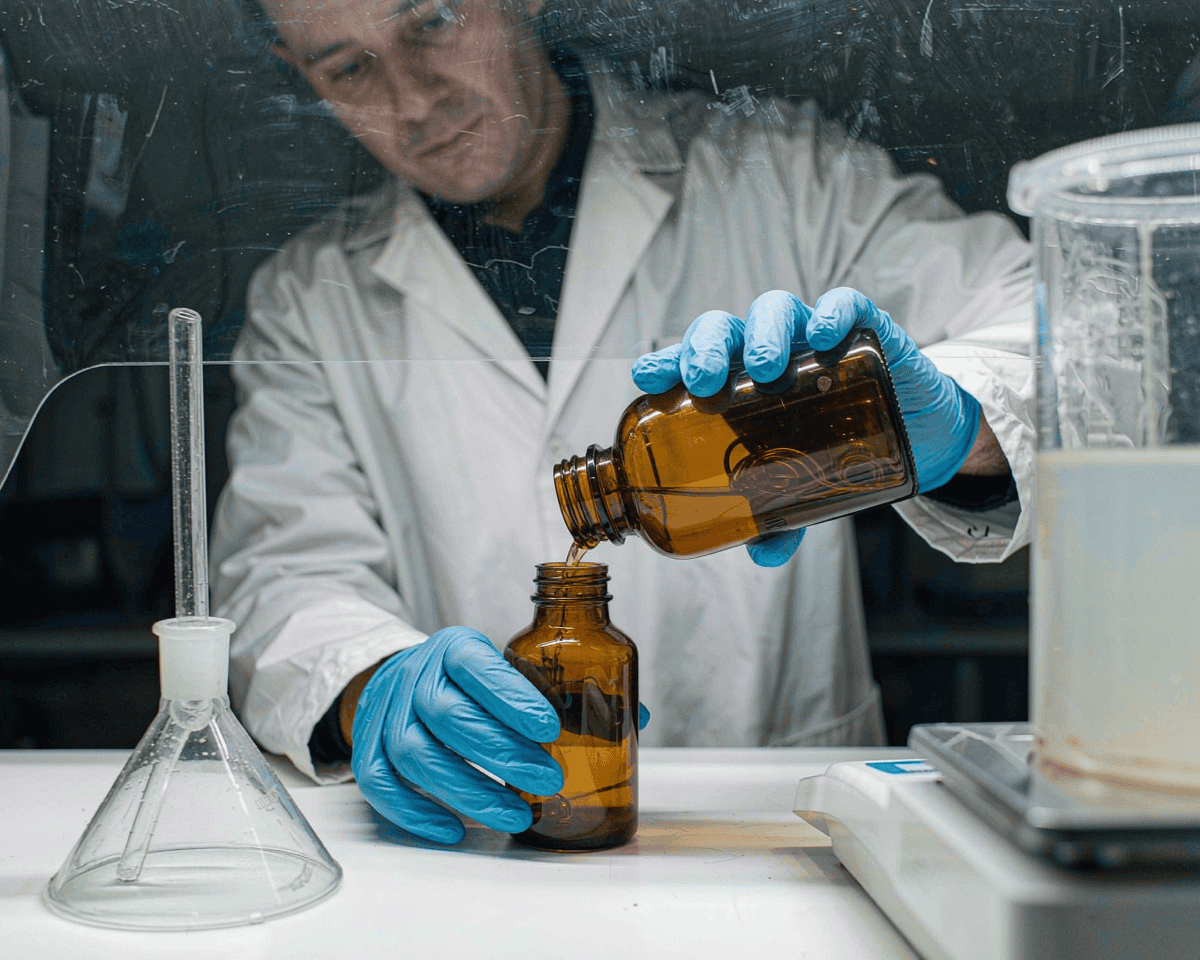
Store in amber: silver nitrate, hydrogen peroxide, iodine and iodine solutions, most vitamins and pharmaceutical intermediates, light-sensitive stains and dyes (crystal violet, ethidium bromide), bilirubin and bilirubin calibrators, riboflavin, and any organic solvent or standard where the manufacturer’s spec says “protect from light.” The Lab Choice amber-vs-clear guide lists silver nitrate, iodine, vitamins, and organic solvents as the classic amber-only cases, and it’s a clean reference list to check your own reagent inventory against.
Clear is fine for: general salt solutions and buffers, non-reactive acids and bases in routine use, most aqueous stock solutions you’ll use within days, and anything where you need to visually confirm purity or fill level.
One warning I always give: don’t “cheat” by wrapping a clear bottle in foil. It looks clever, but it’s fragile — the foil tears, slides off, and gets misread. If a reagent is truly light-sensitive, use intrinsic amber glass. The protection is permanent and can’t be accidentally removed.
Reading the Practical Trade-Offs
The decision isn’t just chemistry — there are workflow considerations too.
Inventory. If you stock both amber and clear in every size, you double your shelf footprint. Many labs standardize on clear for high-turnover reagents and keep amber only for the known light-sensitive list.
Inspection. Amber hides your contents. You can’t see a color change or a growing crystal through it, which can delay catching a bad reagent. Clear lets you catch problems early.
Cost. Amber is generally a bit more expensive than clear because of the extra tinting step, but the difference is small relative to the cost of a ruined reagent or a failed run.
The rule I use: if the reagent would be damaged by sitting in a sunny window for a week, it goes in amber. If it wouldn’t, clear is fine. For more on the bottle side of the equation, our guide on GL45 media bottles covers the closure system that pairs with these bottles, and the GL45 cap explains how the seal fits together.
Conclusion
Amber versus clear is a decision about light, not looks. Amber borosilicate blocks the UV and blue wavelengths below roughly 450 nm that degrade photosensitive reagents, and it does so permanently through a fused external layer. Clear borosilicate gives you the visibility to inspect contents without opening the bottle, which is exactly what you want for general reagents and fast-turnover stock. Whichever color you choose, insist on borosilicate 3.3 that meets ISO 4796-1 and USP/EP Type I standards — that’s the part that protects your chemistry from the glass itself. Store the known light-sensitive compounds in amber, keep the routine stuff in clear, and never fake light protection with foil. Get those basics right and your reagents will stay stable, your results reproducible, and your shelf a lot easier to manage. For the next step, read our complete guide to GL45 media bottles and how to choose between clear and amber vials.
Frequently Asked Questions
Do amber bottles completely block UV light?
They block most of it — amber borosilicate transmits less than 10% of light between 290 nm and 450 nm — but not 100%. For extremely sensitive compounds, store amber bottles in a dark cabinet as additional protection.
Can I use a clear bottle for a light-sensitive reagent if I keep it in the dark?
You can, but it’s risky. The moment you take it out to dispense, it’s exposed. Amber is the safer choice for anything that degrades in ambient light, because the protection is built into the glass and can’t be forgotten.
Are amber and clear borosilicate bottles equally chemical resistant?
Yes. The amber color is only an external layer, so the internal glass surface has the same borosilicate 3.3 properties as clear glass. The color changes light transmission, not chemical resistance.
What standards should a quality reagent bottle meet?
Look for borosilicate glass 3.3 that meets ISO 4796-1 (laboratory glass bottles) and USP/EP Type I classification. These confirm the thermal and chemical performance and the hydrolytic resistance you need for storing reagents.
Is it OK to wrap a clear bottle in foil instead of buying amber?
It’s a common shortcut but a poor one. Foil tears, slips, and gets removed, which leaves your reagent exposed. Intrinsic amber glass is permanent and reliable, so it’s worth the small extra cost for anything genuinely light-sensitive.