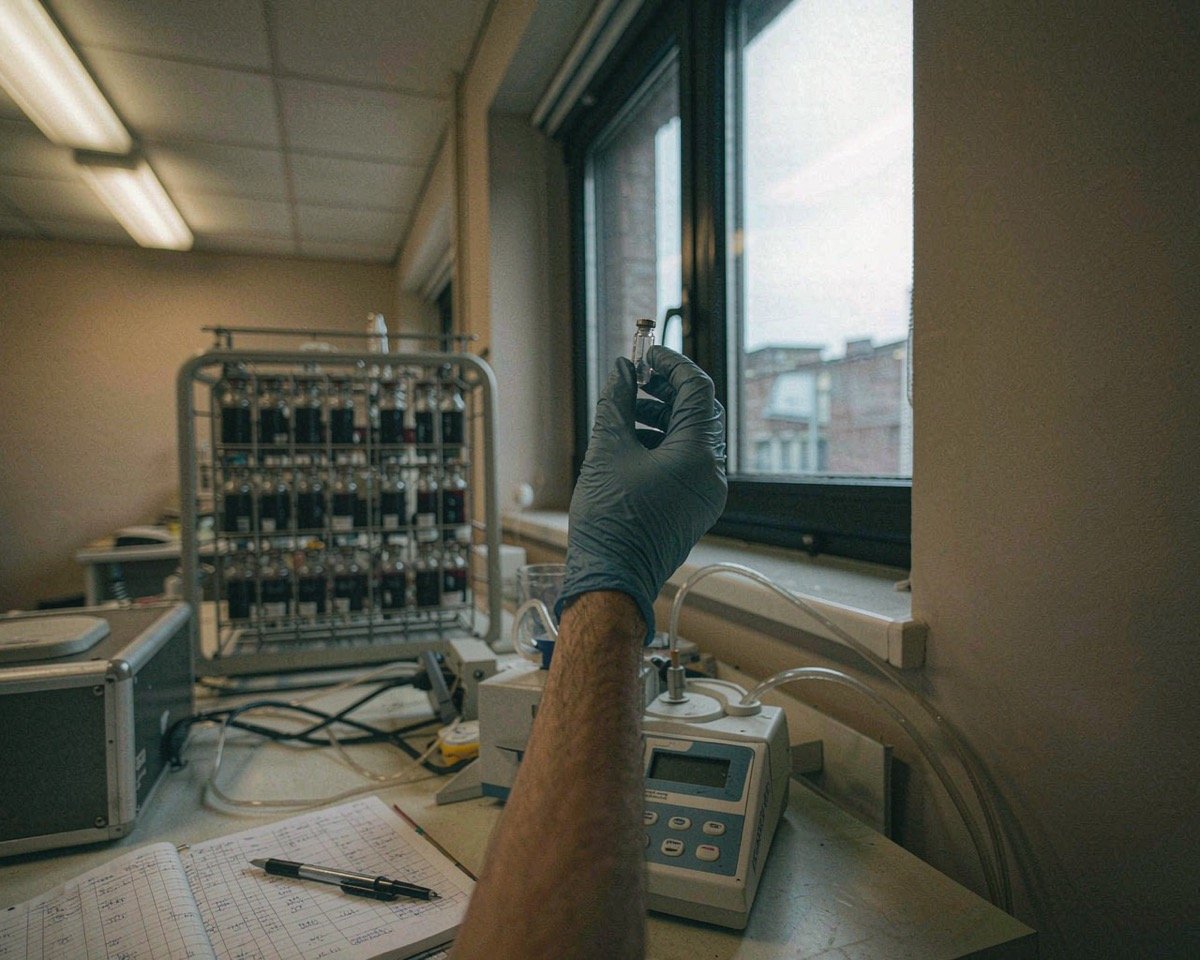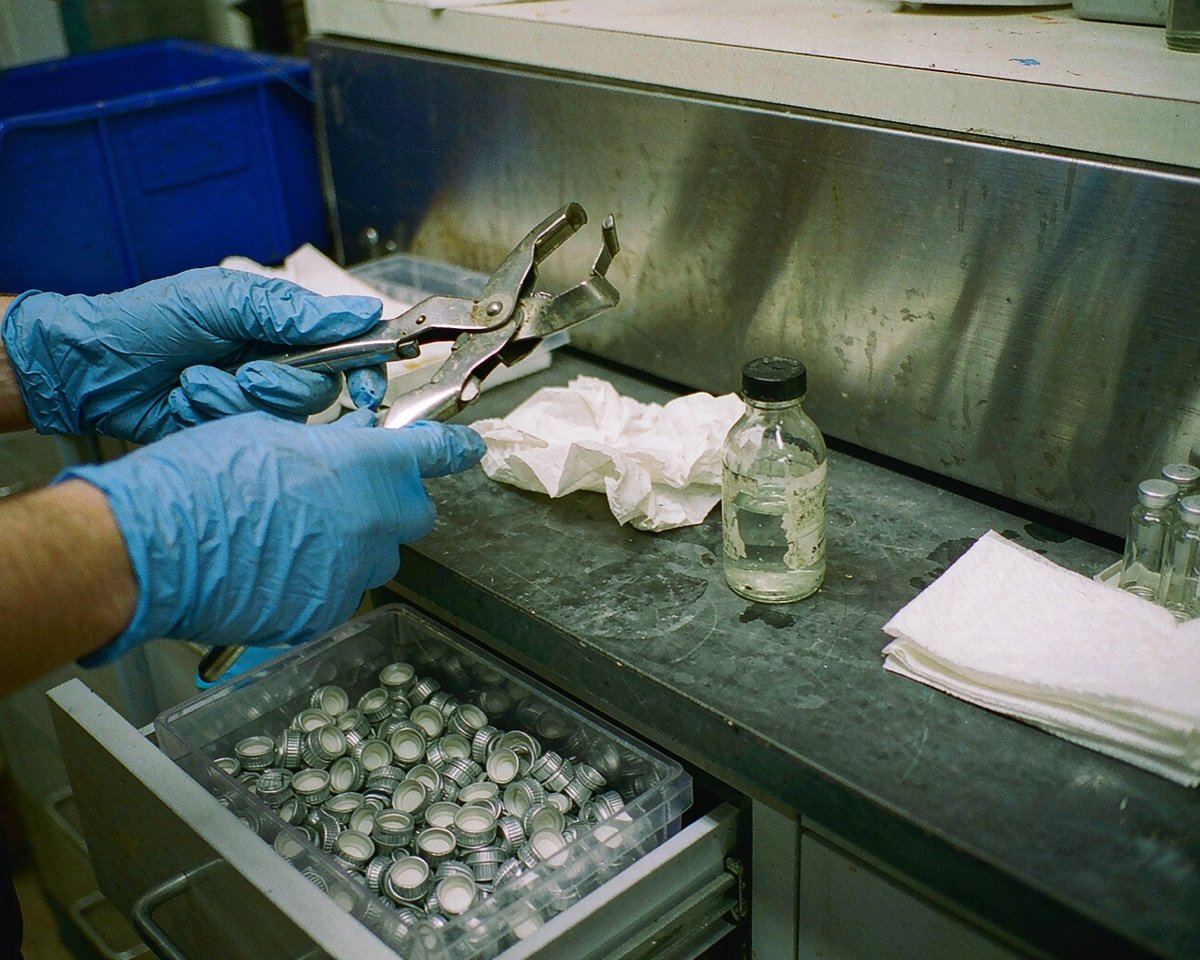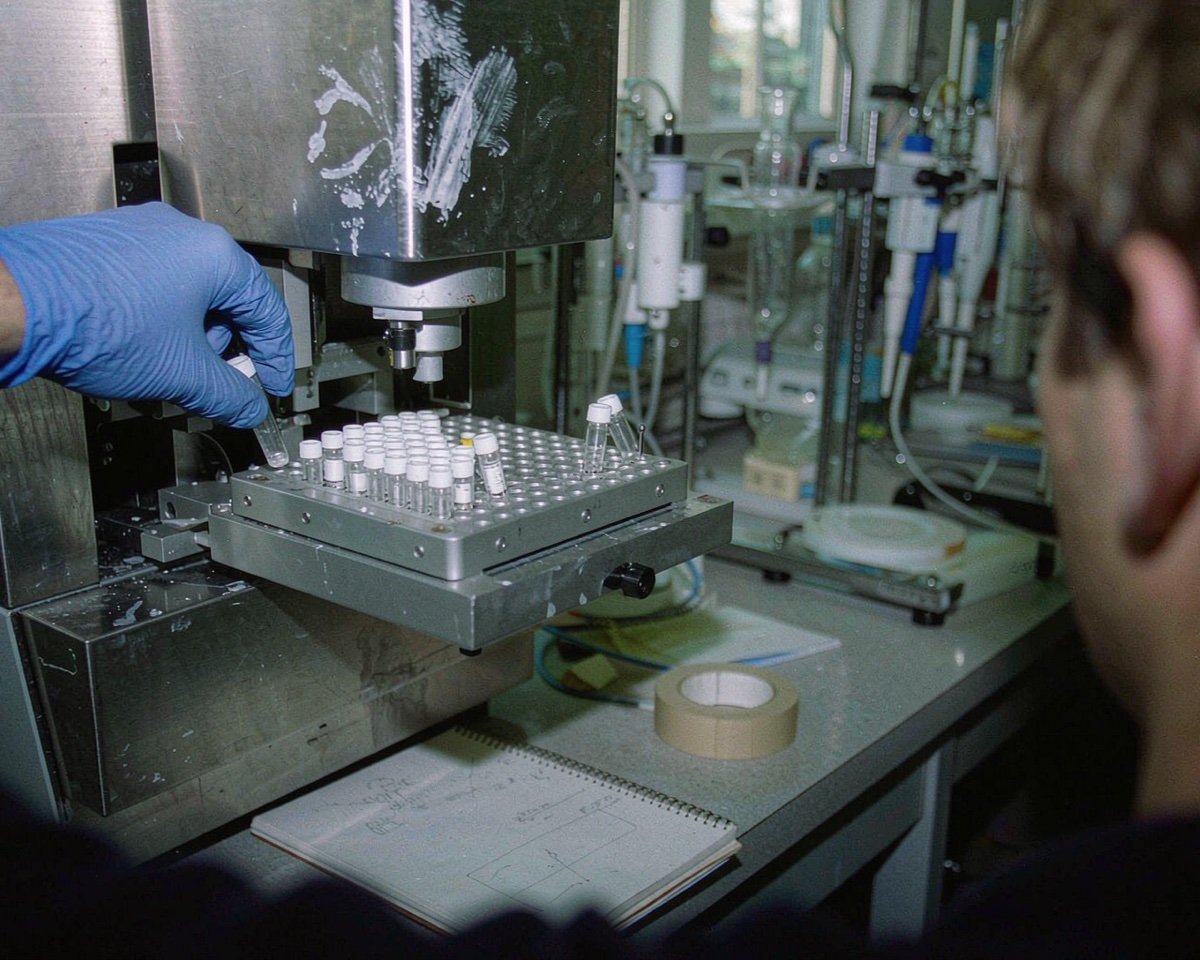
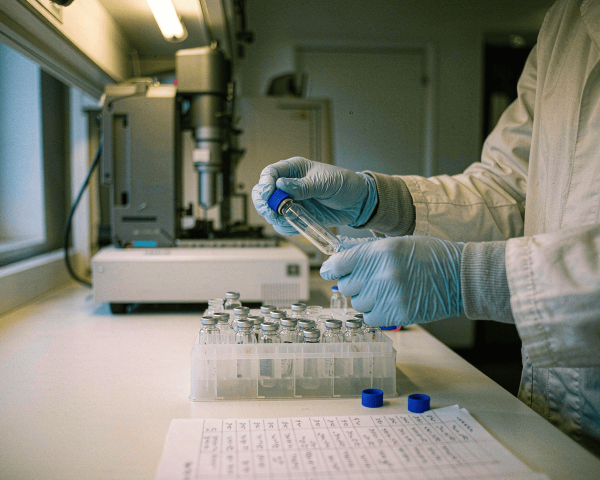

A 2 mL vial sitting in an autosampler for 24 hours can quietly lose a measurable slice of its solvent, and with it, part of your analyte response. The fix costs less than the rework.
Use unpierced, quality PTFE-lined caps, fill the vial appropriately for its size, and don’t let one vial serve a dozen injections. Evaporation through an intact septum is negligible; evaporation through a pierced or cored septum is not.
What the Numbers Actually Look Like
Agilent ran a controlled study on exactly this problem, measuring evaporation from 2 mL screw-cap vials at room temperature under three septum conditions: intact, pierced about nine times by an injection needle, and cored with an open hole. The Agilent application note is worth reading in full, but the headline numbers tell the story.
With hexane, vials with intact septa lost essentially nothing over 24 hours. Vials whose septa had been pierced nine times lost 7.27% in the same period, about 0.30% per hour. Cored septa were the disaster case: 21.06% gone in 24 hours, and by 96 hours, 84.55% of the solvent had left the vial.
I keep those numbers in my head every time I prep a long sequence. A cored septum is not a minor inconvenience. It is an open hole over your sample.
Why This Ruins Data Before It Ruins the Vial
The obvious problem is concentration drift. If the solvent evaporates faster than your analyte does (and it usually does), your apparent concentration climbs across the sequence. Early vials and late vials come from the same solution but report different answers.
The subtler problem is reproducibility. One study on autosampler stability tracked LC-MS/MS response over extended tray residence and found analyte-specific stability windows, some well under 36 hours (Journal of Pharmaceutical Analysis). Add solvent loss on top of that and you get a drift pattern that looks like an instrument problem. People spend days chasing the MS when the vial was the culprit.
Serum and plasma work has its own version of this; storage-condition studies on metabolite profiles show how quickly holding conditions shift results (Europe PMC). The vial is a tiny environment. Treat it like one.
Seven Things That Actually Prevent Evaporation
1. Start with a quality PTFE/silicone septum
PTFE facing resists solvent attack; silicone underneath gives the resealability. Cheap septa with poor silicone recovery never fully close the puncture channel. If you are unsure which septum material fits your solvents, our PTFE vs silicone vs PTFE/silicone comparison walks through the decision.
2. Retire septa after a realistic number of injections
Every injection is another puncture. By roughly the tenth needle pass, you are in the territory where Agilent measured significant hourly losses. Our guide on how often to replace septa gives practical replacement intervals; for volatile analytes, I’d err on the aggressive side.
3. Never run a sequence on cored septa
Coring happens when the needle punches a plug out of the septum instead of parting it. Dull needles, small needle gauges, and hard septa all make it worse. Check caps visually after prep; if you see a clean hole with a plug of septum beside it, re-cap that vial before it enters the tray.
4. Match fill volume to vial size
A 100 µL sample in a 2 mL vial has a huge vapor headspace above it, and solvent vapor plus analyte condense on the walls and cap during temperature swings. If your volumes are small, use vial inserts; the 9-425 screw-neck format takes standard inserts so the liquid occupies the vial properly.
5. Cap it correctly, every time
Screw caps need firm, even tightening; crimp caps need a proper crimper, not fingers. Vial closure makers have invested real engineering in caps that lock out analyte loss, and Thermo’s SureSTART line, for example, markets closure technology aimed specifically at preventing analyte loss through the cap. None of that engineering survives an under-torqued cap.
6. Shorten the gap between prep and injection
Evaporation is a clock, not a switch. If your workflow lets samples sit overnight before the sequence runs, either prep closer to run time or cap and refrigerate. Agilent’s own recommendation in that application note was blunt: do sample transfers as early in the method as possible, before heavy evaporation starts.
7. For truly volatile analytes, consider headspace technique
If your analytes are volatile enough that vial evaporation keeps biting you, static headspace analysis sidesteps the problem entirely by sampling the equilibrium vapor instead of the liquid.
A Sequence Drift Story
A few years ago I watched an overnight sequence come back with the last dozen injections reading 10-12% high against the calibration. The MS was fine, the column was fine, and the calibrants bracketing the sequence were fine.
The prep sheet explained it. Someone had pre-pierced every vial’s septum during an afternoon stock-top-up, then left the tray loaded for nine hours before the run. At roughly 0.3% solvent loss per hour through each puncture, that is nearly 3% of solvent gone before injection one, and climbing all night for the vials at the end of the sequence.
Re-prepping the last twelve vials with fresh caps took ten minutes. The rerun matched the calibration perfectly. Ten minutes versus a day of confused troubleshooting.
What About Low-Volume Samples?
Two situations deserve extra care. The first is sub-200 µL samples, where inserts are the right answer; they lift the meniscus so the small volume sits where the needle can reach it.
The second is long hold times in a warm tray. If your lab runs unattended weekend sequences, ask whether your autosampler tray can hold at 4-10 °C, and use that for volatile or unstable panels. Cooling the tray does not stop evaporation, but it slows it substantially, which is often enough.
Conclusion
Sample evaporation in autosampler vials is unglamorous, which is exactly why it keeps costing labs reruns. The physics is settled: an intact, quality PTFE-lined septum loses essentially nothing, a pierced septum loses around 0.3% of hexane solvent per hour, and a cored septum loses almost everything within days. Build the habit chain: good septa, realistic replacement intervals, correct capping, sensible fill volumes, and short prep-to-injection times. If you extend this thinking to the storage side, our guide on how long samples can safely stay in a vial pairs directly with this one. Fix the caps and your late-sequence injections will finally agree with your early ones.
Frequently Asked Questions
How much sample evaporates from a sealed HPLC vial?
With a new, intact PTFE/silicone septum, evaporation is negligible; Agilent measured near-zero loss from 2 mL vials over 24 hours. Once the septum has been pierced repeatedly or cored, losses reach 0.1-0.9% of solvent volume per hour depending on the solvent and the septum damage.
Do screw caps evaporate more than crimp caps?
A properly tightened screw cap with a quality septum seals nearly as well as a crimp cap for routine work. Crimp caps have the edge for highly volatile analytes because the seal is mechanically deformed and cannot loosen, but most evaporation problems come from septum damage, not closure type.
Can I reuse vial caps and septa?
Caps can be reused if undamaged, but septa should not be. A used septum carries puncture channels that leak, and residual sample in the septum can contaminate the next vial. For any quantitative work, use fresh septa.
Why do my later injections read higher than my standards?
Rising response across a sequence is a classic evaporation signature: solvent leaves through compromised septa faster than the analyte, concentrating the remaining sample. Check whether the affected vials sat longest, and inspect their septa for punctures or coring.
Does refrigerating the autosampler tray help?
Yes. Cooling the tray slows evaporation and also slows many degradation reactions, which helps with unstable analytes. It does not replace good caps and fresh septa; it just extends the time window you can safely work in.