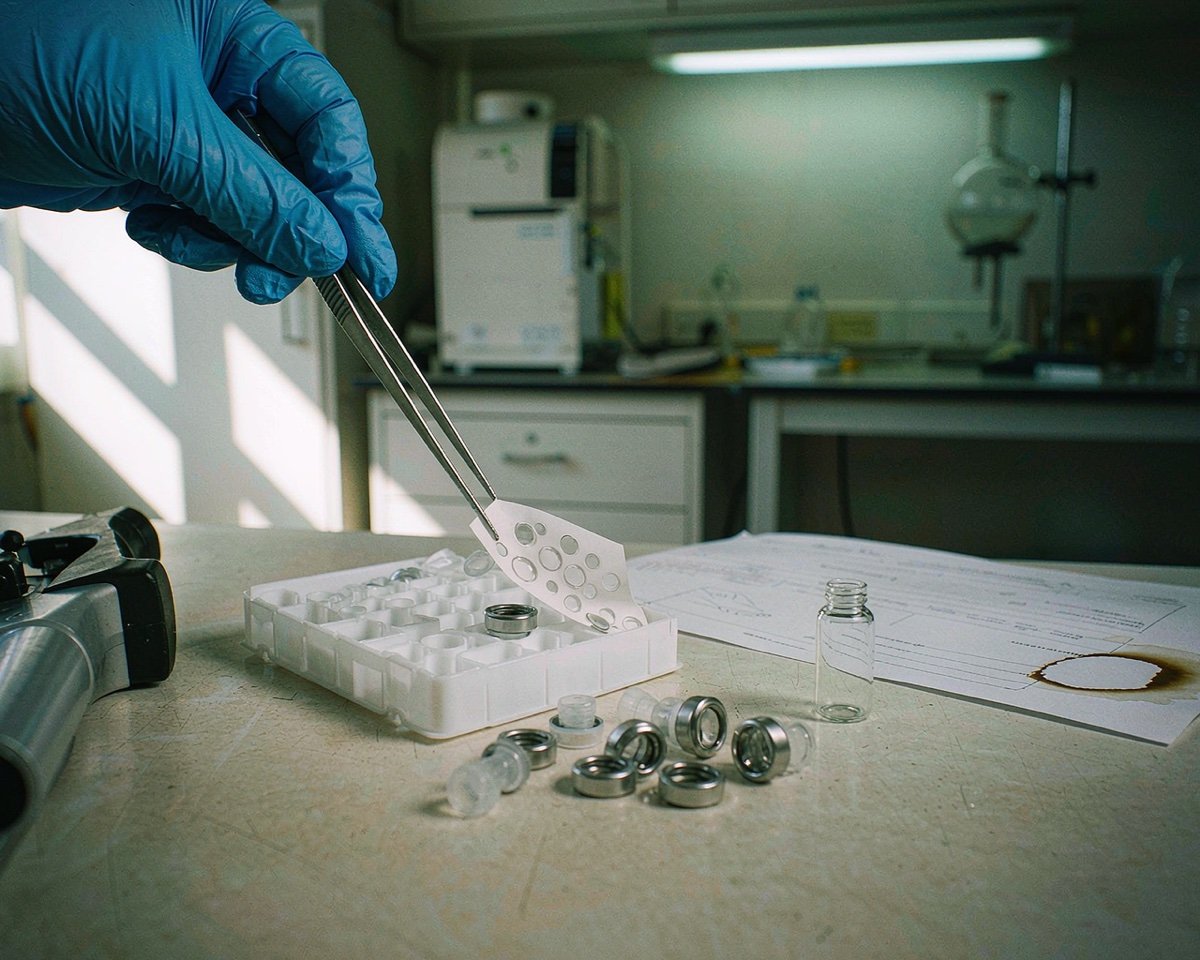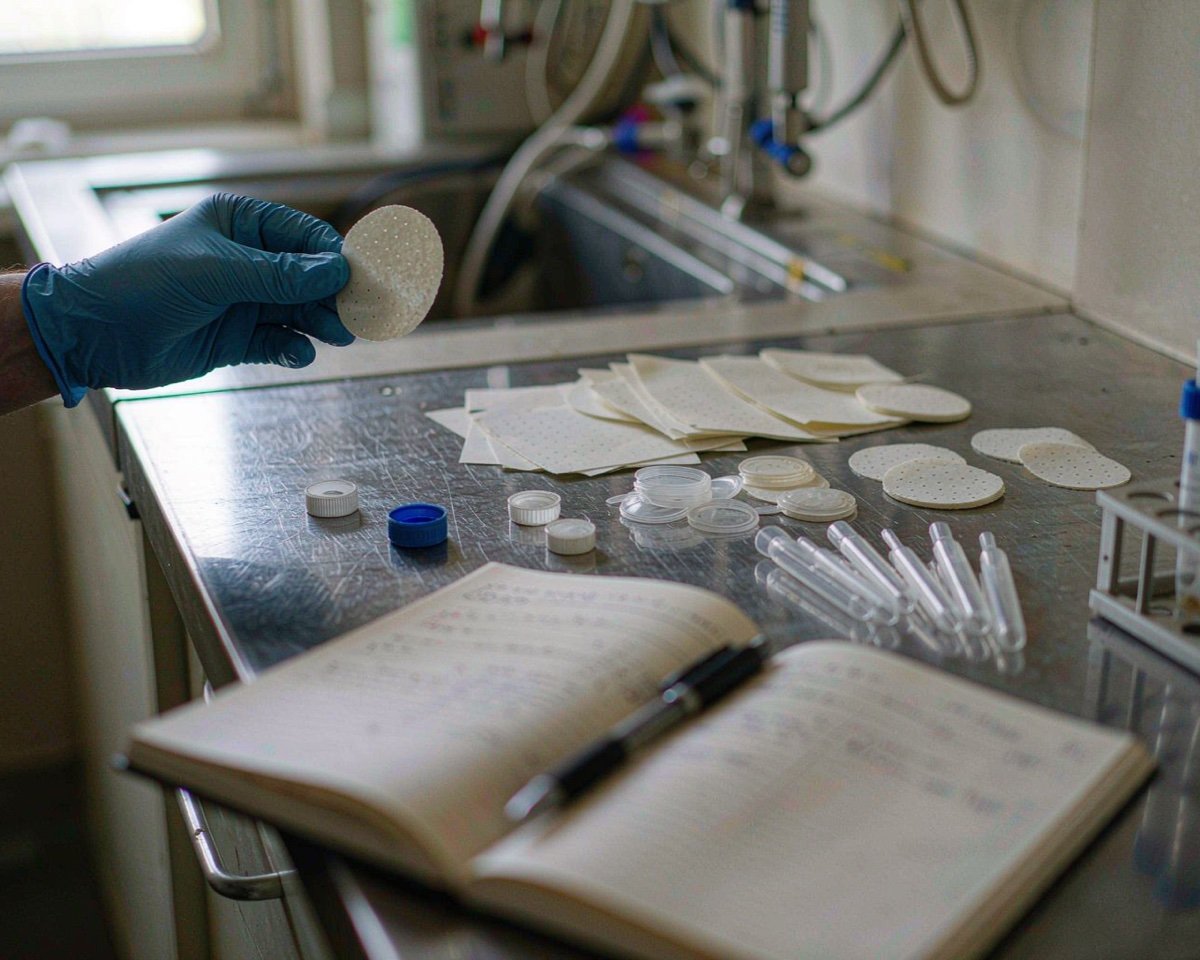
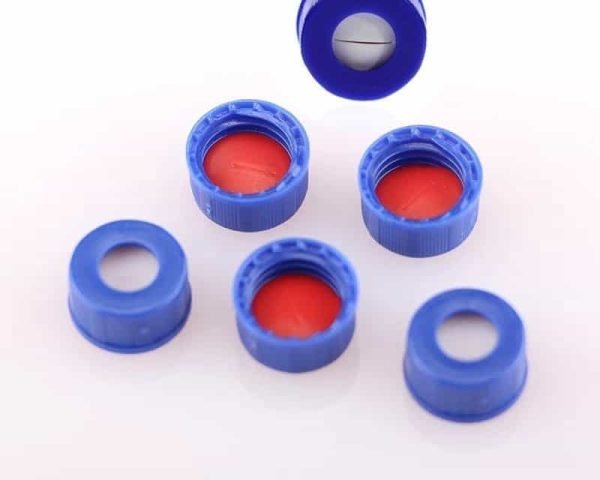

I have lost count of how many labs order septa by habit — “whatever we bought last time” — and then wonder why their blanks are dirty or their samples evaporate overnight. The septum is the only thing between your sample and the outside world, and the material you choose changes how the seal behaves after every needle puncture. This guide breaks down pure PTFE, pure silicone, PTFE/silicone, and PTFE/silicone/PTFE so you can pick the right one on purpose, not by accident.
Pure PTFE septa are ultra-inert but do not reseal — use them for single injections. Silicone reseals beautifully but is soft and chemically reactive. PTFE/silicone combines the two: a PTFE face that resists your sample and a silicone body that reseals, making it the default for multiple injections. For trace-level or long-hold work, step up to PTFE/silicone/PTFE.
Read on — the decision matrix at the end is the part most vendors never show you.
What a Septum Actually Does
Before comparing materials, it helps to nail the job description. A vial septum has to do four things at once:
1. Seal the vial against evaporation and contamination before injection. 2. Withstand needle puncture without coring (shedding fragments into your sample). 3. Reseal after each puncture so a multi-injection method does not leak. 4. Release nothing of its own — no bleed, no extractables that show up as ghost peaks.
No single material nails all four perfectly. That is why the market settled on layered constructions, and why your choice is really a trade-off between resealability, inertness, and cost.
Pure PTFE Septa: Inert but Single-Use
Polytetrafluoroethylene (PTFE) is the most chemically inert polymer in common lab use. It shrugs off aggressive solvents — chlorinated hydrocarbons, strong acids, ketones — that would destroy rubber-based septa.
Agilent’s septa compatibility data rates thin PTFE septa up to 260 °C with “superior chemical inertness” — but note the fine print: they are intended for short cycle times and single injections. PTFE has no elasticity. When the needle pulls out, the hole stays open. No reseal.
When is pure PTFE the right call?
– Short-cycle, single-injection methods where the vial is pierced once and discarded. – Aggressive solvents that would degrade silicone-based septa. – Headspace and high-temperature work where inertness matters more than re-access.
The moment you need a second injection from the same vial — or you want to store the sample and re-run it — pure PTFE is the wrong tool.
Silicone Septa: Resealable but Reactive
Pure silicone is the other extreme. Silicone is soft and elastic, which makes it:
– Excellent at resealing. Puncture it, and the hole closes behind the needle. This is the property that makes silicone the body of most modern septa. – Easy to pierce. Less force needed, less wear on the needle.
But silicone has real weaknesses as a sample-facing material:
– It absorbs and adsorbs. Silicone can take up solvent vapor and even low-volatility analytes, then release them on a later injection — a classic source of carryover and ghost peaks. – It is chemically reactive. Many solvents — hexane, aromatic hydrocarbons, chlorinated solvents — swell or degrade bare silicone. – It can bleed at temperature. Heat stresses the polymer and releases siloxane oligomers into your chromatogram.
Pure silicone septa survive in some older GC workflows, but in modern autosamplers they are rarely the right choice as the sample-facing layer. Where silicone shines is as the elastic body *underneath* a PTFE face — which brings us to the workhorse.
PTFE/Silicone Septa: The Industry Default
A PTFE/silicone septum is a laminate: a thin PTFE disc on the sample-facing side, bonded to a thicker silicone body. You get the best of both materials:
– Before puncture, the PTFE face gives you PTFE-grade chemical resistance — the sample only ever touches PTFE. – After puncture, the silicone body reseals around the needle hole. – The PTFE face also protects the silicone from direct solvent contact, so the combination lasts far longer than either material alone.
This is why Phenomenex’s septum selection guide calls PTFE/silicone the most widely used material combination in vial closures. Its spec sheet: excellent resealing, multiple injections, 200 °C max temperature.
The trade-off: PTFE/silicone is *not* the most coring-resistant option. A large or blunt autosampler needle can still punch fragments through the silicone body — which is why the sandwich version exists.
PTFE/Silicone/PTFE: The Sandwich Upgrade
Add a second PTFE layer on the *outside* — the needle side — and you get the PTFE/silicone/PTFE “sandwich”: a PTFE face over the sample, silicone in the middle, and a PTFE top layer the needle pierces first.
Why does the outer PTFE layer help? It gives the needle a clean, low-friction surface to push through, which dramatically reduces coring. It also provides an inert barrier between the needle and the silicone, so the silicone is less contaminated by needle contact over multiple punctures.
Phenomenex recommends PTFE/silicone/PTFE for “the most critical applications such as ultra-trace analysis or where there is a longer time between injections or for internal standard methods.” It is also autoclavable, which matters if you sterilize your consumables.
The cost: these septa are the most expensive of the silicone family — and worth every cent when your method depends on injection-to-injection reproducibility.
Pre-Slit Septa: A Different Kind of Upgrade
Pre-slit septa come with a small slit or slot cut through the PTFE layer. The slit guides the needle in and cuts the penetration force roughly in half, which:
– Virtually eliminates coring — the needle follows the slit instead of punching new holes. – Prevents vacuum formation in the vial during repeated withdrawals, which improves sampling reproducibility. – Reduces needle wear and the risk of needle bending.
Pre-slit PTFE/silicone is the standard recommendation for high-throughput autosamplers and for methods with many injections per vial. The trade-off is a slightly higher evaporation path through the slit — negligible for short runs, relevant for long unattended sequences with volatile solvents. Our guide to solid vs. slit septa covers this decision in detail.
How to Choose: A Decision Matrix
Here is the framework I use, in the order I apply it:
| Your workflow | Septum choice | Why | |—|—|—| | Single injection, aggressive solvent, high temperature | Pure PTFE | Maximum inertness; reseal not needed | | Routine HPLC, 1–3 injections per vial | PTFE/silicone | Best balance of cost, inertness, reseal | | Ultra-trace analysis, LC-MS, long holds | PTFE/silicone/PTFE | Coring resistance + low bleed | | High-throughput autosampler, many injections | Pre-slit PTFE/silicone | Slit guides needle, cuts coring | | GC with hot inlet / bleed-sensitive detectors | PTFE/silicone (low-bleed) | Cleaner blanks at temperature | | Chlorinated solvents, reactive chemicals | PTFE or PTFE/butyl | Silicone degrades in these solvents |
Three cross-cutting rules:
1. Temperature first. Check the max rating. PTFE/silicone tops out around 200 °C; if your method exceeds that, you need a high-temperature septum. 2. Injections per vial second. More than a couple of injections? Avoid pure PTFE. More than five? Consider pre-slit or sandwich. 3. Sample chemistry third. If your solvent swells silicone, the PTFE face is what saves you — just remember it only protects until the needle punctures it. Agilent’s compatibility chart shows exactly which solvents each material tolerates.
Compatibility Notes: Solvents and Temperature
Two facts from the vendors worth internalizing:
– PTFE/silicone’s chemical compatibility is “excellent until punctured.” The moment the needle breaks the PTFE face, the solvent now touches the silicone core, and silicone’s weaker compatibility takes over. For aggressive-solvent methods with multiple injections, that is an argument for the sandwich (outer PTFE) — or for switching materials. – Temperature ratings are not suggestions. Restek’s caps and seals range and the Agilent and Phenomenex guides all cap PTFE/silicone at ~200 °C. Run it hotter and you get bleed, hardening, and eventual failure — usually right in the middle of a sequence.
Common Septum Mistakes
– Reusing a septum past its puncture limit. Even the best PTFE/silicone is good for roughly 3–5 punctures before coring and bleed risk climb. Track injections per vial. – Ignoring coring until it bites. If you see fragments in the vial or your needle is dull, switch to pre-slit or sandwich septa — and check the needle. Our deep-dive on septum coring has the full prevention playbook. – Choosing by price. The cheapest septum in the catalog is usually PTFE/red rubber — fine for some GC work, but a poor fit for LC-MS or long sample holds. Buy for the method, not the quote. – Over-tightening screw caps. Crushing the septum destroys its reseal properties. A consistent, moderate torque beats brute force every time — and pairing the right cap with the right septum matters just as much, which is why we wrote a full guide to choosing the right vial cap.
Conclusion
The septum choice is a three-way trade between inertness, resealability, and coring resistance — and no single material wins all three. Pure PTFE gives you inertness at the cost of reseal. Silicone reseals but is soft and reactive. PTFE/silicone splits the difference and is the right default for most HPLC and GC work. PTFE/silicone/PTFE and pre-slit versions solve the coring problem for critical and high-throughput methods. Start from your method’s temperature, injection count, and solvent, and let the matrix above pick the material. And if you are chasing a reproducibility gremlin, remember that septum hardness is often the hidden variable — a slightly harder or softer durometer can change coring and sealing behavior completely. Get the material and hardness right, and the septum stops being a variable in your results.
Frequently Asked Questions
What is the difference between PTFE and PTFE/silicone septa?
Pure PTFE is a solid fluoropolymer disc — extremely inert, but it does not reseal after needle puncture, so it is for single injections. PTFE/silicone layers a thin PTFE face over an elastic silicone body, giving you chemical resistance plus resealing for multiple injections.
How many times can you use a PTFE/silicone septum?
Typically 3–5 punctures before coring or bleed becomes a real risk. Pre-slit and PTFE/silicone/PTFE septa extend the useful life, but for quantitative methods most labs still prefer a fresh vial per sample.
Why do my septa cause ghost peaks?
Ghost peaks usually come from septum bleed — low-molecular-weight material released from the septum when heated or stressed by solvent contact. Switching to a low-bleed PTFE/silicone or PTFE/butyl formulation and avoiding over-tightened caps usually cleans up the blank.
Can I autoclave septa?
PTFE/silicone/PTFE sandwich septa are autoclavable per Phenomenex. Standard PTFE/silicone may not survive repeated autoclave cycles well — check the manufacturer’s spec before sterilizing.
What septa should I use for LC-MS?
PTFE/silicone/PTFE is the usual recommendation for ultra-trace LC-MS work: it resists coring, minimizes bleed, and holds samples reliably over long intervals between injections.