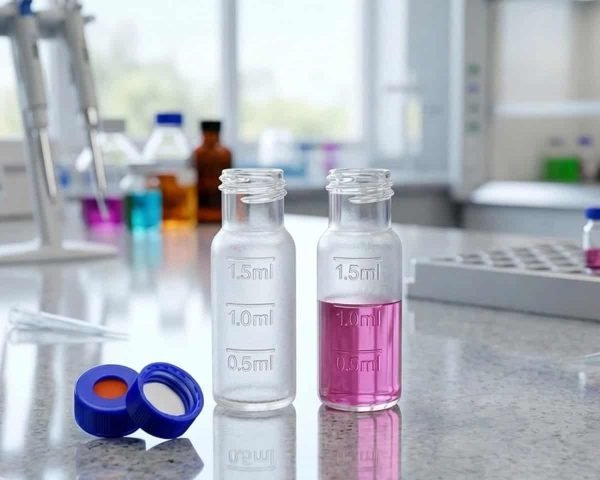

Most labs default to glass autosampler vials without thinking twice. Then one day a peptide method starts losing recovery, or an LC-MS run picks up a sodium adduct you cannot explain, and you start wondering if the vial is the culprit. The honest answer: sometimes it is. Glass and plastic each have a chemistry, and matching that chemistry to your sample is what separates clean data from silent failures.
Glass (borosilicate) vials are chemically inert, solvent-tolerant, and autoclave-safe — the right default for most HPLC and GC methods. Plastic (polypropylene) vials carry no silanol groups and leach no metal ions, which makes them the better choice for proteins, peptides, basic compounds, and trace-metal-sensitive LC-MS work.
Keep reading, and I will walk you through the exact scenarios where each material wins — and the few cases where the “safe” default is quietly costing you data.
Why Vial Material Actually Matters
Here is the uncomfortable truth: your vial is not a neutral container. Its inner surface interacts with your sample, and the interaction is strong enough to change your results.
The mechanism is well documented. Shimadzu’s research on adsorption in vials breaks it down clearly:
– Glass surfaces carry silanol (Si-OH) groups that cause ionic adsorption of basic compounds, plus a siloxane matrix that causes hydrophobic adsorption. Both happen at the same time. – Polypropylene surfaces have no silanols, so they only show material-based hydrophobic adsorption.
The practical consequence: basic compounds with a high pKa adsorb to glass and quietly disappear from your chromatogram. Compounds with a large logP (lipophilic) adsorb to *both* glass and plastic. If your analyte is a basic drug, a peptide, or any amine-containing molecule, the vial material is a real variable in your method — not a footnote.
Glass Vials: The Chemistry of the Workhorse
Type I borosilicate glass has been the standard for HPLC vials for decades, and for good reasons:
– Chemical inertness. Borosilicate resists most organic solvents — acetonitrile, methanol, hexane — and strong acids. For the vast majority of small-molecule methods, nothing happens at the glass surface. – Temperature tolerance. Glass survives autoclaving and high-temperature workflows that would soften plastic. – Optical clarity. Clear glass lets you inspect samples visually and works with optical fill-level sensors. – Crimp compatibility. The rigid glass neck holds crimp caps reliably, which matters for GC and for long-term storage seals.
But glass is not perfect. Two weaknesses matter in modern labs:
1. Silanol adsorption. As Shimadzu notes, basic compounds and peptides adsorb ionically to silanol groups. The fix is often surface modification — deactivated or silanized glass — or switching to plastic. 2. Alkali metal elution. Shimadzu’s technical report on vial selection shows that sodium and other alkali metals elute from the surface of ordinary borosilicate glass. In LC-MS, that sodium shows up as adducts that complicate spectra and suppress signal. Shimadzu’s own data connects higher sodium elution directly to lower recovery of a basic compound (chlorhexidine) — the metal ions drive the adsorption.
If you are running trace-level LC-MS, glass may be adding sodium to your samples without you realizing it.
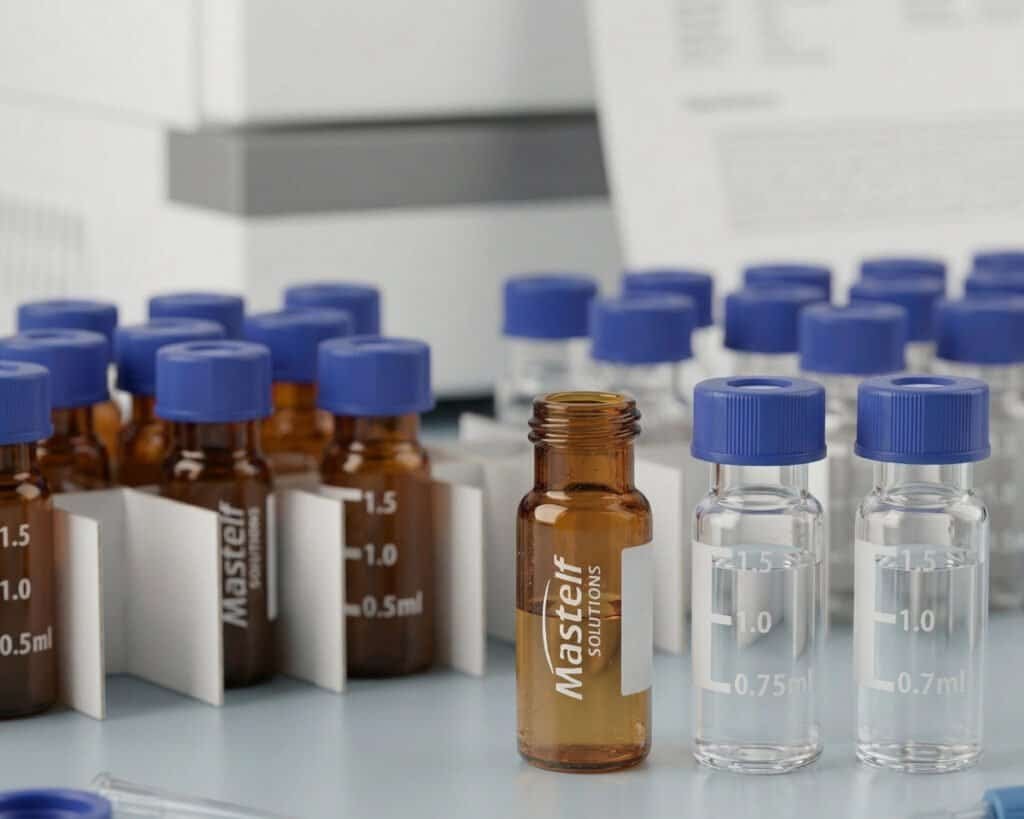
Plastic Vials: When They’re the Better Choice
Polypropylene vials have one huge structural advantage: no silanols and no leachable metal ions. For the right samples, that changes everything.
– Proteins and peptides. MicroSolv’s comparison of PP vs. glass found that polypropylene is naturally resistant to protein and peptide adsorption because it lacks the silanol and siloxane chemistry that glass surfaces present. Labs routinely switch to PP when a protein or peptide method shows unexplained recovery loss. – Basic and amine-containing analytes. Same mechanism — without silanols, ionic adsorption does not happen. This is why bioanalysis labs often standardize on PP for basic drugs. – LC-MS trace work. No metal ion leaching means fewer sodium adducts and cleaner spectra. Thermo Scientific’s SureSTART polypropylene vials even add a 200 nm silicon dioxide coating to the PP surface to eliminate non-specific binding — the low-bind option for ultra-trace analytes. – Physical durability and cost. PP does not shatter, survives rough handling and cold storage down to -80 °C, and costs less than glass. For routine aqueous methods, it is genuinely economical.
The catch: polypropylene is not a universal answer either. Lipophilic compounds can adsorb to PP’s surface. Strong solvents — chlorinated hydrocarbons like chloroform, aromatic hydrocarbons — can attack or swell PP over time. And the temperature ceiling (roughly 100–121 °C sustained) is far below glass. For aggressive-solvent or high-temperature work, glass stays king.
How to Decide: A Practical Decision Matrix
Here is the decision framework I use with customers, in rough order of importance:
| Your sample / situation | Recommended material | Why | |—|—|—| | Small-molecule drugs, QC, routine HPLC | Glass (borosilicate) | Inert, solvent-proof, autoclave-safe | | Proteins, peptides, enzymes | Plastic (PP) | No silanol adsorption; higher recovery | | Basic compounds, amines | Plastic (PP) or deactivated glass | Avoids ionic adsorption on silanols | | Trace LC-MS | PP or low-adsorption glass | Minimizes sodium elution and adducts | | Aggressive solvents (chloroform, THF, DMF) | Glass | PP may swell or degrade | | High-temperature or autoclaved workflows | Glass | Higher thermal tolerance | | Field work, cold storage, rough handling | Plastic (PP) | Shatterproof, -80 °C tolerant | | Long-term sample storage | Glass with crimp cap | Best seal and inertness over time |
The Thermo Scientific autosampler vials range illustrates the same logic in product form: they sell both glass and polypropylene screw vials across three “performance levels,” with PP positioned explicitly as “an economical alternative to glass” for labs where inorganic-ion levels must be kept to an absolute minimum.
The Middle Ground: Modified and Specialty Vials
If you keep hitting adsorption problems, you do not have to choose between “glass with silanols” and “plastic with hydrophobic surface.” Specialty options exist:
– Deactivated / silanized glass. A surface treatment that caps the silanol groups, reducing adsorption of basic compounds while keeping glass’s solvent tolerance. – Low-adsorption glass. Optimized molding creates a smoother surface with less contact area, reducing adsorption without chemistry changes — the approach behind Shimadzu’s LabTotal vials. – SiO2-coated polypropylene. As noted above, Thermo’s GOLD-grade PP vials coat the plastic with silicon dioxide to create an inert, ion-free surface — PP’s durability with glass-like inertness. – Amber variants of either material for light-sensitive samples.
If your budget allows, test one of these on your problem analyte before rewriting the method. A vial swap is the cheapest “troubleshooting” you will ever do.
Common Myths Worth Ignoring
“Plastic vials are always lower quality.” Not true. High-purity PP vials made without mold-release agents pass stringent extractables testing and are the *first choice* for many LC-MS bioanalytical labs. The MicroSolv white paper is explicit that mold-release-free PP outperforms glass for protein recovery — quality is about manufacturing, not material category.
“Glass is always inert.” Also not quite true. Glass leaches alkali metals and adsorbs bases at its surface. “Inert” is a relative term that depends on your analyte’s chemistry.
“Once you pick a material, you’re stuck.” Vials are consumables — you can switch per method. Many labs run glass for QC methods and PP for bioanalysis on the same autosampler. There is no rule that says one material for everything.
A Word on Sourcing
Whichever material you choose, the quality of the vial depends on the manufacturer. Dimensional accuracy, surface finish, cleanliness, and batch traceability all matter — a cheap vial that is 0.1 mm off or carries mold-release residues can sabotage a method far more expensively than the vial saved. Our guide to how to choose the right HPLC vial covers the selection criteria in depth, and if you want the production-side story, the HPLC vial production process explains what happens between raw material and finished vial — including why manufacturing discipline shows up in your data.
Conclusion
Glass and plastic are not interchangeable — they are two tools with different chemistries. Borosilicate glass remains the right default for most HPLC and GC methods: inert, solvent-tolerant, autoclave-safe. Polypropylene earns its place when your sample contains proteins, peptides, basic compounds, or needs LC-MS-grade cleanliness without metal leaching. Match the material to the analyte, buy from a supplier who documents quality, and you eliminate a whole class of silent, hard-to-diagnose failures. If you are unsure where your method sits, our comparison of 1.5 mL, 1.8 mL, and 2 mL vial formats helps with the sizing side, and the glass standards explainer covers what “Type I borosilicate” really means when you see it on a spec sheet.
Frequently Asked Questions
Are polypropylene HPLC vials as good as glass vials?
For many methods, yes — and for some they are better. Polypropylene has no silanol groups and leaches no metal ions, so proteins, peptides, and basic compounds recover more reliably. For aggressive solvents, autoclaving, or long-term storage, glass remains the safer choice.
Why do basic compounds disappear in glass vials?
Basic compounds with a high pKa adsorb ionically to silanol (Si-OH) groups on the glass surface. The higher the pH and the more basic the analyte, the stronger the interaction. Polypropylene or deactivated glass eliminates this mechanism.
Can plastic vials be used for LC-MS?
Yes — in fact, many LC-MS bioanalytical labs prefer them. Polypropylene does not leach sodium and other alkali metals like glass can, which means fewer adduct peaks and less ion suppression in the mass spectrometer.
What solvents should not be used with plastic vials?
Strong halogenated solvents like chloroform and dichloromethane, plus some aromatic hydrocarbons, can swell or degrade polypropylene over time. If your method uses these, stick with glass.
Do I need different vials for different methods?
Not necessarily, but it helps. Many labs standardize on glass for routine QC and switch to polypropylene for bioanalysis or LC-MS methods. Vials are consumables, so matching material to method is cheap insurance.