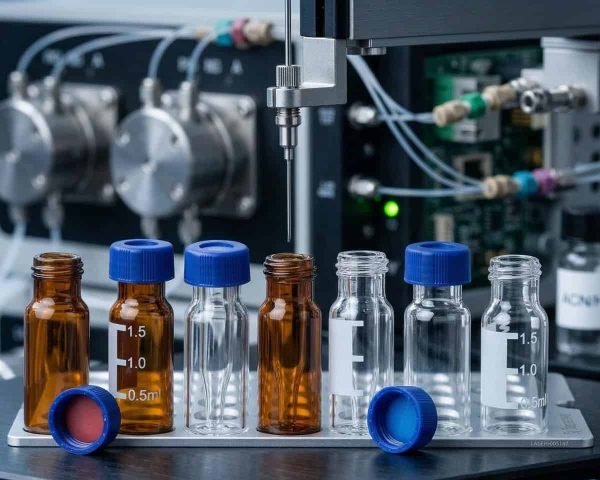

If your lab runs a Thermo Scientific LC system — a Vanquish, an UltiMate 3000, or one of the older Dionex IC instruments — you have probably stared at the consumables catalog and wondered which vials actually fit without paying Thermo prices for everything. The good news: most Thermo LC and UHPLC autosamplers use industry-standard vials, which opens the door to compatible third-party supplies. The slightly tricky part: Thermo’s IC (ion chromatography) and headspace samplers use very different vial formats. This guide maps it all out.
Most Thermo Scientific LC and UHPLC autosamplers — Vanquish and UltiMate 3000 included — use standard 12 × 32 mm autosampler vials with 9 mm screw threads and PTFE/silicone slit septa. Thermo’s IC autosamplers (AS-AP, AS-40, AS-50) use special polypropylene vials or 10 mL vials, and TriPlus headspace samplers use 20 mm headspace vials. Match the vial to the instrument family, not the brand name.
Keep reading, and I will walk you through each sampler family with the exact specs that matter.
First, Find Your Sampler Family
Thermo’s instrument portfolio spans three distinct worlds, and each one wants a different vial:
1. LC / UHPLC autosamplers — Vanquish series, UltiMate 3000 series (WPS-3000 family). These use standard 12 × 32 mm vials. 2. IC autosamplers — Dionex AS-AP, AS-40, AS-50, AS-HV. These are ion-chromatography systems with their own vial formats, including the famous 1.5 mL PolyVials. 3. GC / headspace samplers — TriPlus RSH, TriPlus 500 HS. These use 20 mm headspace vials (10 or 20 mL).
If you are not sure which family your system belongs to, the model name on the front panel usually settles it. The Chrom Tech Thermo compatibility matrix organizes exactly this — it lists Thermo autosampler models down one side and vial formats across the top, so you can look up your instrument and see its supported formats at a glance.
LC Autosamplers: Vanquish and UltiMate 3000
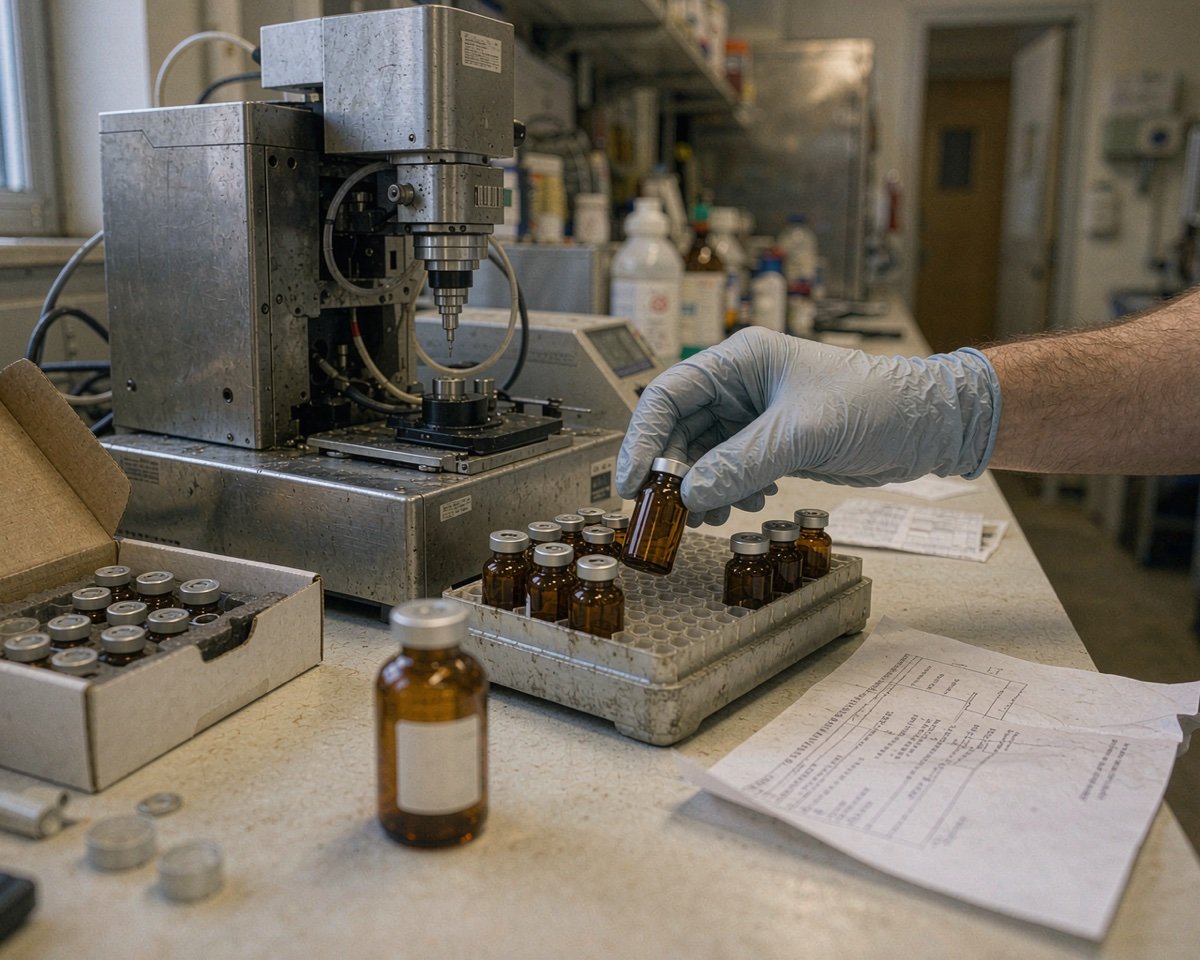
For LC work, the answer is pleasingly boring: standard 12 × 32 mm vials, 9 mm screw thread, 1.5–2 mL capacity. This is the same footprint used across the industry, which is why compatible suppliers exist.
Take the Vanquish Core HPLC system spec sheet: the standard sampler configuration holds “4 racks of 54 vials (≤ 1.5 mL) each” based on standard 12 mm OD vials, with an additional carousel capacity for 12 × 22.5 mm OD vials (≤ 10 mL). The higher-end Vanquish Split Sampler follows the same pattern — 54 × 12 mm OD vials per rack, plus the carousel.
What that means in practice:
– 1.5 mL or 2 mL vials (both fit the same 12 × 32 mm footprint — the volume difference is internal geometry). – 9 mm screw thread caps are the standard closure, though some samplers also accept 11 mm crimp or snap formats. The Chrom Tech matrix shows Vanquish and WPS-3000 autosamplers accepting crimp, snap, and 9 mm screw formats. – PTFE/silicone slit septa are the default recommendation — the slit reduces coring and needle wear during the high injection counts these samplers are built for. – Vial inserts become relevant for low-volume samples (< 500 µL) — a 12 × 32 mm vial with a conical insert lets the needle reliably reach 100 µL or less.
One nuance worth knowing: Vanquish systems are high-performance UHPLC instruments with very fast cycle times and high injection counts, so dimensional tolerances and septum durability matter more than on a slower system. Buy vials with consistent manufacturing tolerances — a slightly tall vial or a soft septum that cores will show up as needle damage and failed runs long before you blame the vial.
IC Autosamplers: AS-AP, AS-40, and AS-50
This is where Thermo breaks from the LC standard. Ion chromatography autosamplers use their own vials because the samples, needles, and flow paths are different.
AS-40 and AS-50 are the classic Dionex IC autosamplers. They use the 1.5 mL polypropylene PolyVial — a small, conical-bottom PP vial designed specifically for these instruments. The polypropylene material matters here: IC measures inorganic ions, and glass can leach ions that would show up as baseline artifacts in conductivity detection. Plastic keeps the ion background clean.
AS-AP is the modern workhorse, and it is more flexible. Per Thermo’s AS-AP product page, it handles anywhere from 81 × 10 mL vials up to 1,152 microplate samples, with a PEEK sample needle and options like tray cooling (4–60 °C) for temperature-sensitive samples. The 10 mL vials used here are large-format — not the 12 × 32 mm LC vials — and the system also supports 96- and 384-well microplates.
If you are buying consumables for an IC system, the critical questions are:
– Which autosampler model (AS-AP, AS-40, AS-50, AS-HV)? – Vial format: 1.5 mL PolyVial (older models) vs. 10 mL vial (AS-AP) vs. microplates? – Material: always polypropylene for IC — never glass.
GC and Headspace: TriPlus Samplers
On the GC side, Thermo’s TriPlus RSH and TriPlus 500 HS samplers use 20 mm headspace vials — 10 mL or 20 mL borosilicate glass with 20 mm crimp caps, typically magnetic for robotic transport. This is the same format used across the headspace industry, so compatible vials are widely available from third-party suppliers.
If your lab runs headspace GC with a Thermo TriPlus, the selection logic is identical to any headspace instrument: Type I borosilicate glass, round or flat bottom, 20 mm crimp (magnetic if your sampler uses magnetic transport), and a 3 mm PTFE/silicone or PTFE/butyl septum.
Caps, Septa, and Inserts: The Closure Side
The vial is only half the compatibility equation. The closure must match both the vial thread and the autosampler mechanics:
– 9 mm screw caps for 12 × 32 mm LC vials. Thermo Scientific’s autosampler vial range shows the pattern clearly: 9 mm screw caps with pre-assembled septa, available in PTFE/silicone, pre-slit, and bonded versions. – Pre-slit PTFE/silicone septa are the safe default for autosampler use — the slit guides the needle, minimizes coring, and prevents vacuum buildup in the vial. – Bonded septa (septum permanently fixed inside the cap) eliminate the risk of the septum dislodging during storage or transport — a real failure mode in high-throughput labs. – Inserts for low-volume work: a 300 µL conical insert inside a 2 mL vial lets you run 50–200 µL samples without losing the needle in an empty vial.
When you buy caps and septa separately from vials, check the thread spec (9 mm = 9 mm), the cap hole size (6 mm center hole is common for fixed-needle autosamplers), and the septum diameter (9 mm for 9 mm caps). Mismatches here leak, core, or jam the autosampler.
Why Compatibility Standards Matter
Here is the thing I tell procurement teams: “Thermo-compatible” does not mean “Thermo-branded.” The reason standard vials work across brands is that autosampler trays, grippers, and needles are built around the same physical formats — 12 × 32 mm vials, 9 mm threads, 20 mm headspace necks. A vial that meets those dimensions and tolerances will seat, seal, and inject correctly regardless of the logo on the box.
What actually matters is manufacturing quality:
– Dimensional consistency. Height, OD, and neck finish must hold tight tolerances across the batch. An inconsistent vial height throws off needle positioning; the same failure shows up as injection-precision problems. – Septum quality. Coring, bleed, and reseal performance depend on the septum material and the cap assembly, not the brand. – Cleanliness. For trace and IC work, the vial and septum must contribute nothing to the analysis.
If you buy from a supplier who documents these specs, you get Thermo-compatible performance at a fraction of the branded price. If you buy purely on price from a supplier who cannot show you a spec sheet, you are gambling with your method.
Buying Thermo-Compatible Vials: A Quick Checklist
Before you place the order, run this list:
1. Confirm the autosampler model — Vanquish/UltiMate (LC), AS-AP/AS-40/AS-50 (IC), or TriPlus (GC/HS). 2. Confirm the vial format — 12 × 32 mm 9 mm screw (LC), 1.5 mL PolyVial or 10 mL vial (IC), 20 mm headspace (GC/HS). 3. Match the closure — 9 mm screw caps with pre-slit PTFE/silicone for LC; 20 mm crimp (magnetic if needed) for headspace; polypropylene caps for IC. 4. Check the septa — material, pre-slit or solid, bonded or not, and temperature rating for your method. 5. Ask for dimensional specs and batch traceability — especially for Vanquish-class systems with tight tolerances.
And if your lab runs multiple instrument brands, our Agilent autosampler vial guide and the Waters HPLC vial guide cover those ecosystems too — useful when you are standardizing consumables across a mixed-brand lab.
Conclusion
Thermo compatibility is less complicated than it looks once you know which family your instrument belongs to. LC autosamplers — Vanquish, UltiMate 3000, WPS-3000 — take standard 12 × 32 mm vials with 9 mm screw threads and PTFE/silicone slit septa. IC autosamplers need polypropylene formats (1.5 mL PolyVials or 10 mL vials), and TriPlus headspace samplers take 20 mm headspace vials. Buy from a supplier who documents dimensions, septa specs, and cleanliness, and you get full compatibility without the brand premium. The broader lesson applies to any instrument: choose the right vial size and format for the autosampler, then let autosampler vial selection principles guide the rest. If injection precision has been drifting, also check the vial size selection guide — getting the format right is often the cheapest fix in the lab.
Frequently Asked Questions
What vials fit Thermo Vanquish autosamplers?
Standard 12 × 32 mm autosampler vials with 9 mm screw threads and PTFE/silicone slit septa. The Vanquish sample racks hold 54 vials of ≤ 1.5 mL (12 mm OD) each, with additional carousel capacity for 22.5 mm OD vials up to 10 mL.
Does Thermo Scientific make its own vials?
Yes — the Thermo Scientific SureSTART line (and the older Chromacol and National brands) covers glass, polypropylene, crimp, snap, and screw formats across three performance levels. But most Thermo LC autosamplers also accept compatible third-party vials that meet the same 12 × 32 mm / 9 mm screw dimensions.
What vials does the Dionex AS-AP use?
The AS-AP accepts up to 81 × 10 mL vials or up to 1,152 microplate samples (96- and 384-well formats). Older IC autosamplers like the AS-40 and AS-50 use 1.5 mL polypropylene PolyVials. For IC work, always use polypropylene — glass can leach ions and disturb conductivity detection.
Can I use Agilent or Waters vials on a Thermo system?
In most cases, yes. Agilent, Waters, and Thermo LC autosamplers all use the standard 12 × 32 mm vial footprint with 9 mm screw threads, so a well-made compatible vial works across all three. What matters is dimensional quality, not the brand on the box.
What septa should I use with Thermo LC vials?
Pre-slit PTFE/silicone septa are the recommended default for autosampler use. They guide the needle, reduce coring, and prevent vacuum formation. Bonded septa add extra security for storage and transport, and pre-slit options reduce needle wear on high-throughput systems.