
If your lab runs a Shimadzu HPLC or UHPLC, you’ve probably asked yourself whether third-party vials are safe to use. The short answer is yes — but the details matter more than most people expect. Here’s what I’ve learned about picking vials that Shimadzu autosamplers handle reliably, injection after injection.
Shimadzu autosamplers (SIL-20A/AC, SIL-30AC, SIL-40 series, and the integrated LC-2010/2030/2040 systems) accept standard 12×32 mm short-thread vials with 9 mm screw caps, plus 1 mL 8×40 mm vials, 4 mL vials, and microtiter plates depending on the rack. Match the vial footprint to the rack, choose borosilicate glass for organic solvents, and use PTFE/silicone septa to keep injections clean.
In this guide, I’ll walk through the main autosampler families, the vial formats each one accepts, and the simple checks that prevent bent needles, carryover, and wasted samples.
Which Shimadzu autosamplers use sample vials?
Nearly every modern Shimadzu LC system draws samples from vials rather than a manual syringe. The families you’ll meet most often:
– Prominence series (SIL-20A, SIL-20AC, SIL-20AHT, SIL-20ACHT): workhorse autosamplers that hold 105 standard 1.5 mL vials on the main rack, or 175 of the smaller 8×40 mm (1 mL) vials. They also accept microtiter plates, and an optional rack changer extends capacity to twelve plates. – Nexera series (SIL-30AC): the high-pressure autosampler built for UHPLC. It uses the same 1.5 mL vial format as the Prominence series. – Nexera 40 series (SIL-40, SIL-40C, SIL-40C XR/XS/X3): the current generation, with an injection cycle as short as seven seconds — the Nexera autosampler design is built around ultra-low carryover and high throughput. Shimadzu says the SIL-40XR autosampler supports a “wide range of vial types,” including shallow and deep-well microplates, plus dedicated plates for 1 mL, 1.5 mL, 4 mL, and 10 mL vials. – Integrated systems (LC-2010, LC-2030, LC-2040): built-in autosamplers that take the same 1.5 mL vial format as the standalone units.
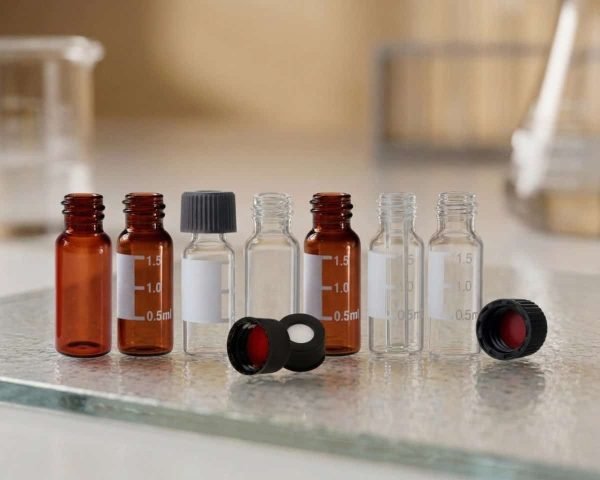
The good news: the 1.5 mL vial used across all of these is the industry-standard 12×32 mm short-thread vial with a 9 mm opening. That’s the same physical format sold by every major consumables brand, so you’re not locked into proprietary glass.
What vial formats do Shimadzu racks accept?
Shimadzu’s official consumables catalog groups sample vials by rack type, and the format really does depend on which sample tray you have installed:
– 1.5 mL vials: the default for standard racks. Part numbers like 228-21283-91 and 228-21287-91 in the Shimadzu SIL consumables catalog are borosilicate glass vials supplied with caps and silicone-rubber septa, and they fit the LC-2030, LC-2040, SIL-30AC, and the full SIL-20A family. – 1 mL vials (8×40 mm): taller, narrower vials that some racks hold in higher density. The plate 228-56197-41 seats eighty-four 1 mL vials, while the 1.5 mL plates (228-50830-91/92) seat fifty-four. – 4 mL vials: used with the spring-loaded adapter 228-21284-91 when you need more sample volume. The 4 mL plate 228-56197-42 seats twenty-eight. – Microtiter plates: if you run 96- or 384-well plates, the SIL-20 and SIL-40 families support them directly — with three plate changers, a single SIL-40XR system can hold more than 16,000 samples.
The practical takeaway: before you buy vials in bulk, check your rack part number or manual. A 1 mL rack won’t seat standard 12×32 mm vials, and forcing them in is how needles get bent.
Glass vs. polypropylene: what Shimadzu’s own catalog says
Shimadzu publishes clear guidance on vial material, and it’s worth following. Their catalog notes that borosilicate glass works for most samples, but ionic compounds like acids or bases may adsorb to the glass surface, which can hurt accuracy and precision. They also warn that alkali solutions or hydrogen fluoride can corrode glass.
Polypropylene vials, on the other hand, are recommended for water-based and buffer systems. Shimadzu suggests mixtures of water or buffer with 20–50% organic solvent (acetonitrile, methanol, or ethanol) for polypropylene, and warns that the plastic can be denatured by organic solvents and may leach additives if the solvent polarity is too low.
That’s a genuinely useful rule for everyday decisions:
– Organic mobile phases and dissolved analytes → clear or amber borosilicate glass. – Aqueous buffers, salts, and biological samples → polypropylene if your method tolerates it. – Light-sensitive analytes → amber glass, which blocks the wavelengths that degrade light-sensitive compounds.
For a deeper look at how this choice plays out in practice, I wrote a full comparison of HPLC vial materials: glass vs. plastic that covers adsorption, leachables, and cost.
Septa and caps: the part numbers that matter
Shimadzu’s own septum line gives you a clue about what the autosampler expects. Their standard sample vials ship with silicone-rubber septa, and the catalog lists 221-26718-93 (silicone rubber with a PTFE cover) and 228-15655-91 (PTFE) as direct replacements.
For most HPLC work, I’d reach for a PTFE/silicone septum — the silicone reseals after needle penetration and the PTFE layer keeps the sample from touching the rubber. That combination is what Agilent’s sample-containment catalog recommends for “most common HPLC and GC analyses,” and the same document explains that the PTFE layer acts as a chemically resistant barrier for sensitive samples.
One more detail: caps matter as much as septa. A 9 mm screw cap with a bonded or pre-assembled PTFE/silicone septum saves assembly time and reduces contamination risk. If you’re running methods with volatile components, a screw cap torqued properly is usually fine at room temperature; for highly volatile or pressurized applications you might consider the tighter seal of a crimp closure — Restek’s vial FAQ has a useful rundown of when crimp caps beat screw caps.
Watch the needle stroke and rack settings
Here’s a mistake I’ve seen more than once: someone swaps a 4 mL vial onto a rack meant for 1.5 mL vials without touching the needle settings. Autosamplers set their needle depth for a specific vial height, so a taller or shorter vial means the needle either bottoms out (bent needle, damaged vial) or misses the liquid entirely.
Shimadzu addresses this in their sample-handling guidance: for 1.5 mL vial racks, the needle stroke should be set to no more than 49 mm, and for filter vials you may need to set it 5 mm from the bottom. Always check your user manual for the exact procedure. It’s a thirty-second adjustment that prevents a very expensive afternoon.
A simple compatibility checklist
When you’re evaluating vials for a Shimadzu system, run through this list:
1. Footprint: 12×32 mm short-thread, 9 mm opening, 1.5 mL nominal volume for standard racks. 2. Material: borosilicate glass for organic solvents; polypropylene for aqueous buffers (within Shimadzu’s 20–50% organic guidance). 3. Septum: PTFE/silicone for routine work; PTFE-only for aggressive solvents; pre-slit septa if your needle is prone to coring. 4. Cap: 9 mm screw cap, open-top if the needle must pierce through. 5. Rack check: confirm the plate matches the vial format before loading. 6. Cleanliness: for trace work, use certified clean vials so you’re not chasing ghost peaks.
If you’re comparing across brands, the same logic applies — the formats are largely interchangeable, which is exactly why my Agilent autosampler vial guide and Waters HPLC vial guide look so similar in structure. And if you’re wondering whether the thread size itself matters, the complete guide to HPLC vial neck types explains 8-425, 9-425, and the rest in plain language.
Conclusion
Shimadzu autosamplers are forgiving about vial brand but picky about format. Stick with the standard 12×32 mm short-thread vial with a 9 mm screw cap for the SIL-20A family, the SIL-30AC, and the Nexera 40 series, and you’ll almost never have a fit problem. Match the material to your sample chemistry — glass for organics, polypropylene for buffers — and use PTFE/silicone septa to keep injections clean. The savings from buying generic vials are real, and they’re safe as long as you verify the footprint, the rack, and the needle stroke before you commit to a bulk order. When in doubt, order a small sample batch, run it through your own method, and check peak shape and carryover before scaling up. If you’re just starting to standardize your glassware, my guide to HPLC vial neck types is a good next read.
Frequently Asked Questions
What vials fit a Shimadzu SIL-20A autosampler?
Standard 12×32 mm short-thread vials with 9 mm screw caps (1.5 mL nominal volume) fit the main rack, which holds 105 vials. The same autosampler also accepts 1 mL 8×40 mm vials and microtiter plates with the matching racks.
Are Shimadzu vials the same as Agilent or Waters vials?
Physically, yes for most models — the 12×32 mm short-thread format is a cross-vendor standard. That’s why third-party vials labeled “for Shimadzu” or “for Agilent” usually work on all of them. The differences come down to rack plates and needle-stroke settings, not the vial itself.
Can I reuse glass vials in a Shimadzu autosampler?
You can, if you clean them properly and inspect for chips and scratches. But reused vials carry a higher risk of contamination and carryover, especially for trace analysis. Most labs reserve reuse for non-critical methods and buy certified clean vials for quantitative work.
What size septa do Shimadzu HPLC vials use?
The standard 9 mm screw-cap vials use 9 mm septa. Shimadzu’s catalog lists silicone-rubber-with-PTFE septa (part 221-26718-93) and PTFE septa (228-15655-91) as replacements, and most PTFE/silicone 9 mm septa from any supplier will fit.
Does Shimadzu make their own vials?
Shimadzu sells branded vials and sample plates through its consumables catalog, but they’re dimensionally the same as the industry-standard 12×32 mm format. The key is matching the rack plate and needle settings, not the logo on the box.