
# 9mm vs 11mm vs 13mm: Matching Vials to Instruments
Three numbers decide whether your autosampler picks up a vial cleanly or chews a needle. The 9mm screw thread, the 11mm crimp, and the 13mm screw thread each belong to specific instrument families, and mixing them up is one of the most common consumables mistakes I see.
9mm screw vials (9-425) are the modern 2mL standard for HPLC autosamplers like Agilent 1100-1290 and Shimadzu SIL. 11mm crimp vials dominate classic GC trays and older LC systems. 13mm (13-425) covers 4mL and larger vials, mainly storage, standards, and WISP-style carousels.
Read on for the full mapping by instrument family, a simple way to identify what your tray accepts, and the mismatch mistakes that quietly burn a Monday morning.
The Detailed Answer: Which Closure Goes Where
All three closures exist because autosamplers evolved at different times. The vial body barely changed (the standard 2mL vial has stayed 12 x 32 mm for decades), but the neck finish moved on, and each instrument tray was built around one of them.
| Closure | Neck code | Typical vial | Where it dominates |
|---|---|---|---|
| 9mm screw | 9-425 | 2mL, 12 x 32 mm | Modern HPLC/UHPLC: Agilent 1100/1200/1260/1290, Shimadzu SIL/Nexera, Thermo Vanquish |
| 11mm crimp | 11mm aluminum seal | 2mL, 12 x 32 mm | Classic GC autosamplers and older LC trays (Agilent 6890/7683, Waters Alliance 2690, Shimadzu SIL-10A) |
| 13mm screw | 13-425 | 4mL, 15 x 45 mm (also 15 and 25 mL) | Storage, standards, fraction collection, Waters WISP 48-position carousel |
The 9mm screw thread: the modern default
The code 9-425 means a 9mm neck finished to the 425 GPI thread specification. The design is short-threaded with a wide opening, and the opening gives the needle roughly 40% more target area than the older 8-425 “standard opening” vials. That wider target is a big reason bent needles became much rarer after the format took over.
Agilent’s own 2 mL screw vial line (the 5182-0715 and its siblings) is built on this 9mm thread, and their 2 mL screw top vials and caps page notes that the short thread speeds up capping and uncapping. If your lab runs Agilent 1100, 1200, 1260, or 1290 with a standard 2mL tray, this is almost certainly what goes in it. Shimadzu’s catalogs point the same way: their guide to vial selection lists the 1.5mL screw vials as ND 9 wide-opening, 32 x 12 mm. The same 12 x 32 mm footprint carries over to Thermo Vanquish and most Waters configurations, which is why third-party 9mm vials work across all four brands.
The 11mm crimp top: the classic that won’t leave
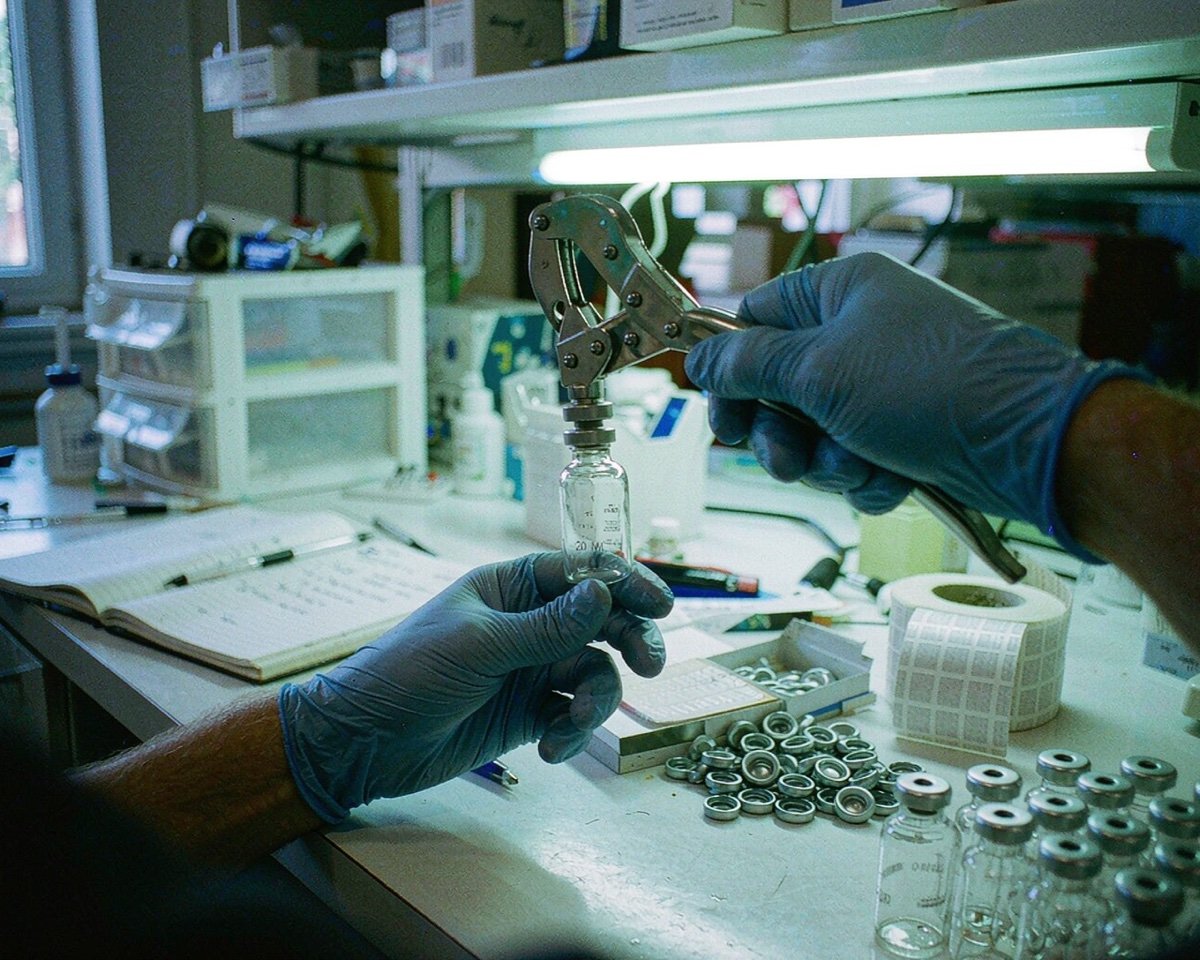
An 11mm crimp vial takes an aluminum seal that a crimping tool presses permanently into place. The seal is excellent: rigid, consistent, and happy at the pressures and temperatures of GC injection. That’s why it stuck around in GC long after LC moved to screw threads.
The compatibility list is long. Restek maintains an instrument reference for 2.0 mL, 11 mm crimp-top vials that covers Agilent 5890, 6890, 7673A/B, 7683, and 7890 GC autosamplers, the Waters Alliance 2690, Shimadzu SIL-10A and AOC-20i, and dozens more. Many LC trays were also designed to hold both formats, so an Agilent 1100 tray position might accept a 9mm screw vial or an 11mm crimp vial depending on the tray variant. When in doubt, look at what’s already in the drawer next to the instrument.
The 13mm screw thread: when 2mL isn’t enough
The 13-425 thread is the closure of the bigger vials: the 4mL format (about 15 x 45 mm), plus 15mL and 25mL storage vials. The classic 4mL autosampler vial is the WISP 48 style, built for the Waters WISP 48-position carousel. Restek’s WISP 48 4 mL vial, 15 x 45 mm, 13-425 shows the exact geometry, and Thermo lists its 4mL (13mm) vials as recommended for Dionex, Shimadzu, Varian, and that same Waters carousel.
Here’s the honest caveat: most modern HPLC trays cannot hold a 4mL vial directly. Labs use 13-425 vials for storage, standards, and fractions, then aliquot into 2mL vials for injection. If that workflow sounds familiar, my guide on what 4 mL vials are used for covers the format in depth. Snap-cap versions in 13mm exist too, handy for quick manual workflows where seal security matters less than speed.
How to Identify What Your Tray Takes
Three checks, in the order I’d do them.
Look at the vials already loaded or stored beside the instrument. A screw cap with a short, wide blue or black cap is almost always 9-425. A shiny aluminum seal means 11mm crimp. A tall 15mm-diameter vial is 13-425.
Check the instrument manual’s consumables section, which lists the exact vial part numbers the tray was designed around.
Measure the neck with calipers if you’re still unsure. Across the threads, a 9mm finish measures close to 9mm and a 13-425 close to 13mm. It takes thirty seconds and settles arguments.
Mixing Pitfalls That Cost Real Time
Cap and vial mismatches are the everyday version. A 9-425 cap will not seal an 8-425 vial, because the thread pitch and diameter differ even though both vials hold 2mL. An 11mm crimp seal obviously can’t go on a screw-neck vial. And a 9mm cap threaded onto a 13-425 vial will spin uselessly without gripping. Most of these get caught at the bench, but one usually slips through at 7 a.m. before the sequence starts.
Magnet pickup is the subtler one. Some autosamplers move vials with magnetic caps rather than a gripper arm, and the magnet geometry matters: systems designed for round-bottom magnetic caps will fumble a flat-bottom one, and vice versa. A vial that sits a millimeter off-center in the pickup can still inject, but the needle hits the septum off-axis, and coring follows.
I once watched a full 90-vial sequence stall twenty minutes in because someone loaded 4mL vials into a tray cut for the 2mL format. The robotic arm clipped every tall neck, the run aborted, and we spent the morning decanting samples. Thirty seconds with the manual would have saved the morning. That’s the stakes here: the vial is cheap, the downtime isn’t.
A Quick Word on Headspace
If you work with volatile samples, none of the three closures above apply. Headspace vials are 10mL or 20mL and use their own closures: 18mm screw or magnetic caps, or 20mm crimp seals. People sometimes lump “13mm” and “18mm” together because both sound like bigger screw threads, but the vials, trays, and caps are entirely separate. Check the neck before ordering either.
Conclusion
Match the closure to the tray and most of your vial problems disappear before they start. The 9mm screw thread (9-425) is the safe default for 2mL work on Agilent 1100/1200/1260/1290, Shimadzu SIL, and most modern LC autosamplers. The 11mm crimp still rules classic GC trays and older LC systems, where its aluminum seal earns its keep. The 13mm (13-425) thread belongs to 4mL and larger vials, mostly for storage and standards rather than injection. When you inherit an instrument, check the manual, look at the caps already in the drawer, and measure the neck if the first two fail. Since neck codes trip up even experienced buyers, my complete guide to HPLC vial neck types decodes 8-425, 9-425, and the rest, and if you’re weighing closure styles for a new method, the crimp vs screw vs snap comparison walks through the trade-offs.
Frequently Asked Questions
Are 9mm screw vials interchangeable with 11mm crimp vials?
Often, yes, because both use the same 12 x 32 mm vial body. Many autosampler trays accept both neck finishes, but the caps are never interchangeable: a 9mm screw cap can’t seal a crimp vial and vice versa. Check your tray’s documentation before switching formats.
What vials does an Agilent 1260 autosampler use?
The standard 2mL tray takes 12 x 32 mm vials with either a 9mm screw thread (9-425) or an 11mm crimp top, depending on the tray variant. Screw vials are the common choice for routine LC because they’re faster to handle and reseal reliably.
Can I put a 4mL vial in my HPLC autosampler?
Usually not. Most standard 2mL trays physically can’t hold the taller 15 x 45 mm vial, and the robotic arm may clip the neck. The exception is systems designed for them, like the Waters WISP 48-position carousel.
What does 13-425 mean on a vial?
It means a 13mm neck finished to the 425 GPI thread specification. You’ll find it on 4mL screw vials (15 x 45 mm) and on larger 15mL and 25mL vials, and it pairs with 13mm screw caps.
Do headspace vials use the same 13mm caps?
No. Headspace vials are 10mL or 20mL and use 18mm screw or magnetic caps, or 20mm crimp seals. They’re a separate closure family from the 9mm, 11mm, and 13mm formats used on standard 2mL and 4mL vials.