
# What Is a Bonded Septum?
Most labs treat vial caps as an afterthought, then wonder why injection 87 looked different from injection 86. A bonded septum removes one of the sneakiest variables in that story: a septum that moves around inside its cap. It’s a small product difference with a surprisingly large effect on run-to-run consistency.
A bonded septum is permanently attached to the vial cap at the factory, so cap and septum arrive as a single unit. Because the septum can’t shift, fall out, or be pushed through, bonded caps reduce leaking, coring, and particle contamination during injection.
Below I’ll walk through how bonded caps are made, what they actually fix, when a plain unbonded cap is still the smarter buy, and how the pricing shakes out in real labs.
A Bonded Septum, Defined
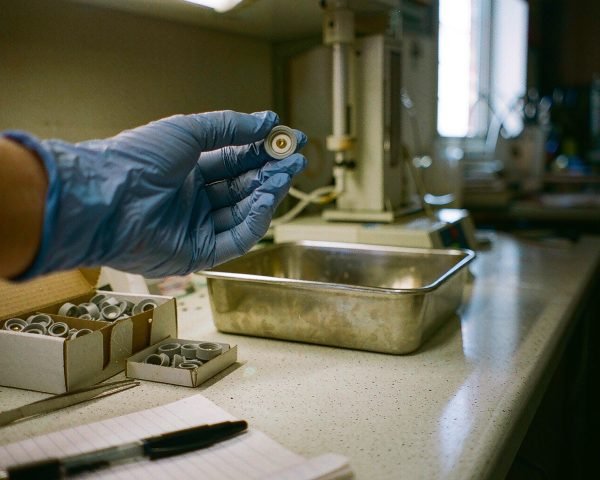
A bonded septum is the same PTFE/silicone (or PTFE/rubber) disc you’d use in any HPLC or GC cap, except the manufacturer has laminated or glued it into the cap shell before packaging. The two arrive as one piece. You can’t separate them with your fingers, and that’s the point.
In an unbonded (assembled) cap, the septum just sits in the shell by friction. Most of the time gravity and the vial neck keep it in place. But it can rotate, drift off-center, or pop through the cap when the needle forces it against a narrow opening. MicroSolv’s technical team covers this in a note on screw cap sealing, listing septum push-through among the quiet failures behind blocked needles, lost seals, and inconsistent injections, and recommending bonded assemblies for volatile or critical samples.
The septum material itself doesn’t change. A bonded cap and an unbonded cap can carry the same red PTFE/white silicone septum, the same 45 Shore A hardness, the same thickness. What changes is geometry. The septum sits fixed in one position for the life of the cap, and that fixed position is the whole product.
How Bonded Caps Are Made
These are made in a controlled production step rather than left to whoever loads the tray. The septa disc is punched slightly oversized, seated in the cap shell, and fixed in place, usually with a thin adhesive layer; some designs use a molded retention feature instead. The finished unit then goes through the same lot testing as the rest of the line: seal and reseal performance, dimension checks, and background (extractables) testing.
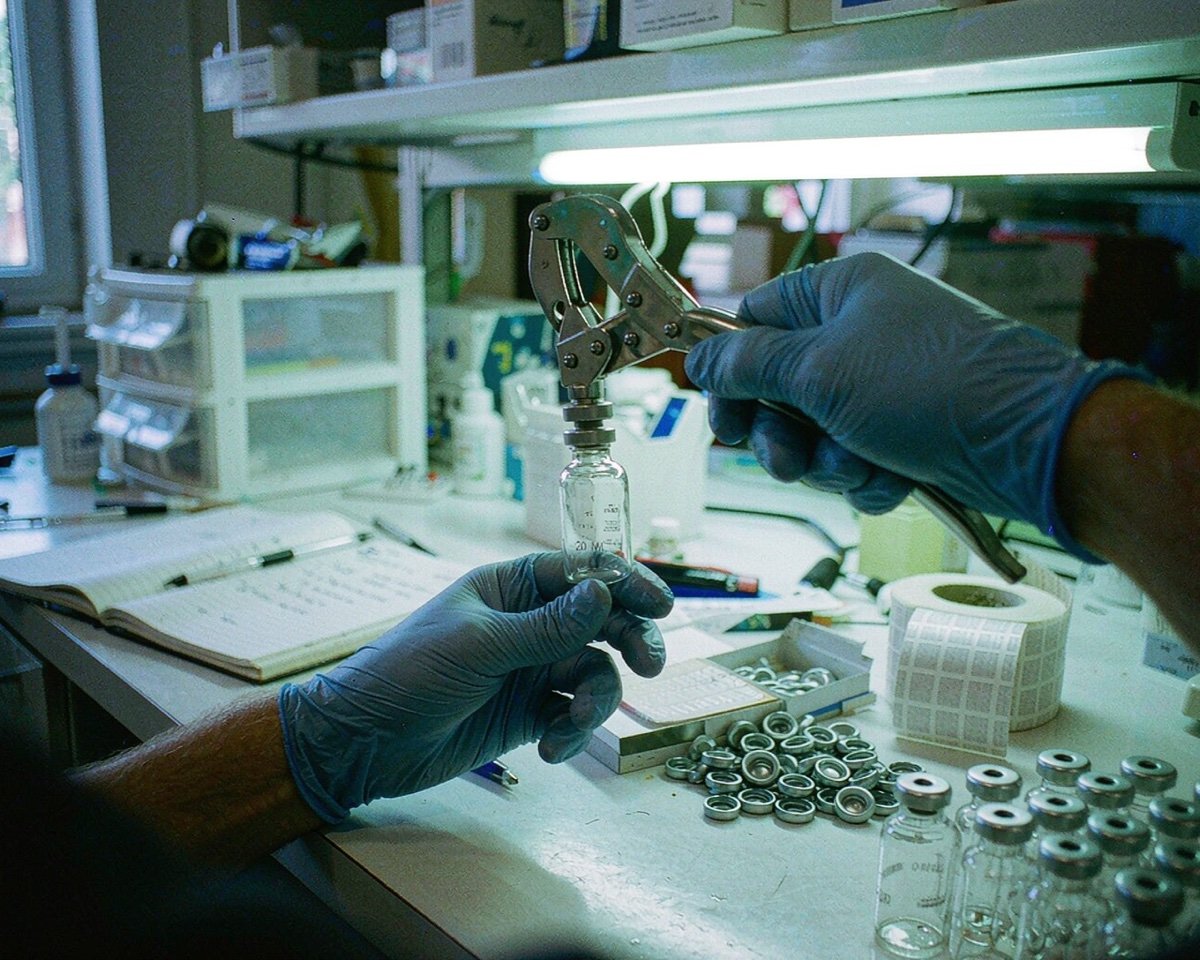
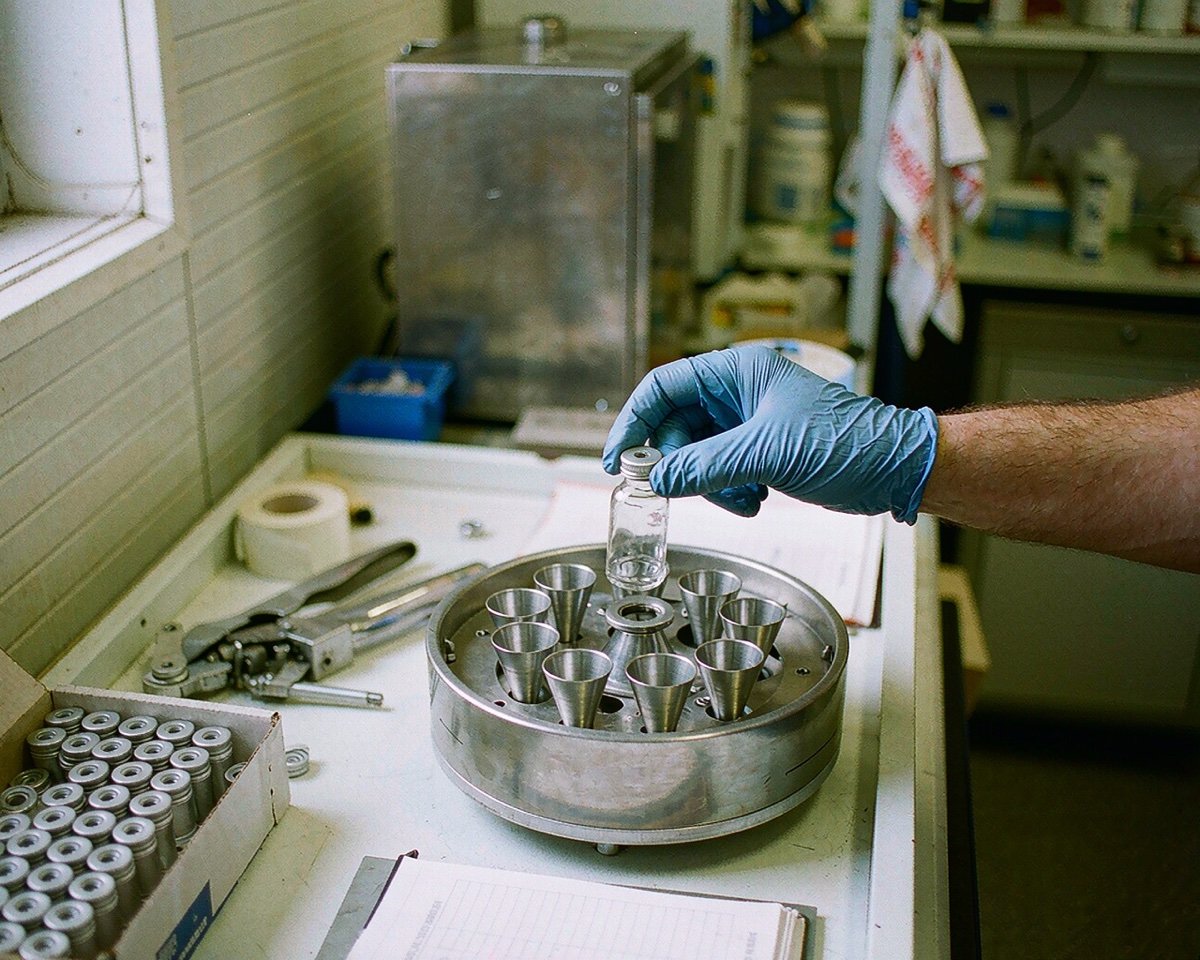
For 11mm crimp caps, the aluminum shell is pressed over the septum during manufacturing. Once you crimp the cap onto the vial, the septum is locked between shell and vial rim, so the mechanical hold does most of the work. On 9mm screw caps there is no crimping step, which is why the bond itself matters more there.
What Bonding Actually Fixes
No septum movement
When the septum is fixed in place, every vial in the tray presents the same puncture geometry. Compression is even. The needle meets the same surface at the same depth on vial one and vial four hundred, which matters most in long sequences that run unattended.
Fewer pushed-through septa
I once watched a 140-injection sequence die at sample 23 because a loose septum shifted in an over-tightened cap and the needle pushed it straight through into the vial. The needle picked up a plug of septum material, the pressure trace went flat, and the lab lost most of a day re-running samples. A bonded cap isn’t magic, but that specific failure mode can’t happen when the septum is fixed in the shell.
Less coring and fewer stray particles
Core plugs form when a needle punches a disc out of the septum. Bonding doesn’t eliminate coring on its own (pre-slit septa and the right needle gauge help more), but the fixed backing stops fragments from migrating into the sample or down the needle path. Agilent’s own consumables catalog warns that red rubber septa tend to cause needle sticking and even recommends specific needle gauges with them, which tells you how much septum behavior matters at the puncture point. If coring is already your problem, pair bonded caps with proper coring prevention steps rather than expecting the bond alone to fix it.
Friendlier for autosamplers and robots
Autosamplers repeat the same motion thousands of times. They don’t re-center a drifting septum the way a careful human would. Bonded caps give the needle a fixed target, which lowers the odds of a bent needle or a partial puncture. Thermo Fisher builds entire product lines around this: their 9mm bonded screw caps are specified to prevent septa push-through and over- or under-tightening, with septum thickness controlled at the factory between 1.0 and 1.3mm depending on the version (see Thermo Fisher’s sample handling catalog).
When an Unbonded Cap Is Fine
Plenty of labs run unbonded caps every day without trouble. If your methods are routine, your sequences are short, and someone is at the bench to eyeball the caps, a standard assembled or unassembled cap works. Unbonded is also the right call when you want to swap septa material for different solvents, since a loose cap lets you pick the liner per application and a bonded cap doesn’t.
In my experience, the crossover point is volatile samples, LC-MS work, or anything running overnight with nobody watching. Below that bar, don’t pay for what you don’t need.
The Cost Question
Bonded caps typically cost a bit more per unit than caps and septa bought separately. The honest math includes the labor you skip: nobody at your bench pairs and seats septa into caps anymore, and that manual step is exactly where batch-to-batch variability sneaks in.
For a lab running a few thousand vials a month, the premium is usually small next to one re-run of a failed sequence. For a teaching lab, I’d still save the money and go unbonded.
Compatibility: 9mm Screw vs 11mm Crimp
Most bonded caps you’ll encounter fall into two camps.
9mm short-thread screw caps (the 9-425 style) are the standard for 2mL autosampler vials across Agilent, Waters, Shimadzu, and Thermo systems. This is where bonding helps most, because nothing but the bond holds the septum centered in the cap. A typical spec reads like this: a grey 9mm polypropylene cap with bonded red PTFE/white silicone septa, 1.2mm thick, no pre-slit.
11mm crimp caps (aluminum, common in GC) hold the septum mechanically once crimped, so bonding is less critical there. Many 11mm crimp caps ship pre-assembled with the septa seated in the shell and the crimp does the rest. Shell quality and even crimping matter more, since a poorly crimped cap leaks no matter how good the septum is.
If you’re unsure which neck finish your vials have, match the cap to the vial first and the septa material second. For material choice itself (pure PTFE versus silicone combinations), this PTFE vs silicone septa guide breaks down the options.
How I’d Buy
Confirm the cap size matches your vial neck (9mm screw, 11mm crimp, or 13mm screw). Ask whether the septa is pre-slit, since Restek notes pre-slit options reduce needle bending and release the vacuum that forms during high-volume draws. Request the lot documentation too: seal/reseal test data and background data are what separate a decent bonded cap from a marketing claim (Restek’s preassembled 9mm caps are a good example of how these specs are usually presented).
One more point, and I’d call it the important one. Buy a small pack first and run it against your current caps in a real method rather than a blank. If peak areas and carryover match, scale up with confidence.
Conclusion
A bonded septum is a small engineering fix for a real problem: septa that move when they shouldn’t. Fixing the septum into the cap at the factory takes push-through, off-center punctures, and manual assembly variability out of your error budget. The trade-offs are honest ones. You pay a little more per cap, and you lose the freedom to swap septa materials on the fly. For routine bench work with short sequences, an unbonded cap remains a perfectly good choice, and I wouldn’t talk you out of it. But for volatile samples, LC-MS methods, and long unattended runs, the consistency is worth the premium in my book. If you want the side-by-side version, our bonded vs assembled caps comparison covers the same decision from the cap-buying angle.
Frequently Asked Questions
Are bonded septa reusable?
No. A bonded septum is still a consumable, and its resealing ability degrades with each puncture. Treat it the same way you’d treat any PTFE/silicone septum and replace it once the injection count gets meaningful.
Do bonded caps fit standard autosamplers?
Yes. 9mm screw caps and 11mm crimp caps follow the same neck-finish standards as unbonded versions, so they fit the same Agilent, Waters, Shimadzu, and Thermo vials. The septa attachment changes nothing about the outer dimensions.
Can I bond septa into caps myself?
Not reliably. The factory bond is applied under controlled conditions with materials chosen not to leach into your sample. DIY adhesives risk extractables ending up in your chromatogram, which defeats the purpose.
Are bonded caps worth it for GC headspace vials?
For 11mm or 20mm crimp-top headspace vials, the crimp itself holds the septum, so bonding mainly saves assembly time. Seal quality there depends more on crimping technique and septum material than on bonding.