
# 8-425 vs 9-425 vs 13-425: Decoding Vial Thread Sizes
A customer of ours once ordered 2,000 caps labeled “9 mm, fits Agilent” for vials they had been buying for years. The caps threaded about halfway on, then jammed. The vials were 8-425, and no amount of force was going to change that. They lost two days of sequencing while we rushed them the right caps.
I write about thread codes a lot because this exact mix-up keeps happening, and it is completely avoidable. The numbers on the box follow one simple rule. Once you can read them, you stop guessing.
8-425, 9-425 and 13-425 describe a vial’s neck finish. The first number is the thread diameter in millimeters. The 425 is the thread style, set by the Glass Packaging Institute (GPI). The three sizes look similar but are not interchangeable.
Below, I decode each number, show which vials and instruments use which thread, and cover the cap and septa pairings that keep your injections clean.
What the Numbers Actually Mean
Glassblowers call the top of the vial, where the cap attaches, the “finish.” In the packaging world, finishes follow a two-part code from the GPI, the US trade body that standardizes glass container threads. So when you see 8-425, the 8 is the outer thread diameter (the “T” dimension) in millimeters, and the 425 is the thread style: two narrow turns over a short neck height. That style happens to suit small containers, which is why it dominates vials.
The practical part: both numbers have to match between vial and cap. Change either one and the seal is compromised. J.G. Finneran’s finish specification sheet lists the typical pairings you still meet in chromatography: 8-425 closures on Varian and Shimadzu systems, 13-425 on the Waters 48-position WISP, and a curious note that the 9 mm thread is not a GPI standard finish at all. More on that wrinkle below.
Here is the quick comparison I keep pinned above my own desk:
| 8-425 | 9-425 | 13-425 | |
|---|---|---|---|
| Thread diameter | 8 mm | 9 mm | 13 mm |
| Opening | Standard (narrow) | Large | Large |
| Thread length | Runs to the shoulder | Short, stops above shoulder | Runs to the shoulder |
| Typical vial | 12 × 32 mm, 1.5–2 mL | 12 × 32 mm, 2 mL | 15 × 45 mm, 4 mL; 15–25 mL |
| Common instruments | Older Shimadzu, Varian | Agilent and most modern LC | Waters WISP, Shimadzu |
| Matching septa | ~8 mm | ~11 mm | ~13 mm |
The 8-425 Thread: The Narrow-Opening Original
This is the screw thread that predated the wide-opening era. The opening is narrow, roughly 6 mm of usable diameter, and the threads run all the way down to the shoulder of a standard 12 × 32 mm, 2 mL vial.
Narrow openings have one real advantage: the vial shell is the same footprint as an 11 mm crimp vial, so it drops into older trays designed around crimp geometry. That is why legacy Shimadzu and Varian autosamplers often expect it.
I still recommend 8-425 vials when a customer runs one of those older instruments, or when a method transfer document pins the neck finish explicitly. They usually cost a little less, too. Just remember that the small opening leaves less margin for needle misalignment, so tray calibration matters more.
The 9-425 Thread: Today’s Default
The 9-425, often called the “9 mm short thread,” is the finish you will meet on most modern HPLC and UHPLC autosamplers. Agilent made it standard, and nearly everyone else followed.
Two things make it different from its GPI cousins. The threads are short and stop above the shoulder, and the opening is wide, which gives the needle a bigger target and makes bent needles rarer. The short thread is also why it never made the GPI chart: it grew out of autosampler design rather than container standards, as the Finneran sheet points out.
There is a second reason it spread. A 9-425 vial matches the 11 mm crimp vial dimensionally, so it slides into the same trays and racks. Labs switching from crimp to screw could keep their tray geometry. That friction-free swap is why 9 mm became the de facto standard. (If you want a deeper dive, we have a whole post on what 9-425 means on a vial.)
Cap design has improved around this thread too. Thermo Fisher’s AVCS technical note shows how a stop-point closure keeps the septum compressed evenly even when someone overtightens, with evaporation data to back it up. If your lab has ever lost a volatile analyte overnight, that document is worth ten minutes.
The 13-425 Thread: When You Need More Volume
The 13-425 is a genuine GPI finish with a large opening and threads running to the shoulder. You will find it on 4 mL vials in the 15 × 45 mm format, the classic Waters WISP size, and on 15 mL and 25 mL vials used for sample storage or large-volume injection work.
A quick browse through Restek’s vial catalog shows the pattern: their WISP 48 screw-thread step vials, 15 × 45 mm, are all specced as 13-425. If your autosampler has a tall tray or a robotic arm that handles bigger shells, this is your thread.
Do not confuse it with 15-425, which is a different diameter entirely despite the shared style code. The same caution applies to 18-400 and 24-400 headspace threads, which share diameters with nothing else in your drawer.
Cross-Compatibility Pitfalls
This is where the jams happen. A 9-425 cap onto an 8-425 vial threads about one turn, then binds hard. Force it and you crack the cap or shatter the neck, and now you have glass slivers in your tray.
The reverse is quieter. An 8-425 cap on a 9-425 vial spins loosely without ever compressing the septum. The vial looks sealed. It is not. Solvent evaporates, your peak areas climb run after run, and you spend the afternoon chasing a “method” problem that was a cap problem.
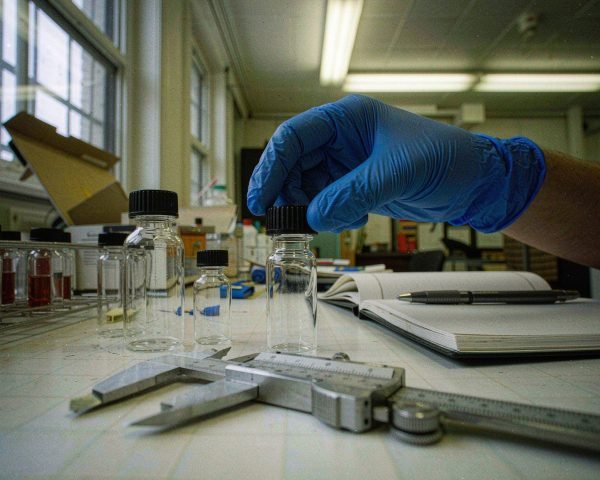
Two more traps worth naming. The 10-425 finish, which the Waters Alliance 2690 used, is one digit away from 9-425 and nearly the same diameter, but the thread profile differs enough that sealing is unreliable. And on the large end, 13-425 and 15-425 look alike through safety glasses. When in doubt, measure the outer thread diameter with calipers. Thirty seconds at the bench beats a wasted sequence.
Matching Caps and Septa to the Finish
Caps and septa are sold by the same codes as vials, so match all three. An 8-425 cap takes septa around 8 mm across, a 9-425 cap takes 11 mm septa, and a 13-425 cap takes 13 mm. Suppliers vary slightly, so check the cap specification rather than assuming.
Septum choice is its own decision. PTFE/silicone laminate reseals after the needle withdraws, which matters for re-injection work. Solid tops protect stored samples; open-hole tops let the autosampler pierce through. Forgetting this pairing is one of the cheaper ways to ruin a weekend of samples, and our guide to choosing the right vial cap walks through it in detail.
Autosampler Compatibility Notes
Most modern Agilent, Waters, Shimadzu, and Thermo systems accept 12 × 32 mm vials, but the neck finish they expect varies by model and tray generation. Agilent’s current autosamplers are 9-425 territory. Older Shimadzu units often want 8-425. Legacy WISP trays take 13-425, 4 mL vials.
The instrument manual is the final word, because the tray was machined for one geometry and physics does not negotiate. Worldwide Glass Resources’ finish chart lists the full T and H dimensions for every GPI finish, which helps when you are verifying an unfamiliar vial against a spec sheet.
My honest rule of thumb: if a method works and the vials seal, do not “upgrade” the thread mid-project. Save the change for method development, where you can revalidate properly.
Conclusion
Thread codes look like alphabet soup until you know the two-part rule: diameter first, GPI thread style second. From there, 8-425 is the narrow-opening original still living in older Shimadzu and Varian trays, 9-425 is the wide-opening standard that took over modern LC, and 13-425 covers the larger 4 mL and bulk-format vials. None of them are interchangeable, and the failure modes are sneaky: a jammed cap at best, slow evaporation and drifting peak areas at worst. Check the finish before you order caps, measure with calipers when a vial arrives unlabeled, and keep one box of each thread your instruments actually use. For the wider picture, our complete guide to HPLC vial neck types covers crimp and snap finishes too, and it pairs well with this one.
Frequently Asked Questions
Are 8-425 and 9-425 vials interchangeable?
No. The diameters differ by 1 mm and the thread profiles differ more than that. A 9-425 cap will jam partway onto an 8-425 vial, and an 8-425 cap will never seal a 9-425 vial properly.
Is 9-425 the same as an 11 mm crimp neck?
They share outer dimensions, so a 9-425 vial fits trays and racks built for 11 mm crimp vials. The closure systems are completely different, though: one screws, the other needs a crimping tool.
Which vials use a 13-425 thread?
Mostly 4 mL vials in the 15 × 45 mm format, such as the classic Waters WISP vials, plus 15 mL and 25 mL vials for storage or large-volume work.
Can I mix vial brands within one method?
Usually yes, as long as the neck finish, outer dimensions, and glass quality match your current spec. Verify the finish code and run a system suitability check before switching lots in a validated method.