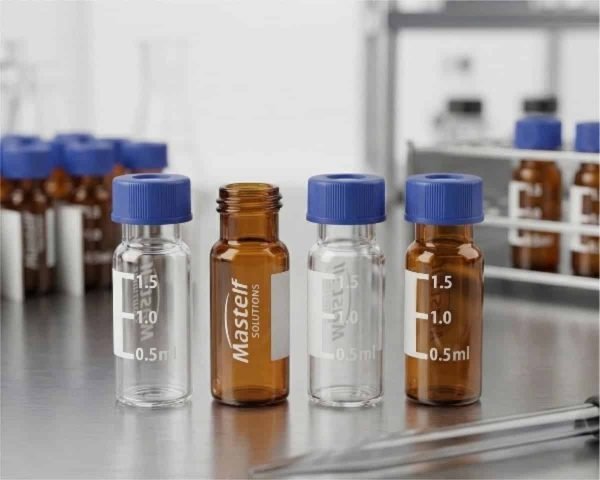

You’ve probably stared at a rack of Agilent vials and wondered whether the generic pack on your shelf will actually work in your autosampler. Here’s the short version: most Agilent autosamplers accept the same standardized 12 x 32 mm, 2 mL vials, and many third-party vials work perfectly — as long as the dimensions, neck finish, and glass quality match. In this guide, I’ll walk you through exactly what to check before you buy.
Agilent autosamplers (1100, 1200, 1260, 1290 Infinity, and GC autosamplers) use standardized 2 mL vials measuring 12 x 32 mm (11.6 mm body diameter x 32 mm height), with either a 9 mm screw thread, 11 mm crimp top, or 11 mm snap top. Third-party vials with identical dimensions and certified glass quality are fully compatible and can be used in place of branded Agilent vials.
That’s the direct answer. Keep reading if you want the details that separate a smooth run from a bent needle or a leaked sample.
What “Compatible” Actually Means for an Agilent Autosampler
Compatibility isn’t a vague marketing word. It’s a set of physical and chemical requirements that the autosampler’s gripper, needle, and injector depend on. If a vial doesn’t meet them, you might get away with it once — and then pay for it with a crashed sequence.
The good news? Autosampler design has become remarkably standardized. Agilent’s own autosampler vials selection guide notes that over time, autosampler designs have become more standardized, allowing the same vials and caps to work across most common autosampler brands. That harmonization is why a well-made 2 mL vial from a reputable supplier can slot into an Agilent, a Waters, or a Shimadzu autosampler without modification. What you need to focus on is whether your vial meets the same dimensional and quality specifications Agilent builds its own certified vials to.
The Three Things You Must Match
When I help labs pick vials for Agilent systems, I tell them to check three things: dimensions, neck finish, and glass quality. Get these right and you’re 95 percent of the way there.
Outer Diameter and Height
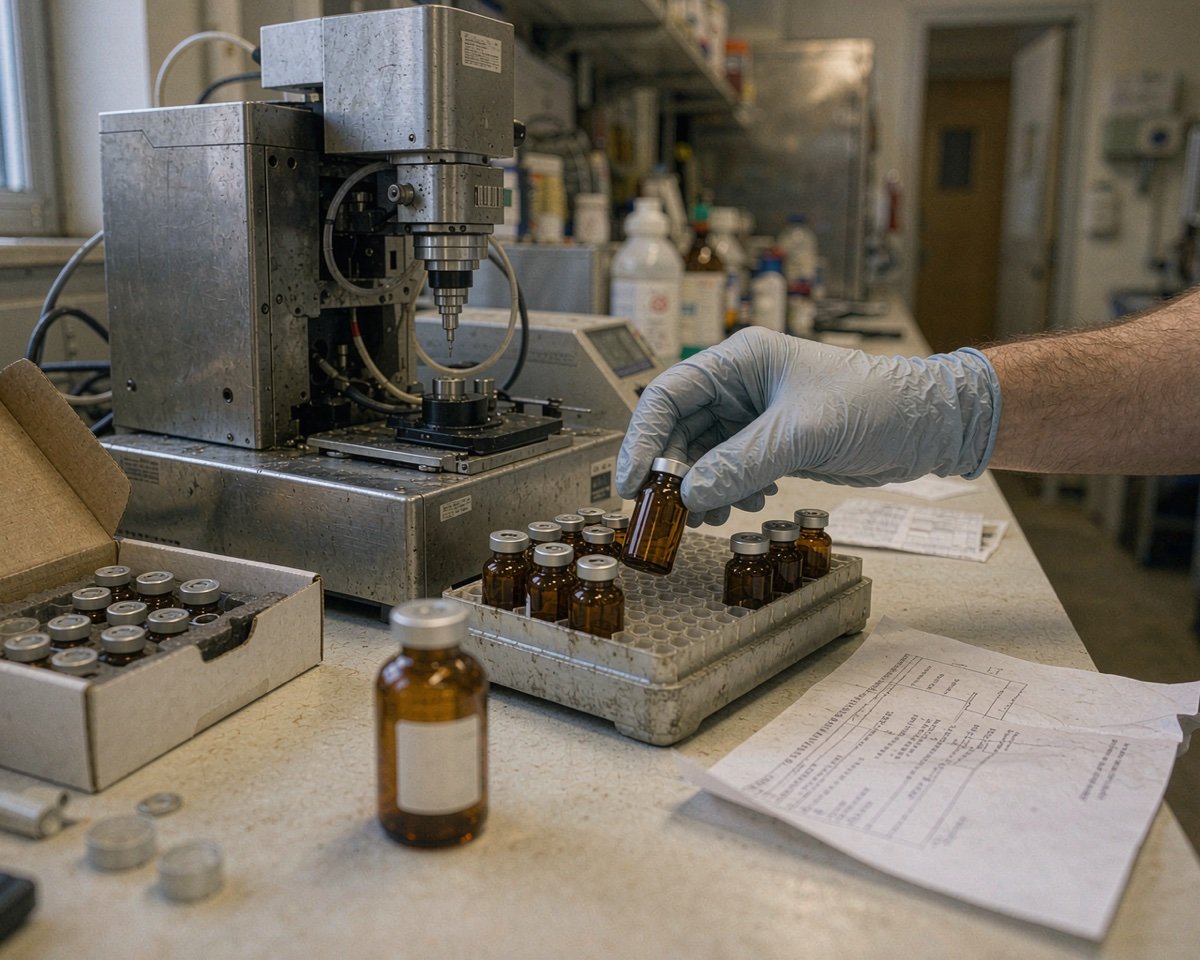
The 2 mL vial’s footprint is 12 mm outer diameter and 32 mm height — the actual glass body is 11.6 mm across, with the cap bringing the total to 12 mm. This size is so universal that Waters sells its own certified 12 x 32 mm screw-neck vials for the same autosampler class. If a vial is even slightly oversized in diameter, the gripper may struggle to seat it; if it’s undersized, the vial can wobble and the needle can miss the septa center. Height matters just as much: too tall, and the needle hits the bottom or the cap jams; too short, and the needle can’t reach the sample.
Neck Finish: 9 mm Screw, 11 mm Crimp, 11 mm Snap
The neck finish determines which cap you can use, and that determines the seal. Three closures dominate Agilent workflows:
– 9 mm screw thread — the most common choice for LC and LC/MS. The screw cap makes handling easy, reseals reliably, and pairs with micro-volume inserts. Agilent’s own 5182-0715 2 mL screw vials use a 9 mm thread and are explicitly listed as compatible with Agilent, Shimadzu, Thermo, Varian/Bruker, and PerkinElmer autosamplers. – 11 mm crimp top — the classic GC and GC/MS closure. A crimped aluminum seal gives a rock-solid, consistent seal that holds up to the pressures and temperatures of GC injection. Agilent’s guidance has long been that crimp-top vials are generally preferred for GC/GC-MS while screw-top vials suit LC/LC-MS. – 11 mm snap top — a quick, tool-free option for non-volatile samples where convenience beats absolute seal security.
Glass Type and Quality
Type 1 borosilicate glass is the standard for HPLC and GC vials because of its chemical inertness and low extractables. Beyond the material, dimensional consistency matters far more than most people think. Agilent’s general chromatography supplies catalog warns that inconsistency with vial bottom thickness leads to sample draw inconsistency and damaged needles, and that an undetected improper seal causes sample loss, evaporation, and contamination. Their certified vials pass a 33-point visual inspection in ISO 9001 clean environments. A third-party vial that matches that level of dimensional control will behave the same on your autosampler.
Which Vial for Which Agilent System
Every Agilent autosampler family has a slightly different personality, but the vial requirements are more alike than the marketing suggests.
1100 and 1200 Series
These classic LC autosamplers use the standard 2 mL vial tray with 9 mm screw or 11 mm crimp positions. Either closure works; labs with heavy automation usually prefer screw caps because they’re faster to handle and gentler on the gripper.
1260 Infinity and 1290 Infinity
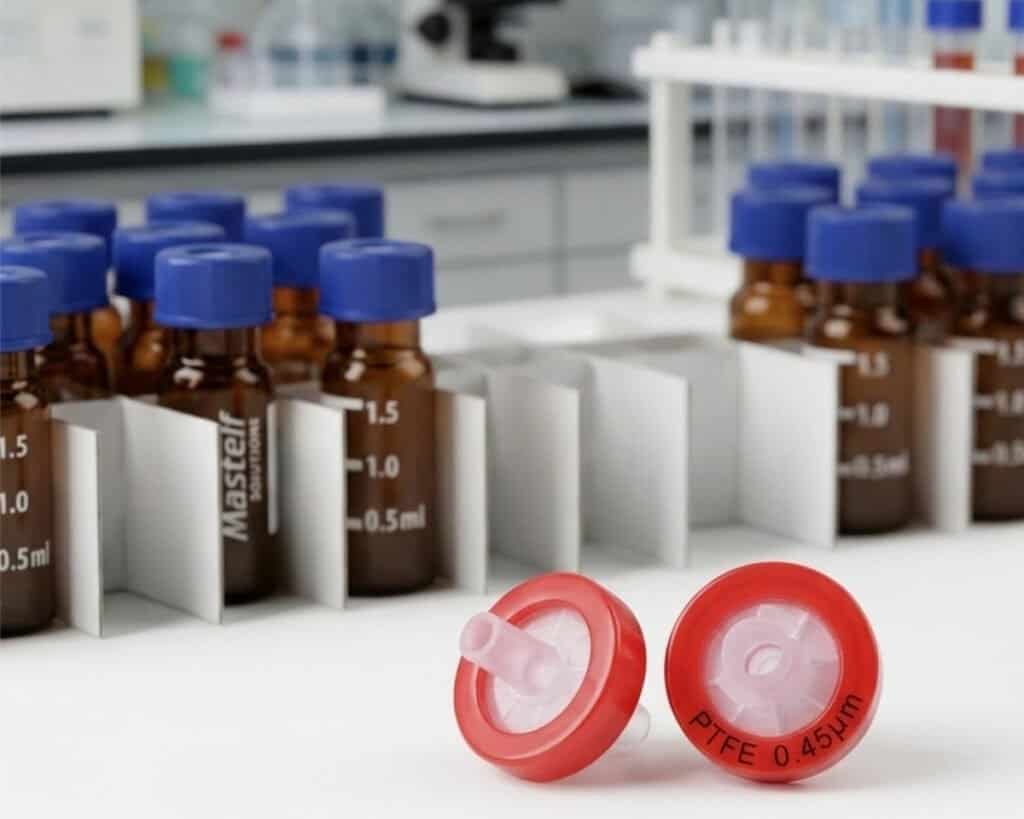
The Infinity line keeps the same 2 mL footprint, so your existing compatible vials carry over. The 1290’s faster injection cycles put more stress on seal integrity — a well-seated screw cap with a PTFE/silicone septa handles it without drama. If you’re doing ultra-trace work, pre-slit septa reduce needle force and minimize coring.
GC and GC/MS Autosamplers
For GC, 11 mm crimp-top vials remain the workhorse, and 9 mm screw vials are also accepted by most modern Agilent GC autosamplers. Headspace applications step up to 10 mL or 20 mL headspace vials with magnetic or crimp caps. The same logic applies: match the closure to the autosampler’s gripper and follow the recommended needle depth.
Cross-Brand Compatibility: The 2 mL Standard
Here’s the part that saves labs real money. Because the 12 x 32 mm format became an industry standard, you’re not locked into one vendor’s vial. Agilent, Waters, Shimadzu, and Thermo all build their autosamplers around this footprint, and each of them sells “certified” vials tested for their own instruments. A Waters certified 12 x 32 mm screw vial, for instance, is designed for exactly the same autosampler class as an Agilent one.
What differs between brands is largely the certification testing and the part-numbering. That’s also where the opportunity sits: a quality third-party vial that matches the dimensional spec and glass quality gives you the same performance at a fraction of the cost. This is the core of the OEM-compatible approach we use at Mastelf — the same 12 x 32 mm geometry, the same 9-425 thread, the same Type 1 borosilicate glass, without the brand markup. If you want to compare the two paths side by side, my guide on choosing the right HPLC vial walks through the trade-offs in plain language.
One more thing worth knowing: residual volume is autosampler-dependent. Waters documents that the same vial can leave 165 µL in one of their systems but 750 µL in another. If you work with small sample volumes, choose low-recovery-loss vials or inserts and tune the needle depth accordingly.
Why Certified Quality Matters
I keep coming back to certification because it’s the difference between “it fits” and “it works every time.” A compatible vial isn’t just one that physically fits in the tray. It’s one that:
– sits at a consistent height so the needle draws the same volume every time, – seals consistently so samples don’t evaporate overnight, – has a clean, low-bleed interior so you don’t chase ghost peaks, – and holds tight dimensional tolerances so the gripper never drops it mid-sequence.
Agilent’s own documentation lists exactly these failure modes when vials are off-spec: inconsistent relative standard deviation values, interrupted sequences, sample loss, and ghost peaks from septa contamination. When you buy cheap vials with sloppy tolerances, you inherit all of those risks. When you buy compatible vials from a supplier that controls dimensions and cleanliness, you don’t.
A Quick Compatibility Checklist
Before you commit to a vial for your Agilent autosampler, run through this list:
– Diameter: 11.6 mm body, ~12 mm with cap. – Height: 32 mm total — check the full spec, not just the label. – Neck finish: 9-425 screw thread for LC, 11 mm crimp for GC, snap top if you prefer tool-free capping. – Glass: Type 1 borosilicate (clear or amber), consistent wall and bottom thickness. – Closure: matched cap and septa — PTFE/silicone for standard HPLC, pre-slit for high-throughput, PTFE/silicone/PTFE for ultra-trace. – Documentation: ask for dimensional inspection data and lot-to-lot consistency records.
If you’re still unsure whether your vials will fit your instrument, two of our older guides help: how to pick vials for your autosampler and what the 1.5 mL, 1.8 mL, and 2 mL sizes really mean. And once you’ve matched the vial, don’t forget the vial cap and seal — that’s where sample loss hides.
Conclusion
Agilent autosamplers don’t demand magic — they demand precision. The 12 x 32 mm, 2 mL format is a shared industry standard, which means any vial that matches the dimensional spec, the correct neck finish, and certified glass quality is genuinely compatible, whether it carries the Agilent logo or not. The checklist above gives you everything you need to evaluate a third-party supplier with confidence. Start with the geometry, verify the glass, and check the documentation — the money you save by buying OEM-compatible vials is money you keep, with no sacrifice in data quality. If you’re comparing vial options for your lab, our guide on choosing the right vial for your autosampler is a good next read.
Frequently Asked Questions
What size vials do Agilent autosamplers use?
Agilent autosamplers use 2 mL vials with a 12 x 32 mm footprint — 11.6 mm body diameter and 32 mm height. This is the same format used by Waters, Shimadzu, and Thermo autosamplers.
Are generic vials compatible with Agilent autosamplers?
Yes, if they match the dimensions, neck finish, and glass quality of Agilent’s certified vials. Many labs run third-party vials successfully because the 2 mL format is an industry standard.
What is the difference between 9 mm screw and 11 mm crimp vials?
A 9 mm screw vial uses a threaded cap that you twist on and is the standard for LC and LC/MS. An 11 mm crimp vial uses an aluminum seal that must be crimped, and is preferred for GC and GC/MS.
Which Agilent vial part number should I match?
For the standard 2 mL clear screw vial, the reference part number is 5182-0715 (clear with writing label). For amber, use 5182-0716, and 5188-6535 for the amber wide-mouth version.
Can I use the same vials for Agilent LC and GC autosamplers?
Mostly, but check the closure. LC autosamplers typically accept 9 mm screw vials, while GC autosamplers often require 11 mm crimp-top vials. The vial body and glass are the same; the cap is what differs.