
# What Consumables Does Soxhlet Extraction Need?
A Soxhlet extraction looks like an antique, yet it still anchors EPA soil methods and crude fat determinations in food labs worldwide. The glassware gets all the attention, but the consumables decide whether your extract comes back clean or full of surprises. I have run enough of these setups to know the list is shorter than most people expect.
A Soxhlet extraction needs five core consumables: an extraction thimble (cellulose or glass fiber) sized to the extractor, solvent of the correct grade, anti-bumping chips, filtration media (a glass-fiber prefilter plus a 0.45 µm membrane), and amber HPLC or GC vials for the finished extract.
Read on and I will walk through each one: how to size the thimble, when glass fiber beats cellulose, which solvent grade actually matters, and the small consumables like glass wool and sodium sulfate that purchasing lists forget.
How Soxhlet Extraction Works in 30 Seconds
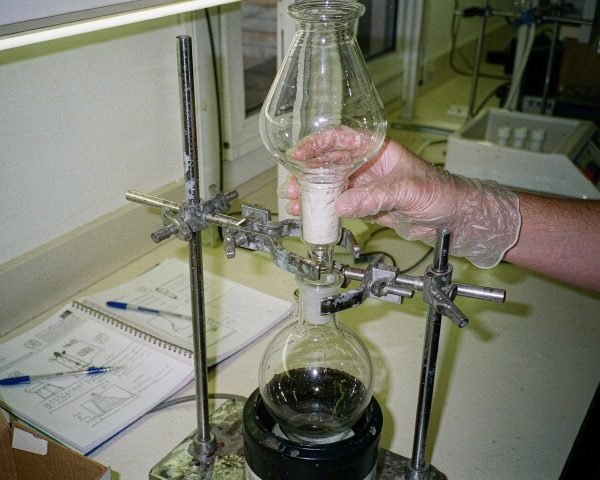
Solvent boils in a round-bottom flask, vapor travels up the side arm, and condenses in the condenser above. The condensed solvent drips onto your sample, and once the level reaches the top of the siphon tube, the whole load flushes back into the flask. That flush is one cycle.
Each cycle brings fresh, clean solvent into contact with the sample, which is why Soxhlet extracts so thoroughly even with cheap glassware. EPA Method 3540 calls for 4 to 6 cycles per hour over 16 to 24 hours, so one run pushes hundreds of fresh solvent charges through a single thimble. Your consumables must survive that repetition without shedding anything into the extract.
Extraction Thimbles: Sizing Comes First
The thimble is a porous sleeve, usually cellulose, that holds your solid sample while solvent passes through it. Getting the fit right matters more than the brand. The outer diameter should sit close to the extractor chamber’s inner diameter, and the length should leave room above the siphon return so the sample stays submerged.
I have seen people drop a 33 × 80 mm cellulose thimble into a 45 mm extractor body and call it done. That leaves a wide annular gap on both sides, and solvent will take the path of least resistance around the sample instead of through it. If your extractor has a 45 mm chamber, buy a thimble near 41 mm; for the classic 40 mm EPA setup, match accordingly. Cytiva’s Whatman 603 range runs from 25 up to 80 mm inner diameter, and the thimble listing shows the full size matrix, so measure before you order.
Retention is the second spec: standard cellulose holds particles back to a few microns, finer grades and glass fiber go lower, and an under-spec thimble lets fines migrate into the flask. Then you spend the afternoon re-filtering.
When glass fiber beats cellulose
Cellulose thimbles are cheap and mechanically strong when dry, and they handle hexane, acetone, or ethanol work at modest temperatures. They do have limits. Heat is one: cellulose tolerates roughly 130 °C, and some hot solvents push past what the fibers like. Aggressive chemistry is another, since acidic or alkaline media slowly chew cellulose. And a fat-laden sample can soften the wall until it slumps.
Glass fiber thimbles handle higher temperatures and most aggressive media while retaining fine particles better. They cost more, so I reach for them when the method demands it, not by default. For trace dioxin work, labs step up to quartz fiber.
Solvent Choice and Grade
Hexane, dichloromethane, acetone, methanol, petroleum ether, and mixtures like 1:1 hexane-acetone cover most Soxhlet work. The chemistry of your analyte picks the solvent; your detector should pick the grade.
Technical grade solvent is fine for crude fat determination where you weigh a flask. It is not fine when the extract gets concentrated 100-fold before GC-MS, because every non-volatile impurity in four liters of solvent ends up in one milliliter of final extract. That shows up as baseline creep and artifact peaks that eat your week. For trace work, buy HPLC-grade dichloromethane or an equivalent residue-analysis grade and let the certificate do the worrying for you.
Two related consumables belong here: anhydrous sodium sulfate to dry wet samples before extraction, exactly as EPA 3540 prescribes, and the solvent-extracted boiling chips that go into the flask.
Boiling Chips and the Glassware Train
Boiling chips sound trivial until a flask bumps hard enough to crack a joint. EPA specifies solvent-extracted silicon carbide chips around 10/40 mesh. One or two per flask, replaced every run.
The reusable side of the train includes the extractor body, a condenser (Allihn or Liebig both work), a round-bottom flask, a heating mantle, and stands with clamps. EPA’s classic configuration pairs a 40 mm ID extractor with a 500 mL flask. Check the ground glass joints at every setup, because a chipped one leaks vapor and changes your cycle rate.
Glass wool is another option. The method lets you pack the sample between two contaminant-free plugs instead of a thimble. Pre-wash it with solvent first, or the binder in commercial pads will surface in your blank.
Filtering and Concentrating the Extract
When the cycles finish, you have solvent plus whatever the thimble let through. Dirty matrices like soil and tissue leave particulates and waxes behind, and pushing that straight into an HPLC is a short road to a clogged inlet.
My default sequence for a messy extract is a glass-fiber prefilter first, then a 0.45 µm membrane for the polish. The prefilter takes the coarse load so the membrane does not blind after two milliliters. Cleaner extracts can go straight to a membrane; the selection factors are the same ones I cover in how to choose a syringe filter.
Concentration has its own consumables. A rotary evaporator needs correctly sized evaporation flasks and good vacuum seals; EPA’s Kuderna-Danish route needs concentrator tubes and Snyder columns. For small final volumes, a nitrogen blowdown needs vials that tolerate a gentle gas stream without spitting analyte out. Whatever you use, never take a volatile extract to complete dryness; you lose the compounds you chased for 24 hours.
If the extract also needs cleanup, silica gel or florisil SPE takes over from here; that workflow has its own consumable list, which I lay out in what SPE is and which consumables it needs.
Vials for the Final Analysis
The last transfer is the one auditors and instruments both care about. EPA 3540 asks for 2 mL glass vials with PTFE-lined screw or crimp tops, and that spec is a good default even outside regulated work. PTFE liners resist nearly every extraction solvent; polyethylene liners can leach into chlorinated solvents and add ghost peaks.
For HPLC-UV, a 0.45 µm filtered extract into an amber 2 mL vial is the everyday answer. For LC-MS, step down to 0.22 µm filtration to protect the ion source from fines. Amber glass earns its premium whenever the extract is light-sensitive, which describes most environmental analytes. Keep it to one transfer; every pour is a chance for loss.
Method Context: EPA 3540 and the Faster Alternatives
The reference point for regulated Soxhlet work in the US is EPA SW-846 Method 3540 for nonvolatile and semivolatile organics in solids. It calls for 10 to 30 g of sample mixed with anhydrous sodium sulfate, 16 to 24 hours of extraction at 4 to 6 cycles per hour, and a 300 mL solvent charge in the flask. Regulators like it because it is rugged.
Almost. The two real complaints are time and solvent volume, which is why alternatives exist. Automated Soxhlet, the Randall configuration, dips the thimble into the boiling solvent first, then finishes with rinse cycles, cutting a 16-hour run to roughly two hours. Pressurized fluid extraction goes further: hot solvent under pressure in a sealed cell finishes in minutes with a fraction of the solvent. A review of pressurized liquid extraction for food contaminants compares it directly against conventional and automated Soxhlet, and head-to-head recovery studies like this Soxhlet versus PLE comparison found generally good agreement across methods.
My take: a handful of Soxhlets a month needs nothing more than the consumables in this article; fifty a week justifies the automated instrument on solvent savings alone.
Liquid samples are a different game entirely. If your matrix is aqueous rather than solid, the matching consumables are covered in what liquid-liquid extraction needs instead.
Selection Tips, Troubleshooting, and Lot Consistency
Three buying habits will save you money and re-runs.
Match the thimble to the chamber, always. Write your extractor’s inner diameter on the consumables shelf, and order thimbles whose outer diameter sits within a couple of millimeters of it. Wall thickness counts toward that outer diameter.
Check plastic compatibility before you pipet. Dichloromethane and other chlorinated solvents attack polypropylene, which rules out ordinary PP racks and funnels anywhere the solvent touches. Glass and PTFE are the safe pair for chlorinated work.
Ask for certificates on anything that touches your extract. Cellulose thimbles are paper products, and a new lot can carry background organics that surface in your method blank. In my experience most labs get away with it until an auditor asks why the blank grew a peak. A certificate of analysis per lot, plus a solvent pre-wash of new thimble lots, keeps that conversation short.
Troubleshooting has three usual suspects. Bypass: solvent flows around the thimble because the gap is too wide or the thimble sits crooked in its holder. Channeling: the sample cracks an open path, usually from loose packing, so most of it never sees fresh solvent. Slow cycles: the thimble is overpacked, the condenser water is too warm, or the heating mantle is set too gently. Fix the geometry first, the packing second, and only then reach for the power knob.
And the failure no troubleshooting table catches: I once watched a thimble fold over during cycle three and drop half its sample into the flask. The run was dead, and the sample had to be re-extracted from scratch. An oversized thimble, or one overloaded past its wall strength, is how that happens.
Conclusion
Soxhlet extraction earns its keep through simplicity, and its consumable list is honest: a well-sized thimble, solvent at the right grade, boiling chips, sodium sulfate for wet samples, staged filtration, and PTFE-lined amber vials. Size the thimble to the extractor before anything else, because that one decision decides whether solvent actually extracts. Buy solvent grade for the concentration factor your method imposes, not the price on the shelf. And when a blank surprises you, check the lot certificate before you blame the instrument. If you are building out the rest of the workflow, the SPE cleanup guide and the syringe filter selection guide are the two reads I would put next.
Frequently Asked Questions
How long does a Soxhlet extraction take?
A conventional run takes 16 to 24 hours under EPA Method 3540, typically at 4 to 6 siphon cycles per hour. Automated Randall-type Soxhlet systems compress the same work into about two hours by boiling the sample directly before the rinse cycles.
What is the difference between cellulose and glass fiber thimbles?
Cellulose thimbles are cheaper, mechanically strong when dry, and suit common solvents up to about 130 °C. Glass fiber thimbles cost more but tolerate higher temperatures and aggressive chemical media while retaining finer particles, which makes them the pick for hot, acidic, or finely divided samples.
Can you automate Soxhlet extraction?
Yes. Automated Soxhlet (the Randall configuration) lowers the thimble into boiling solvent for an initial period, then completes normal rinse cycles, and EPA Method 3541 describes this approach. Pressurized liquid extraction goes further still, replacing the glassware with a pressurized cell and finishing in minutes.
Do I need HPLC-grade solvent for Soxhlet extraction?
Not always. If the extract is weighed gravimetrically, as in crude fat, technical grade is usually fine. If the extract gets concentrated and analyzed by GC-MS or LC-MS, impurities in cheap solvent concentrate with it, so residue-analysis or HPLC grade pays for itself in fewer artifacts.
How many cycles does a Soxhlet extraction need?
Most methods target 16 to 24 complete siphon cycles, which at 4 to 6 cycles per hour gives the standard overnight run. Exhaustive extraction of tightly bound analytes can need more, and the practical check is a clear extract after an additional cycle or two.