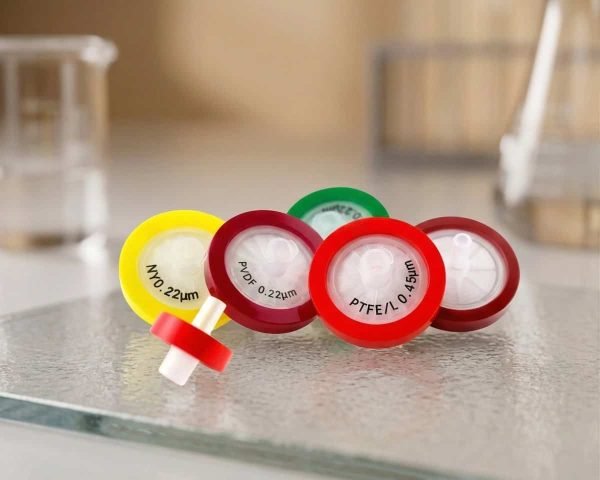

Filter diameter is the one decision most labs get wrong. People agonize over membrane material and pore size, then grab whatever filter happens to be on the bench. Six months later they’re losing 30% of every sample to hold-up or watching 25 mm filters clog halfway through the prep. Picking the right syringe filter size isn’t a finishing touch. It’s the difference between a method that runs reliably and one that drives you crazy.
The Short Answer
Match the filter diameter to your sample volume: 4 mm for under 1 mL, 13 mm for 1–10 mL, 25 mm for 10–100 mL, and 33 mm for 100–150 mL or whenever you need faster flow. Smaller filters waste less sample; larger filters push more volume faster. The right answer for your method depends on volume, viscosity, and how much sample loss you can afford.
Why Filter Diameter Matters So Much
The filter does three jobs at once: it removes the particles, it holds onto the sample, and it lets the rest pass through. Diameter controls all three. A 4 mm filter with a 0.65 cm² filtration area handles tiny volumes beautifully, but try to push 50 mL through it and you’ll be at the bench all day. Conversely, a 33 mm filter with a 4.5 cm² area pushes large volumes in seconds, but its 80–125 µL hold-up volume can quietly swallow an entire low-volume sample.
Per Vivek Joshi at EMD Millipore, writing on SelectScience, the filter diameter “balances filtration performance with the risk of extractables and analyte binding” and depends almost entirely on your sample volume. Pick too small and you’ll fight pressure and clogging. Pick too big and you’ll lose analyte to nonspecific binding and waste sample to hold-up volume.
The 4–13–25–33 mm Sizing Chart
Every reputable vendor publishes essentially the same table, and they’re right. Round numbers from the Sigma-Aldrich Millex syringe filter selection guide:
| Filter diameter | Best for sample volume | Typical hold-up volume | Typical filtration area | |—|—|—|—| | 4 mm | < 1 mL | ~10 µL | ~0.1 cm² | | 13 mm | 1 – 10 mL | < 25 µL | ~0.65 cm² | | 25 mm | 10 – 100 mL | < 100 µL | ~3.6 cm² | | 33 mm | 10 – 150 mL | ~80–125 µL | ~4.5 cm² |
The 25 mm and 33 mm filters overlap on purpose: 33 mm is a bit faster on the same volume but costs a bit more. If you’re processing buffers or media in volume, 33 mm saves real time. If you’re prepping a handful of HPLC vials, 25 mm is plenty.
Sigma-Aldrich’s product page for a representative 25 mm PTFE Millex filter confirms the 13 mm units are designed for 0.5–10 mL volumes. Anything bigger and you start pushing past the membrane’s capacity in real conditions.
Picking by Sample Volume
For most chromatography labs, sample volume is the answer. If you’re prepping a single HPLC vial from a stock solution, you’re filtering about 1 mL into the vial; a 13 mm filter is the right call. If you’re prepping a buffer or mobile phase you’ll use all week, you’re filtering 50 mL at a time; 25 mm is faster and you’re not losing meaningful sample to hold-up. If you’re filtering a 200 mL tissue-culture media batch, 33 mm lets you finish before lunch.
There’s a subtle point most buyers miss: hold-up volume matters most when your analyte is precious or expensive. A 33 mm filter might hold 125 µL, which is nothing when you’re filtering buffers but a real percentage of a 500 µL protein sample. My guide to choosing the right syringe filter walks through the membrane and pore-size decisions; for size, the volume-vs-diameter table above is the rule.
Picking by Viscosity and Particulate Load
Volume isn’t the only input. If your sample is viscous (serum, fermentation broth, or samples with significant protein content), a 13 mm filter will clog long before you’ve pushed your full volume through. Move up to 25 mm, or use a prefilter. Per the same SelectScience article, a multilayered syringe filter with a glass-fiber prefilter can let you push four to six times more volume through before the membrane fouls.
If your sample is relatively clean (a dissolved API in methanol, say), the size table applies cleanly. If it looks cloudy, suspect a 25 mm filter from the outset.
Picking by Your Analyte
Two more things nudge you toward one size over another. First, low-analyte-binding membranes lose less of your compound to nonspecific adsorption, but they do this more effectively at smaller diameters with less membrane surface area. So if you’re chasing trace analytes by LC-MS, a 13 mm filter in a low-binding membrane like hydrophilic PTFE or PVDF gives you the cleanest result with the least analyte loss. If you’re prepping a buffer that just needs to be clean, material matters less than flow rate.
Second, automation. If you’re running samples on an automated liquid handler, filter geometry matters. The Millex product page specifically calls out that the domed housing on automation-compatible Millex filters prevents “shingling” between units on the transport rack. A tiny detail that turns into a service call the first time you skip it.
Common Sizing Mistakes
I see the same three mistakes over and over. Filtering 30 mL through a 13 mm filter because the box was open. Filtering 500 µL through a 25 mm filter and losing a third of the sample. Filtering a viscous serum through a 25 mm filter with no prefilter and wondering why the run took an hour. Each of those is fixable with a one-line change.
If you want a deeper dive into membrane and pore-size selection alongside size, see my pore size comparison and Luer lock vs slip tip syringe filters. For the full prep-to-injection workflow, my HPLC sample prep guide covers the rest.
A Quick Decision Checklist
1. What’s your sample volume? Use the size table above. 2. Is the sample viscous or particulate-laden? Move up one size, or add a prefilter. 3. Is the sample precious or low-volume? Stay at 13 mm or smaller. 4. Is this for LC-MS trace work? 13 mm low-binding membrane. 5. Are you running an automated workflow? Check the housing geometry, not just the diameter.
Conclusion
The right syringe filter diameter is the one that matches your sample volume without wasting your sample or your time. 4 mm for under 1 mL, 13 mm for routine HPLC vial prep, 25 mm for the 10–100 mL range, and 33 mm when volume or viscosity demands flow. Pick by volume first, then adjust for viscosity, particulate load, and analyte binding. The decision gets easier the third time you make it, because you’ll start to feel which diameter suits your bench’s workload, and you’ll stop overthinking the rest. If you remember nothing else, remember that oversized filters waste sample and undersized filters waste time, and both are easy to fix once you know which one you’re doing.
Frequently Asked Questions
What size filter do I need for 1 mL of HPLC sample?
A 13 mm syringe filter is the standard answer for 1–10 mL volumes. Its hold-up volume is roughly 25 µL, which is a small, predictable fraction of your sample, and it fits directly onto a standard Luer-lock syringe.
Is a bigger filter always faster?
Yes, up to a point. A 33 mm filter has roughly seven times the filtration area of a 13 mm filter and pushes volume much faster, but its hold-up volume is also higher, and on small samples that hold-up is real sample loss. Match the diameter to the volume, not the other way around.
Do I need a prefilter with my syringe filter?
If your sample is cloudy, viscous, or particulate-laden, yes. A glass-fiber prefilter on top of the membrane can extend throughput by 4–6×. For clean dissolved samples, the prefilter usually isn’t worth the cost.
How does filter size affect analyte binding?
Larger membranes have more surface area, which means more potential for nonspecific binding of proteins, peptides, and oligonucleotides. If you’re filtering precious or low-concentration analytes, a smaller-diameter low-binding membrane (hydrophilic PTFE or PVDF) often gives better recovery than a larger filter with a generic membrane.
Can I reuse a syringe filter?
No, syringe filters are single-use. Reusing a filter compromises both the seal and the membrane, and it almost always costs you more in bad data than it saves in filters.