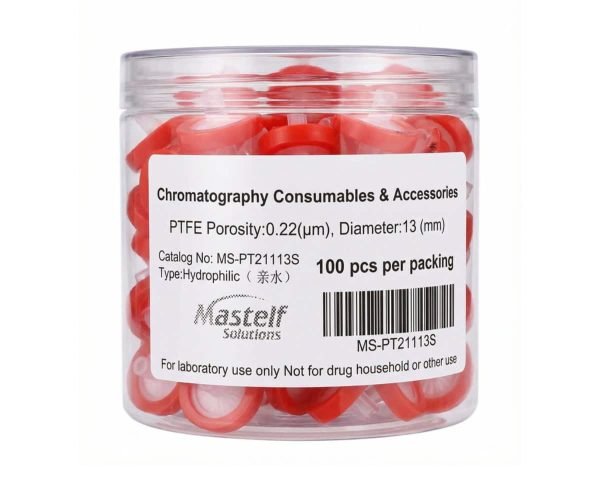

Filtering your samples before injection is the single cheapest insurance policy your HPLC system will ever have. A two-cent filter can protect a thousand-dollar column — if you pick the right pore size, membrane, and diameter. Here’s how to do that without overthinking it.
The Short Answer
For routine HPLC, use a 0.45 µm syringe filter; for UHPLC with sub-2 µm particles, drop to 0.2 µm. Pick the membrane to match your solvent — nylon for general aqueous/organic work, PTFE for aggressive organics, PVDF for proteins and LC-MS — and the diameter to match your volume: 4 mm under 1 mL, 13 mm for 1–10 mL, 25 mm for 10–100 mL. Discard the first 1–2 mL of filtrate to avoid extractables.
Read On
If you’ve ever watched a column die early or chased a ghost peak that “came from nowhere,” this guide is for you. I’ll cover pore size, diameter, membrane chemistry, extractables, and a workflow you can paste straight into your SOP.
Why You Should Filter HPLC Samples at All
Here’s the problem in one sentence: particulates in your sample clog columns, shorten column life, destabilize detector baselines, and wreck reproducibility.
Cytiva’s guide to chemical compatibility in HPLC samples puts it plainly — efficient HPLC analysis requires removing particulates that could interfere with detection, and filtration physically segregates insoluble particles to help prevent irregular chromatogram peaks. Dilution and centrifugation can handle some of this, but they don’t remove the particles; filtration does.
So the filter is doing two jobs at once: protecting your instrument (column frits, needle seats, detector flow cells) and cleaning your data (stable baseline, no stray peaks). Both matter, but the instrument protection alone usually pays for a year of filters after one saved column.
Start With the Right Pore Size
The pore size decision is actually the easiest one, because the rule is short:
- 0.45 µm is the standard for conventional HPLC. It removes the particulates that damage columns and injectors while keeping flow fast.
- 0.2 µm is recommended for UHPLC systems with sub-2 µm column packings, and whenever you need to remove bacteria for sterile work.
Sigma-Aldrich’s syringe filter guide for chromatography publishes exactly this split: 0.45 µm for HPLC, 0.2 µm for UPLC/UHPLC, and either for ion chromatography.
Don’t over-specify. Going smaller than you need just makes filtration slower and increases the risk of analyte adsorption onto the membrane. If you’re running standard 5 µm particle columns, 0.45 µm is the right call — and if you want the full reasoning on that trade-off, I covered it in detail in this comparison of 0.22 vs 0.45 µm syringe filters.
Pick the Diameter for Your Sample Volume
Filter diameter controls two things: how much sample can pass through before the membrane clogs, and how much dead volume the filter holds.
The sizing rule from the same Sigma-Aldrich guide is easy to remember:
- 4 mm — samples under 1 mL
- 13 mm — 1 to 10 mL
- 25–33 mm — 10 to 100 mL
Why bother? A filter that’s too small for your volume will clog mid-filtration, spike the backpressure, and either slow you down or force you to swap filters mid-sample. A filter that’s too large wastes sample in dead volume. If you’re filtering 10 mL of a mobile phase or sample, a 25 mm filter gives you the membrane area to finish the job in one push.
Choose the Membrane That Matches Your Solvent
This is where most of the real decisions live. The membrane has to survive your solvent and your sample without eating either one. Restek’s sample preparation FAQ includes a membrane selection guide that’s worth bookmarking; here’s the short version:
- Nylon — hydrophilic, broad compatibility with aqueous and organic solvents like acetonitrile and methanol. The workhorse for routine HPLC. But it degrades in strong acids (below about pH 3) and binds proteins, so keep it away from those.
- PTFE — the most chemically inert membrane. It shrugs off aggressive organics, strong acids, and bases. It’s hydrophobic, so aqueous samples need pre-wetting with an organic solvent first, or you’ll get an air-lock and no flow.
- PVDF — hydrophilic, low protein binding, and very low UV-absorbing extractables. That last point makes it the go-to for gradient methods with detection below 220 nm and for LC-MS work.
- PES — hydrophilic, very low protein binding, fastest flow. Great for aqueous buffers and cell culture media, but limited in organic solvents, so keep it under roughly 20% organic.
A quick decision matrix for the common cases: routine acetonitrile/water or methanol/water methods → nylon or PVDF; aggressive or high-polarity organics → PTFE; anything with proteins or peptides → PVDF or PES. If you want the full membrane-by-membrane breakdown, nylon vs PTFE vs PVDF vs PES is the deep dive.
Extractables: The Hidden Risk in Every Filter
Here’s the uncomfortable truth: the filter that’s protecting your column can be contaminating your sample. Filters release compounds called extractables — residual monomers, oligomers, plasticizers from the housing, manufacturing residues — when solvents interact with the membrane or housing materials.
MicroSolv’s extractables primer breaks down the sources: nylon can release monomers or oligomers in strong acids, PTFE may release trace processing aids, and polypropylene housings can contribute extractables when exposed to strong or halogenated solvents. The consequences show up in your chromatogram as ghost peaks, raised baselines, or altered quantitation — worst case, an extractable elutes at the same retention time as your analyte, and you can’t even tell.
Cytiva’s compatibility guide gives three practical defenses:
1. Choose a membrane with high compatibility with your mobile phase solvents — PTFE, PVDF, and regenerated cellulose are popular because they resist the common solvents. 2. Ask the manufacturer for extractables data, or run a blank-value test with your own mobile phase. 3. Discard the first 1–2 mL of filtrate — most extractables elute in the first drops.
That last habit is free, takes five seconds, and removes most of the risk. For sensitive trace work, look for HPLC-certified filters that carry a certificate of analysis, and prefer ultrasonically-welded polypropylene housings over glued ones — glue is a classic extractable source. Sorbtech’s chromatography syringe filter page is a good example of what certified filters advertise: HPLC-evaluated low-extractable content, sonically welded leak-free housings, and COAs on request.
A Simple, Reproducible Filtration Workflow
Here’s the protocol I’d put in any SOP. It takes two minutes per sample and it’s boring in the best way:
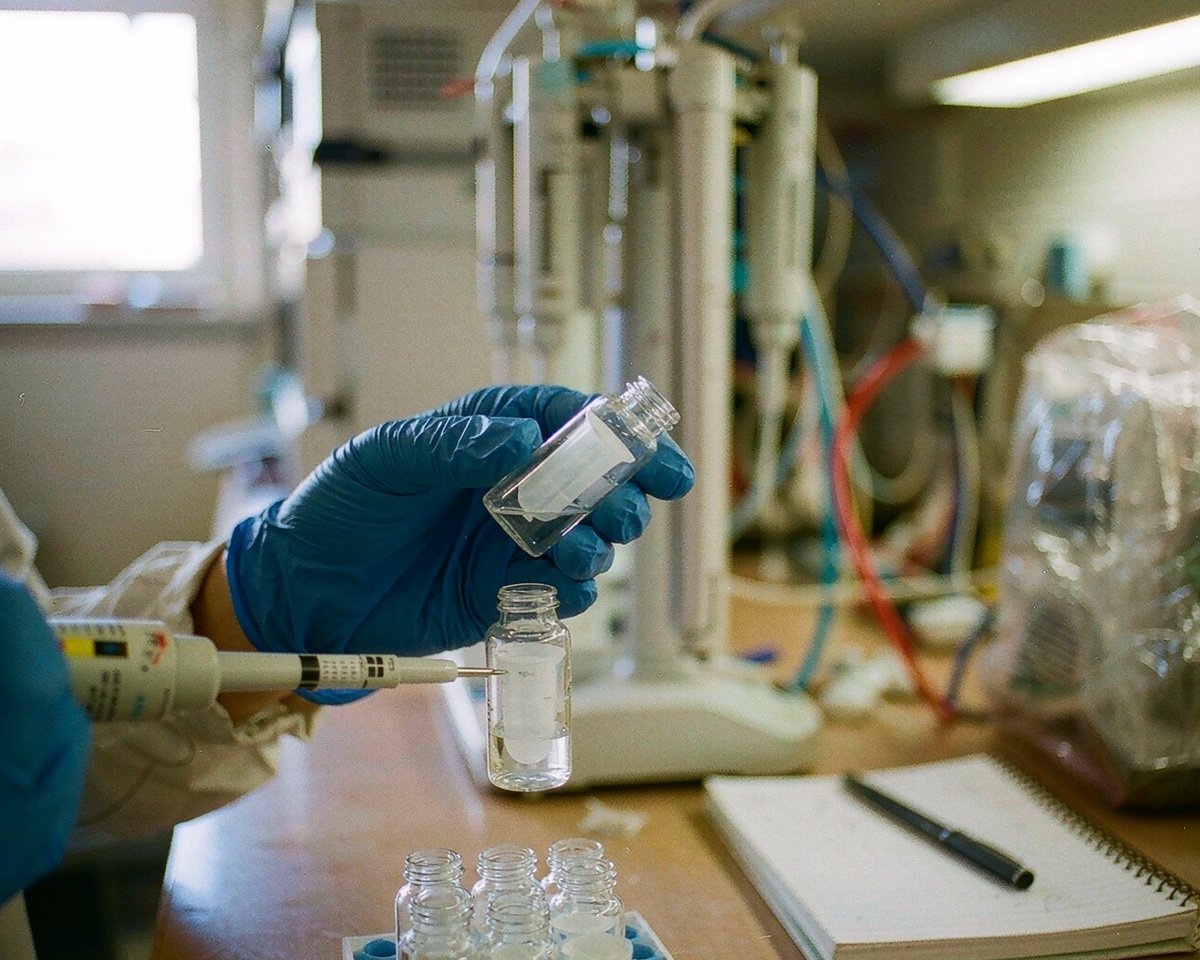
1. Draw your sample into a syringe of the right size for the volume (match the syringe material to your solvent — glass-barreled syringes for aggressive organics). 2. Attach the filter with a Luer-lock connection so it can’t pop off under pressure. 3. Discard the first 1–2 mL of filtrate into waste. This flushes any manufacturing residue off the membrane and out of the housing. 4. Push the rest through steadily — constant, moderate pressure. If backpressure spikes suddenly, the membrane is clogging; stop and swap in a fresh filter rather than forcing it. 5. Collect the filtrate directly into a clean autosampler vial and cap it immediately so nothing evaporates or picks up dust.
One more tip: don’t reuse syringe filters. They’re single-use for a reason — a reused filter is a contamination vector with a barcode on it.
Common Mistakes to Avoid
- Using 0.22 µm everywhere because “smaller is cleaner.” It’s slower and adsorbs more analyte; match the pore size to your column particles.
- PTFE on a purely aqueous sample without pre-wetting — instant air-lock, no flow, wasted time.
- Nylon with strong acids — the membrane degrades and the filtrate picks up nylon extractables.
- Skipping the first-drops discard — this is where most filter-introduced ghosts come from.
- Ignoring filter certification — for trace and LC-MS work, an uncertified filter is an unknown variable. Buy HPLC-certified and ask for the COA.
Conclusion
Syringe filters are a small consumable with an outsized impact on HPLC data quality and instrument longevity. The whole decision reduces to four questions: what pore size (0.45 µm for HPLC, 0.2 µm for UHPLC), what diameter (match it to your sample volume), what membrane (nylon for routine, PTFE for aggressive solvents, PVDF for proteins and LC-MS), and what extractables risk (discard the first drops, demand certified filters for trace work). Answer those and you’ll filter faster, protect your column, and stop chasing ghost peaks that were never your method’s fault.
If you’re still deciding between membrane types, this membrane comparison guide will settle it, and when you’re ready to buy, the complete syringe filter buyer’s guide walks through specs, certifications, and supplier questions so you don’t overpay or under-spec.
Frequently Asked Questions
What size syringe filter should I use for HPLC?
For conventional HPLC, use a 0.45 µm filter. For UHPLC with sub-2 µm particles, use 0.2 µm. The filter diameter should match sample volume: 4 mm for under 1 mL, 13 mm for 1–10 mL, and 25 mm for 10–100 mL.
Can I use a syringe filter for organic solvents?
Yes, but pick the membrane by solvent. PTFE handles nearly all organic solvents, acids, and bases. Nylon works with common HPLC solvents like acetonitrile and methanol but degrades in strong acids. PES is limited to mostly aqueous solutions.
Why do I get ghost peaks after filtering?
Ghost peaks usually come from extractables — compounds leaching from the filter membrane or housing into the sample. Discard the first 1–2 mL of filtrate, use a membrane compatible with your solvent, and choose HPLC-certified filters for trace analysis.
What is the difference between 0.22 and 0.45 micron syringe filters?
0.45 µm is the standard for HPLC, removing particulates that damage columns while keeping flow fast. 0.22 µm is used for UHPLC with sub-2 µm packings and for sterile filtration, but it filters slower and adsorbs more analyte, so don’t over-spec.
Can syringe filters be reused?
No. Syringe filters are single-use devices. Reusing one risks cross-contamination from trapped particles and extractables from the previous sample, which can show up as extra peaks or baseline noise in your next run.