
Pick the wrong syringe filter membrane and you might never see the problem coming. It shows up later as a ghost peak, a drifting baseline, or a column that clogs three months early. The good news? Matching the membrane to your sample takes about a minute once you know the rules.
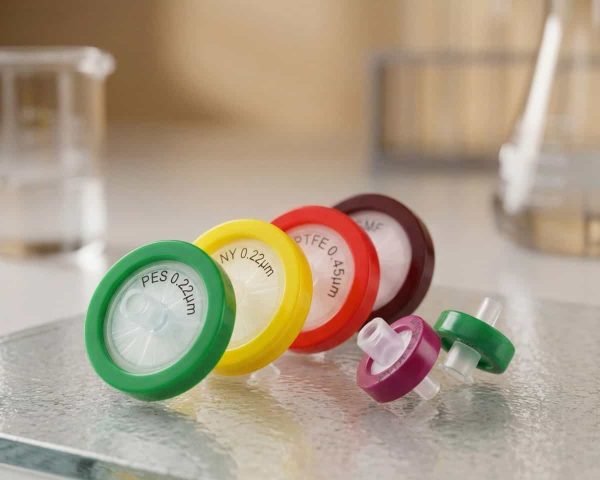
For most routine HPLC work, Nylon handles the widest range of aqueous and organic samples at the lowest cost. Reach for PTFE when you’re filtering aggressive solvents or strong acids, PVDF when you need low protein binding or a quiet UV baseline below 220 nm, and PES when your sample is biological — proteins, buffers, or tissue culture media. Match the membrane to your solvent and your analyte, not to habit.
In this guide I’ll walk you through all four membranes, show you a quick decision table you can bookmark, and flag the two mistakes that quietly wreck chromatograms — even when your filter “looks” fine.
Why the Membrane Matters More Than You Think
A syringe filter isn’t just a tiny sieve. It’s a polymer disc that sits directly in your sample’s path before injection. That means it can do three things to your data if you choose poorly.
First, it can bind your analyte. Some membranes grab proteins, peptides, or polar compounds out of solution, which quietly lowers your recovery. Second, it can leach extractables into your filtrate. Those leached compounds show up as extra peaks or a noisy baseline, especially at low UV wavelengths. Third, it can simply fail to flow. A hydrophobic membrane hit with a purely aqueous sample can air-lock and stop you mid-filter.
Thermo Fisher’s syringe filter selection guidance is built around exactly these three variables: membrane compatibility with your sample type, membrane compatibility with your solvent, and filter size for your volume. Their membrane guide splits filters by whether they’re hydrophilic or hydrophobic, and by what they can filter without degrading.
Restek makes the same point more bluntly: particulates in an extract can plug columns, injectors, detectors, and small-diameter tubing. A clean extract from a well-chosen syringe filter extends the life of expensive columns and parts.
Here’s the mental model I use: hydrophilic membranes pass water easily; hydrophobic membranes pass solvents but fight water. Every choice below flows from that one idea.
The Four Membranes, Side by Side
There’s no single “universal” membrane. Each one trades off chemical resistance, protein binding, flow rate, and extractables a little differently. Here’s the quick comparison, then the detail on each.
| Membrane | Hydrophilic? | Best for | Avoid |
|---|---|---|---|
| Nylon | Yes | General HPLC, aqueous + organic mixes | Strong acids (< pH 3), protein-heavy samples |
| PTFE | No (hydrophobic) | Aggressive organics, strong acids/bases | Aqueous samples without pre-wetting |
| PVDF | Yes (low-binding) | Protein samples, low-UV methods, mixed solvents | Strong oxidizers, some strong bases |
| PES | Yes | Proteins, buffers, tissue culture media | Harsh organics, strong solvents |
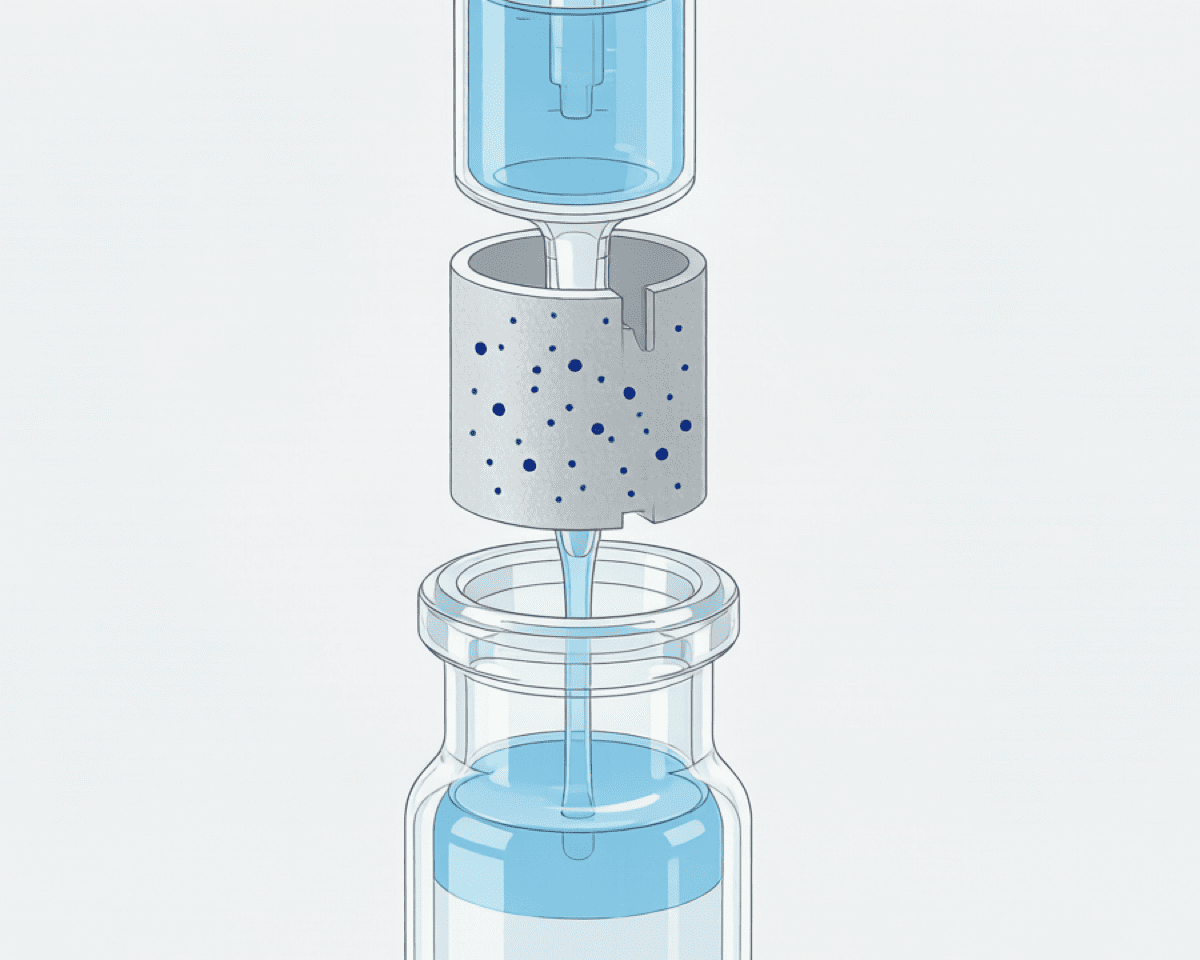
Nylon: The Workhorse
Nylon (polyamide) is the most common membrane in analytical labs for a reason. It’s hydrophilic, so it handles both aqueous and organic solvents, and it flows fast with very low extractables.
I reach for Nylon for everyday HPLC sample prep — methanol, acetonitrile, and water-based mobile phases. Restek’s membrane selection table lists Nylon for bases, HPLC solvents, alcohols, and aromatic hydrocarbons.
But Nylon has a hard limit: it degrades below about pH 3. Run a 0.1N hydrochloric acid dissolution sample through a Nylon filter and the membrane can start to break down, releasing polyamide extractables into your filtrate. It also binds proteins to a moderate degree, so it’s the wrong call for peptide or protein assays.
PTFE: The Chemical Tank
PTFE (polytetrafluoroethylene, Teflon) is the most chemically inert membrane you can buy. It shrugs off nearly every solvent, including concentrated acids, strong bases, and aggressive organics.
The catch is that PTFE is hydrophobic. It repels water, so a purely aqueous sample won’t pass through unless you pre-wet the membrane with a small amount of alcohol first. Phenomenex explains it well: a hydrophobic PTFE membrane is ideal for organic-based, highly acidic, or basic samples — and can be made hydrophilic by wetting with alcohol and flushing with deionized water.
Use PTFE when your sample is “everything-proof” nasty. Heavy metal acid digests, chlorinated solvents, pure organic mobile phases — that’s PTFE territory.
PVDF: The Low-Binding All-Rounder
PVDF (polyvinylidene fluoride) is my favorite “safe default” when I don’t want to think too hard. It binds very little protein, resists a broad range of solvents, and — critically — throws off almost no UV-absorbing extractables.
That last point matters a lot. If you run gradient methods with detection below 220 nm, extractables from a Nylon filter can show up as baseline artifacts. PVDF’s cleaner profile is why many pharma QC labs prefer PVDF filters for high protein recovery and for samples where a quiet baseline is non-negotiable.
PVDF handles aqueous and organic samples, DMSO, DMF, and THF. Skip it for strong oxidizers and some concentrated bases.
PES: The Biologist’s Choice
PES (polyethersulfone) is built for biology. It has the lowest protein binding of the common membranes and the highest flow rates for aqueous media.
If your sample contains proteins, nucleic acids, buffers, or cell culture media, PES is the answer. Phenomenex notes that PES membranes filter critical biological samples with ultra-low protein binding. Thermo Fisher lists PES for ion chromatography, tissue culture, proteins, and nucleic acids.
The trade-off: PES doesn’t love harsh organic solvents. Keep it in the aqueous and mild-organic world.
How to Pick in 30 Seconds
Here’s the decision shortcut I actually use, distilled into a few rules.
- Sample is mostly water or buffer? Start with Nylon or PES.
- Sample has proteins or peptides? Go PES or PVDF — you need low binding.
- Sample is a strong acid, base, or aggressive solvent? PTFE, no question.
- Sample is a mix of aqueous and organic? PVDF or Nylon.
- Running LC-MS or low-UV methods? PVDF, for the cleanest baseline.
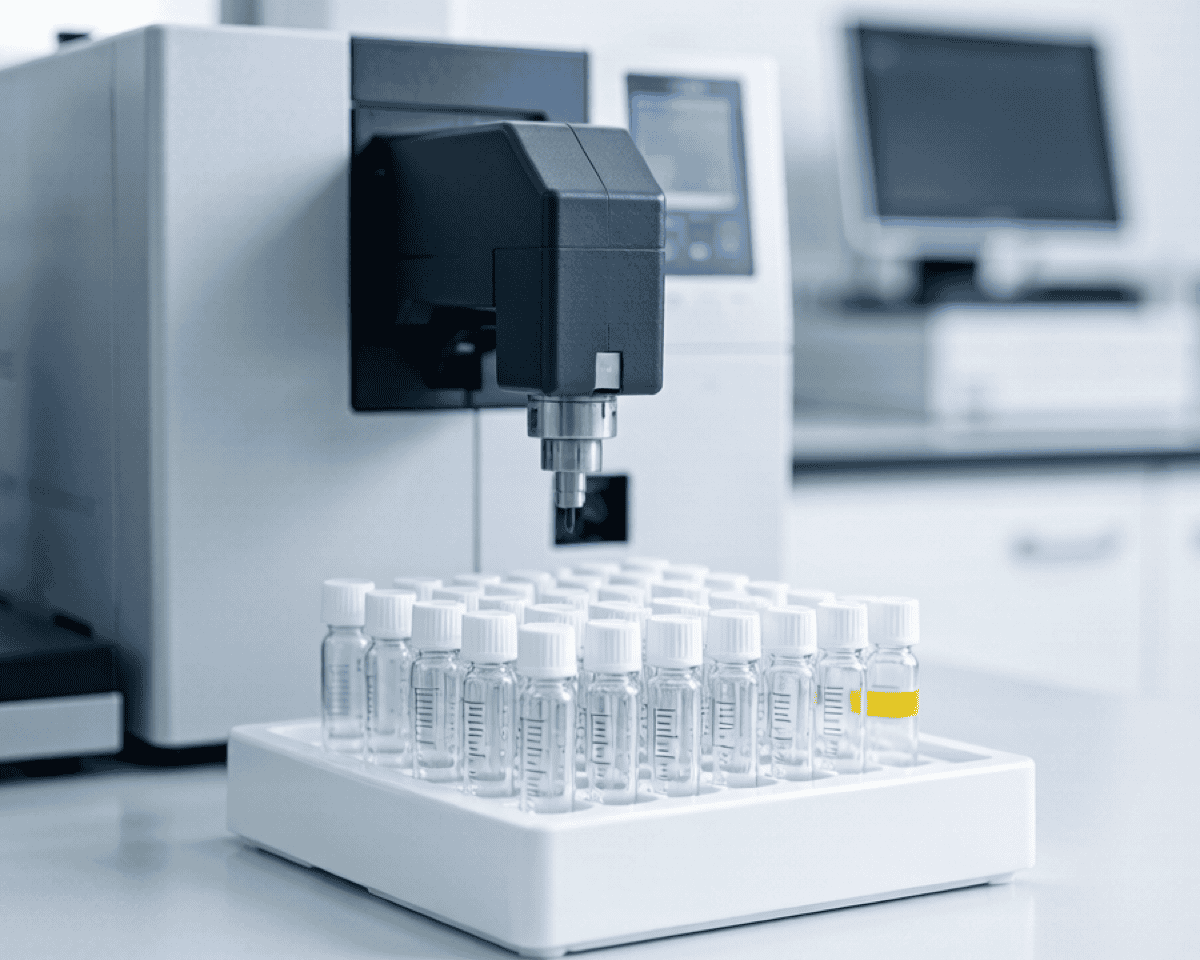
Pore size is a separate decision. As a rule, 0.45 µm handles routine particulate removal for HPLC, while 0.22 µm is for sterilizing-grade filtration and finer particles. If you want the full breakdown, I covered it in my guide to syringe filter pore sizes.
The Two Mistakes That Quietly Ruin Data
Even experienced chemists make these two. Both are invisible until your chromatogram betrays you.
Mistake one: using PTFE on a water sample without pre-wetting. The membrane air-locks, pressure builds, and you either blow the filter off the syringe or give up. If you must use PTFE for an aqueous sample, pre-wet with a little methanol, then flush with water. Better yet, choose a hydrophilic membrane from the start.
Mistake two: ignoring protein binding. If you filter a protein solution through Nylon, the membrane can adsorb a chunk of your analyte before it ever reaches the column. Your “recovery” drops and you’ll never see the loss directly. For any biological sample, default to PES or PVDF.
The theme running through both mistakes is the same: the membrane and the sample have to agree chemically. Get that right and a syringe filter is the cheapest insurance policy in your lab. Get it wrong and it’s a silent source of bad data.
If you want a deeper look at how filters fit into your whole prep workflow, I’ve written a guide to choosing a syringe filter that covers diameter, housing, and pore size in more detail.
Conclusion
Choosing between Nylon, PTFE, PVDF, and PES isn’t about finding the “best” filter — it’s about finding the filter that agrees with your sample. Nylon is your everyday workhorse for routine aqueous and organic HPLC prep. PTFE is the chemical tank you need for aggressive solvents and strong acids, as long as you pre-wet it for water. PVDF is the low-binding, low-extractable all-rounder that keeps baselines quiet below 220 nm. And PES is the biologist’s default for proteins, buffers, and media.
The cost of picking wrong is usually silent: a few percent of lost analyte, a ghost peak you chase for an afternoon, or a column that dies early. The cost of picking right is about thirty seconds of thought. Match the membrane to your solvent and your analyte, keep the two classic mistakes in mind, and your filters will quietly do their job. If you’re ready to move past membrane selection, check out my guide to choosing the right pore size next — it’s the natural follow-up to this one.
Frequently Asked Questions
What is the difference between nylon and PTFE syringe filters?
Nylon is hydrophilic, so it filters both aqueous and organic samples easily, while PTFE is hydrophobic and repels water unless pre-wetted. PTFE offers far greater chemical resistance to strong acids, bases, and aggressive solvents, so it’s the choice for harsh chemistry.
Can I use a PTFE filter for aqueous samples?
Only with pre-wetting. Because PTFE is hydrophobic, a purely aqueous sample will air-lock and refuse to flow. Wet the membrane with a small amount of methanol or ethanol first, then flush with water, or simply choose a hydrophilic membrane instead.
Which syringe filter is best for protein samples?
PES is the best choice for most protein solutions because it has the lowest protein binding and the fastest aqueous flow. PVDF is a strong alternative when you also need broader solvent compatibility, and both beat Nylon, which binds proteins to a moderate degree.
Which membrane has the lowest UV extractables?
PVDF is known for very low UV-absorbing extractables, which makes it ideal for gradient methods with detection below 220 nm. Nylon and other membranes can release more extractables that appear as baseline noise or extra peaks at low wavelengths.
Do I need 0.22 or 0.45 micron for HPLC?
For routine HPLC particulate removal, 0.45 µm is usually sufficient and flows faster. Use 0.22 µm when you need sterilizing-grade filtration or are working with finer particles and sub-3 µm column packings.