
Every lab has a bottle of acid, buffer, or solvent that gets measured out twenty times a day. Every one of those measurements is a chance for splash, drift, and inaccuracy. The bottle-top dispenser exists to delete that risk, and it does a better job than most people expect from something that screws onto a bottle cap.
Answer: A bottle-top dispenser is a piston metering device that mounts directly on a reagent bottle and dispenses set volumes (typically 0.5-100 mL) through a valve and discharge tube. You need one when you repeatedly aliquot the same reagent, when accuracy matters more than “about 50 mL,” or when the reagent is hazardous enough that open pouring is a bad idea.
What It Actually Is
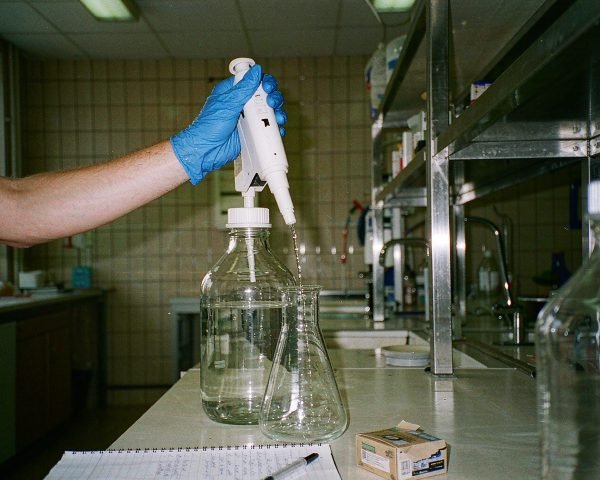
Three parts do the work: a piston and cylinder that meter the volume, a two-valve system that draws from the bottle on the upstroke and dispenses on the downstroke, and an adjustable volume dial. Mount the unit on the bottle neck (adapter sets cover common threads like GL32, GL38, S40), prime until the air is gone, and each smooth stroke delivers the set volume.
Compared with a graduated cylinder, you get:
- No pouring, no glug, no splash
- Consistent volume stroke after stroke, typically within ±0.5-1% at the top of the range
- One-handed operation with the bottle staying closed
- Direct dispensing into flasks, beakers, or autosampler vial trays
For a feel for the accuracy class: Conduct Science’s DispensMate overview lists typical specs around ±0.5% at mid-range settings, which a cylinder and a steady hand will not match at speed.
When You Need One
The trigger is repetition plus risk. If any of these describe your bench, a dispenser pays for itself quickly:
- You aliquot the same reagent (mobile phase buffer, extraction solvent, acid, base, media) more than a handful of times daily
- The reagent is corrosive, volatile, or toxic, and every open pour is exposure
- Volumetric accuracy matters: dilutions, media preparation, standards
- Multiple people use the same reagent and volumes drift between them
Media prep is the classic case. Ten liters of buffer a week, aliquoted from a stock bottle, is exactly the workflow where cylinders get sloppy and dispensers stay honest.
When You Don’t
Honest limits, because the dispenser isn’t always the answer:
- One-off measurements. Setup, priming, and cleaning cost more than a cylinder for occasional use.
- Suspensions and crystallizing solutions. Particles jam valves; the device is for true liquids.
- Very small volumes. Below ~1 mL, piston burettes and pipettes are the right tools.
- Incompatible chemistry. Aggressive media demand the right wetted materials. BRAND’s Dispensette SOP covers the standard testing regime, and manufacturers publish compatibility lists for a reason: HF, for example, needs all-polymer wetted paths.
Also know the two classic prohibitions from the safety side: no explosive liquids, and beware vapor pressure. One dispenser guide’s operating limits warns to slow down on volatile solvents because fast strokes can make them boil inside the cylinder.
Accuracy: Getting the Stated Numbers
The spec sheet assumes three things most benches skip.
- Primed means no bubbles. Air in the cylinder compresses, so the delivered volume varies stroke to stroke. Prime slowly, several full strokes, until the discharge runs bubble-free. I once chased a 3% volume error through an entire media batch before realizing someone had swapped in a half-primed dispenser after lunch. The reagent was fine; the stroke count wasn’t.
- Smooth, full strokes. Jamming the piston to the stop, or stopping short, changes the volume. Consistent speed, complete travel, every time.
- Verified calibration. Dispensers drift like any volumetric instrument. The standard method is gravimetric: dispense into a weighed vessel, convert mass to volume, compare to the setpoint. BRAND’s testing SOP recommends checks every 3-12 months, with gravimetric testing at 10%, 50%, and 100% of range, following ISO 8655. Hawach’s calibration walkthrough describes the six-replicate weighing procedure in practical detail.
Log the check if your quality system tracks liquid handling. Two minutes with a balance beats a questionnaire from an auditor.
Volume range is the other quiet decision. A 0.5-5 mL unit set at 1 mL sits near the top of its range where accuracy is best; the same 1 mL drawn from a 10-100 mL dispenser sits at the bottom where relative error is worst. Buy the range that puts your daily aliquots in the upper half.
Care and Feeding
Dispensers die from neglect, not use:
- Rinse after use with a compatible solvent, then deionized water, especially after salts or buffers. Crystals in the valve seat are the number-one repair cause.
- Store with the discharge tube capped or the valve in the closed position to keep dust out.
- Replace wear parts (piston seals, valves, discharge tubes) on schedule; they’re consumables with part numbers, not mysteries.
- Match the adapter to the bottle. A wobbly mount on the wrong thread is a spill waiting for a schedule. Our guides to GL45 media bottles and bottle thread sizing help you match dispensers to the glass you already own.
- Respect the media change. When switching to an incompatible reagent, disassemble and clean, don’t just purge.
For the bottles themselves, our reagent and media bottles guide covers material and closure choices that pair well with dispensing.
Safety Notes Worth Keeping Visible
The dispenser’s best safety feature is also its simplest: the reagent stays in the bottle. Every stroke that used to be an open pour into a graduated cylinder is now a closed transfer, and with corrosives that difference is the whole argument.
Still, respect the failure modes. A loose adapter on the wrong thread will walk loose mid-stroke. A discharge tube pointed at your face during priming is a classic rookie moment. And volatile solvents dispensed fast can spit when they flash; slow strokes keep the liquid where it belongs.
Choosing One: The Short Checklist
1. Volume range matched to your most common aliquot (don’t buy 0.5-100 mL if everything is 10 mL) 2. Wetted materials compatible with your nastiest reagent 3. Adapter set covering your bottle threads 4. Recirculation valve if you want zero-loss priming back into the bottle 5. replaceable valve and seal kits in stock before you need them
Conclusion
A bottle-top dispenser is the right tool when the same reagent meets the same volume often enough that accuracy and safety compound. It removes pouring from the equation, holds a repeatable volume across operators, and turns a daily exposure risk into a closed system. Buy the range you actually use, prime properly, calibrate gravimetrically on a schedule, and rinse after use. For the glass it mounts on, start with our GL45 media bottle guide, and for the bigger picture of reagent storage, our reagent and media bottles guide covers material choices end to end. A calibrated dispenser is one of the cheapest accuracy upgrades a wet bench can buy.
Frequently Asked Questions
How accurate is a bottle-top dispenser?
Quality units dispense within roughly ±0.5-1% at the upper part of their range, considerably better than a graduated cylinder in daily use. Accuracy depends on priming, smooth strokes, and periodic gravimetric calibration per ISO 8655.
Can I dispense organic solvents with it?
Yes, if the wetted materials (glass, PTFE, PFA, specific polymers) are rated for the solvent. Use the solvent-rated models for aggressive or volatile organics, and dispense volatile solvents slowly to prevent boiling in the cylinder.
How often should I calibrate it?
Every 3-12 months for general use, more often for heavy use or aggressive media. A gravimetric check with an analytical balance at 10%, 50%, and 100% of range takes minutes and documents accuracy.
Why is my dispenser delivering inconsistent volumes?
Air bubbles in the cylinder are the usual culprit: re-prime until the discharge is bubble-free. Crystals in the valve seat, a worn piston seal, or strokes that don’t travel fully are the next suspects.