
I’ve lost count of how many cap orders started with the sentence “I need a cap for my bottle, it’s about an inch across.” That’s how bottles end up in a drawer with three caps that almost fit and none that seal. The two numbers on a bottle finish look cryptic, but they’re the easiest sizing system you’ll deal with all year once someone shows you the trick.
The Short Answer
24-400 = 24 mm neck with a 400-style GPI thread, common on 100 mL to 1 L lab bottles. 33-400 = the same thread style on a 33 mm neck, on larger round bottles like 950 mL Boston rounds. Match both numbers and the cap seals. So what do those digits actually measure?
How GPI Neck Finish Codes Actually Work
The code comes from the Glass Packaging Institute, the trade group that standardized glass container finishes back when American glass plants needed a common language. SPI, the plastics equivalent, maintains matching codes for plastic containers, so a 24-400 HDPE bottle and a 24-400 glass bottle accept the same cap.
The first number is the outer diameter across the bottle’s threads, in millimeters. Not the bore, not the cap. It’s the “T dimension” you’d see on a supplier drawing, measured over the crest of the thread.
The second number is the thread style, and this is where people get burned. A 400 finish has a single thread turn with a short height, the workhorse for general-purpose bottles. A 410 adds half a turn, a 415 goes to two turns, and each needs its own matching cap even when the diameter is identical. So a 24-400 cap will spin loosely on a 24-410 neck without ever seating down on the sealing ring.
Every glass plant forms the finish in the mold first, and it never gets reworked after that. Change the finish and you’re buying new tooling, which is why suppliers take the code seriously even when buyers don’t. The neck finish compatibility guide from GlassRock walks through the full T, E, I, and H dimension set if you ever need to spec a custom bottle.
Where 24-400 and 33-400 Show Up in the Lab
The 24-400 finish is the default on small and mid-size reagent and media bottles. Think 100 mL, 250 mL, 500 mL, and 1 L round bottles with a narrow mouth, the ones that live next to your balance and your solvent shelf. Wheaton-style Boston rounds in the 4 to 16 oz range commonly carry it too, and DWK’s own product listings show the GPI code printed right in the spec table, like this 16 oz Boston round specified as GPI 28-400 one size up.
The 33-400 finish kicks in where the neck needs to get wider. Qorpak’s 32 oz (950 mL) Boston rounds, popular as solvent and sample storage bottles, use it, as you can see on this 33-400 amber glass Boston round listing. Once you get past that size, the industry usually jumps to 38 mm finishes: Nalgene’s media bottles and 4 L jugs list 38-430 closures across their range, which you can check on Thermo Fisher’s product spec tables.
Now the warning part. GL45 is a completely different standard, a DIN thread from German lab glassmakers, and it happens to measure about 45 mm across the thread with a fine pitch and a shallower profile. Plenty of 100 to 1,000 mL media bottles use it, which is exactly why confusion happens. If you’ve got a Duran-style bottle, check our GL45 media bottles guide and our breakdown of GL25 vs GL32 vs GL45 threads before you order anything. DIN threads and GPI threads do not interchange, full stop.
Cap Compatibility: The Rules That Actually Matter
The rule is simple and unforgiving: the cap must match the finish exactly, both numbers. 24-400 cap on a 24-400 bottle, nothing else. There’s no “close enough” in thread sizing, only caps that seal and caps that leak.
I learned this the expensive way. A colleague once forced a 33-400 cap onto a GL45 media bottle because the diameters looked close and the threads “caught” for the first turn. Two hard twists later the cap jammed cross-threaded and the glass neck cracked at the sealing ring. One bottle gone, and a week of waiting on a replacement, all to save a ten-second spec check. Threads that engage for one turn and then fight you are telling you the pitch is wrong, not that you need more muscle.
Liners are the second half of the decision, and they matter more than the cap color ever will. A lined phenolic cap is the classic pick for solvents, while polypropylene caps with a molded seal ring handle aqueous media and autoclaving. If your bottle holds anything aggressive, read our guide on cap liner materials and solvent compatibility before you check out. The wrong liner swells, leaches, or glues itself to the neck, and no thread code can save you from that.
One more trap worth naming: a vented cap and a solid cap can share the exact same 33-400 finish code, yet they behave completely differently with volatile contents. The thread code tells you nothing about venting, so read the full spec line, not just the numbers.
How to Measure an Unmarked Neck
Older bottles, hand-me-downs, and anything that survived a dishwasher rarely keeps a legible finish code. Calipers fix that in a minute.
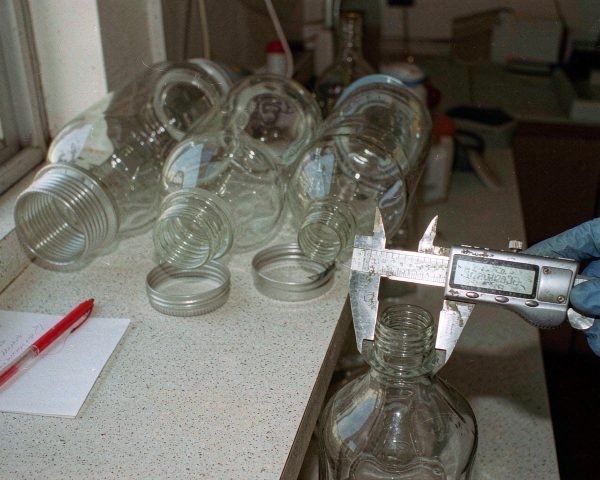
Measure straight across the outer threads, crest to crest, with the jaws seated in the thread valleys on both sides. A true 24-400 finish reads about 24.8 mm over the threads at the upper tolerance, and a 33-400 lands around 33.2 mm. Don’t measure the bore or the smooth neck below the threads, because both will read smaller and send you shopping for a cap that doesn’t exist.
While the calipers are out, count the thread turns. One full turn of thread wraps to roughly a 400-style finish, one and a half suggests 410, and two turns points to 415. Diameter plus turns gets you to a code you can order against, even with no label in sight.
No calipers in the drawer? A strip of paper wrapped around the outer threads, marked and measured flat against a ruler, gets you within a millimeter. That’s usually enough to tell a 24 from a 28 or a 33, but confirm with calipers before you order a case.
Buying Tips That Save Rework
Buy caps and bottles as a matched set whenever you can. Suppliers pair them at the factory, so the finish, liner, and torque all arrive as one tested system. Mixing brands works when the codes match, but it shifts the risk of a bad seal onto your bench.
If you must order caps separately, order one first and test it. Spin it on, check that it seats on the sealing ring within a turn and a half, then run whatever leak check your work demands. Only then buy the case. That single test cap costs almost nothing compared with a case of caps that bottom out or spin forever.
Stock one liner type per cap size and label the bins. Every lab I’ve visited that kept five liner variants loose in one drawer also had a story about the wrong one going onto a solvent bottle. Simple beats clever on a shelf.
Conclusion
The 24-400 vs 33-400 question boils down to two numbers doing two different jobs: diameter and thread style. Read the first number off the outer threads in millimeters, read the second off the thread pattern, and buy caps that repeat both exactly. Measure with calipers when the bottle is unmarked, match liners to your contents, and never assume a cap that “almost” threads on is close enough, because it isn’t. Get in the habit of checking the finish code before ordering and you’ll never again fund a drawer of orphan caps. If you’re sizing up bottles for media prep or solvent storage, our complete guide to reagent and media bottles pairs well with this one.
Frequently Asked Questions
Will a 33-400 cap fit a GL45 bottle?
No. GL45 is a DIN-standard thread with a different pitch, depth, and profile than the GPI 400 series. The two systems look similar in size but they do not interchange, and forcing one onto the other can crack a glass neck.
Are 24-400 and 24-410 caps interchangeable?
No. Both fit 24 mm necks, but the 410 finish is taller with more thread turns. A 400 cap won’t seat on a 410 bottle and a 410 cap will bottom out or spin on a 400 bottle.
What does the 400 in 24-400 actually mean?
It’s the GPI thread style code, not a measurement. A 400 finish has a single thread turn and a short height, and it’s the most common general-purpose thread on lab and packaging bottles.
How do I measure a bottle neck without a label?
Use digital calipers across the outermost threads, crest to crest. The reading in millimeters is the first number of the finish code, then count the thread turns to identify the style.
Do 24-400 caps come with different liners?
Yes, and the liner choice matters as much as the fit. PTFE-faced and PE foam liners suit solvents, while polypropylene caps with molded seals handle aqueous and autoclave work.