
Somewhere in your lab right now, a small plastic or glass part is quietly deciding where your liquid goes. Stopcocks and Luer valves are the traffic cops of fluid handling, and most of us use them daily without thinking twice. This post covers what each one is, where it earns its keep, and how to pick one that won’t leak at the worst moment.
The Short Answer
Both control fluid flow in lab tubing setups. A stopcock is a simple on/off or diverter tap (straight, Luer, 1- to 3-way), while a Luer valve connects through Luer fittings to syringes, manifolds, and chromatography columns.
Pick the wrong one and you get weeping fittings, lost vacuum, or a plug that refuses to budge halfway through a titration. Keep reading and you’ll know which one to grab.
What Exactly Is a Stopcock?
A stopcock is a valve built into glassware or tubing that lets you start, stop, or redirect flow by rotating a plug. The classic version is the ground-glass stopcock fused into a burette or a separatory funnel. The plug has a bored hole through it, and turning it either aligns that hole with the barrel (flow) or turns it sideways (no flow).
Glass plugs are the traditional choice, and they have one annoying quirk: they need stopcock grease to seal properly and to keep from seizing in the barrel. Fisher Scientific’s stopcock guide points out that glass-on-glass stopcocks require lubrication, while glass bodies with plastic (usually PTFE) plugs seal without grease. Swapping a ground-glass plug for a PTFE one eliminated an entire category of bench misery for organic chemists.
Suppliers like DWK Life Sciences still make a huge range of these in borosilicate glass with PTFE keys, from simple one-way taps to high-vacuum valve designs.
One-Way, Two-Way, Three-Way: What the Configurations Mean
The naming is refreshingly literal.
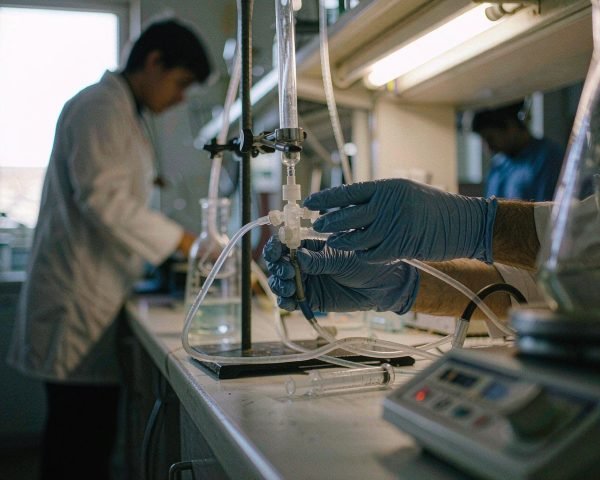
A one-way stopcock is a simple on/off tap on a single line. Two-way means the plug bore lets you choose between two flow paths, like switching from one solvent line to another. A three-way stopcock, usually arranged in a T shape, connects any two of its three arms, or all three at once. The Thermo Scientific Nalgene three-way stopcock, for example, has tubulated outlets that accept 1/4″ through 5/16″ tubing, and it’s the kind of part that quietly holds a whole fluid-transfer rig together.
What About Luer Valves?
A Luer valve (you’ll also see “Luer stopcock”) does the same job as a stopcock, but it connects through Luer fittings instead of being built into glassware. One end is typically a male Luer lock or slip tip, and the other is a female Luer. That means you can push it onto a syringe, snap it into a tubing line, or thread it onto a filter holder in seconds.
The Luer lock matters here. A slip connection is faster but can pop off under pressure, while a locking taper stays put. We’ve covered that tradeoff in detail in our Luer lock vs slip tip syringe filter guide, and the same logic applies to valves.
Materials lean plastic for these. Polypropylene and polycarbonate bodies are common, and PVDF shows up when chemical resistance and high purity matter. Cole-Parmer’s Luer stopcock line, for instance, offers Kynar PVDF bodies with full 360-degree rotating handles and male lock or slip Luer options on each port, with tapers built to ISO 594 standards so they mate reliably with other Luer components.
Everyday Lab Uses
So where do these things actually show up? Pretty much anywhere fluid moves on purpose.
Titration. The stopcock at the base of a burette is the whole game. You crack it open to approach the endpoint, then feather it closed drop by drop. Anyone who’s overshot an endpoint by 2 mL because a sticky plug lurched open knows how much plug quality matters here.
Vacuum manifolds for filtration. If you filter multiple samples at once, each port gets its own valve so you can open and close lines independently. A dedicated filtration manifold turns that job from a juggling act into a routine.
Flash chromatography flow control. A stopcock above the column bed lets you stop flow to load a sample, then release it cleanly. It’s a small part, but it protects your resolution.
Sample line switching. Three-way Luer valves let you alternate a syringe between a sample reservoir and a waste line without disconnecting anything. Sterile setups love this because every disconnection is a contamination risk.
Syringe flow control. Put a one-way Luer stopcock between a syringe and a needle, and you can fill, hold, and dispense with one hand. It’s the same trick IV lines use.
One underrated use: purging. A three-way valve on a gas line lets you vent pressure before you break a connection. Your ears and your glassware will both appreciate it.
Materials Matter
The body is only half the story. The plug material decides whether your stopcock survives contact with your solvents.
PTFE plugs are the modern default. PTFE is self-lubricating, chemically inert to nearly everything you’ll throw at it, and it seals without grease. DWK’s DURAN single-way stopcocks pair borosilicate 3.3 glass bodies with PTFE valve plugs exactly for this grease-free operation. One caveat: PTFE expands and contracts with temperature far more than glass, so for greaseless applications with big temperature swings, a spindle valve design holds tightness better.
Glass plugs still have a place in high-vacuum work, where a precision ground and lapped plug seals beautifully, provided you keep it greased.
For plastic Luer valves, polypropylene handles aqueous solutions and most acids and bases happily. Polycarbonate is transparent, which is great for spotting bubbles, but it has a known weakness with some organic solvents. PVDF is the premium pick for aggressive solvents and high-purity work. Match the material to your chemistry the same way you’d match a cap liner to a solvent, because the failure mode is identical.
How to Choose the Right One
Run through four questions before you order.
What connection does it need? Built into glassware means a glass or PTFE-plug stopcock sized to the joint. Tubing and syringes mean Luer fittings, and in anything with pressure behind it, go Luer lock over slip.
How much flow do you need? Plug bore drives flow rate. A 2 mm bore is fine for a burette; a 4 mm bore moves serious volume in a manifold. Bigger bore also means coarser control, so don’t oversize a titration stopcock.
What pressure will it see? Almost every plastic Luer stopcock is a low-pressure part, meant for gravity flow, syringe pressure, or gentle vacuum. Check the rated pressure on the spec sheet before you put one on a pressurized line.
Which configuration? Count your ports honestly. Buying a three-way when you need a one-way costs a little more; buying a one-way when you need switching costs a re-order and a wasted afternoon.
Care and Failure Modes
These parts fail in predictable ways, and almost all of them are preventable.
Stuck plugs top the list. Ground-glass stopcocks seize when old grease dries out or when the plug sits in the barrel for months, especially if residue crystallizes in the joint. The fix is prevention: pull and regrease plugs before storage, and never store a stopcock closed with liquid inside. PTFE plugs don’t seize the same way, but they can bind if someone cranked them down too hard, and PTFE’s softness means a forced plug can deform and never seal again.
Then there’s the failure I still think about. Years ago a colleague wrestled with a PTFE plug that had frozen in a separatory funnel after a weeks-long extraction. He added a cheater bar to the plug handle. The plug held. The funnel neck didn’t, and a funnel full of solvent ended up in the sink. The lesson stuck with me: no stopcock is worth a piece of glassware. Warm the barrel gently, work the plug back and forth in tiny increments, or sacrifice the plug.
Leakage usually traces to a worn taper, a scratched plug, or a Luer connection that wasn’t fully seated. Cracking shows up in polycarbonate bodies after solvent exposure or repeated autoclaving. Cheap insurance: rotate spare valves into service, inspect tapers when you clean, and replace anything with a hairline crack before it fails.
Conclusion
Stopcocks and Luer valves are small, cheap, and easy to ignore, right up until one sticks, leaks, or cracks at the worst time. Know the difference between them, match the plug and body material to your solvents, and buy the configuration your setup actually needs. Do that and these little valves will quietly do their job for years.
If you’re setting up flow control for a column, our low-pressure column chromatography guide walks through the full consumables checklist, valves included. Small parts, yes. But ask anyone whose three-way valve failed mid-transfer and they’ll tell you the same thing: the cheapest component in your setup can still stop your whole day.
Frequently Asked Questions
What is the difference between a stopcock and a valve?
A stopcock is a specific type of valve: a rotating tapered plug with a bore that opens, closes, or diverts flow. “Valve” is the broader category and includes diaphragm valves, needle valves, ball valves, and check valves. In lab slang, though, people often use both words for the same plastic Luer stopcock.
Can I use a Luer stopcock with any syringe?
Any syringe with a standard Luer taper will mate with a Luer stopcock, since the taper dimensions follow ISO 594 standards. Make sure you match lock to lock or slip to slip, or use a lock-type stopcock with a slip syringe for a friction fit. For anything with meaningful pressure, use locking connections on both sides.
Why did my glass stopcock seize, and how do I free it?
Glass plugs seize when stopcock grease dries, degrades, or gets contaminated with crystallized residue, especially during long storage. Try gentle warmth on the barrel and tiny back-and-forth plug movements rather than force. If it won’t move, replace the glassware, because snapped plug handles and cracked funnels cost more than the part ever did.
Are plastic stopcocks autoclavable?
Many are, but not all. Polypropylene bodies and PTFE plugs generally tolerate 121 °C autoclave cycles, while polycarbonate can cloud and craze after repeated cycles. Check the manufacturer’s spec sheet before autoclaving, and disassemble or open the valve during the cycle so trapped air and thermal stress don’t damage the plug.