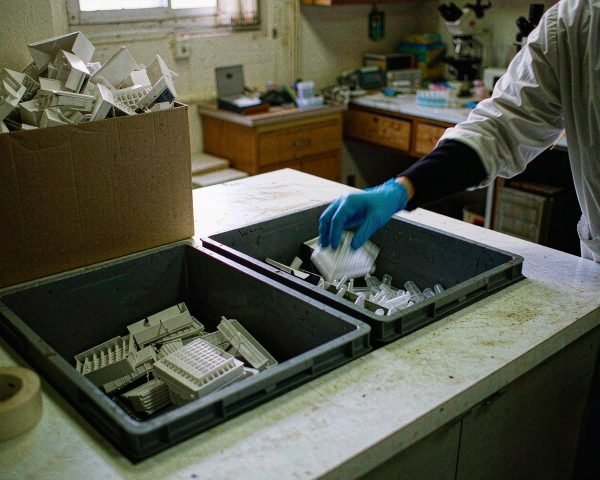

Labs generated an estimated 5.5 million tonnes of plastic waste in 2014, about 2% of global plastic production, per Urbina, Watts and Reardon in Nature (Labs should cut plastic waste too). That number nagged me enough to change how my bench runs. These nine fixes will not touch your data.
The Short Answer
Right-size your plastics, move buffers into glass, buy bulk packs, and separate clean plastic for recycling. Validate any change that touches a sample, and none of it will move your results.
The Bin That Started It
Last year I helped clear out a storage room and counted eleven sealed boxes of individually wrapped 25 mm syringe filters that had expired in 2021. Eleven boxes. Each filter came in its own plastic sleeve, blister, and outer bag, and every single one went straight into the hazardous waste stream.
That afternoon bothered me more than any sustainability webinar ever has. Lab plastic is invisible waste: small items, tossed constantly, nobody signs off on it. The good news is that most of the fixes are boring, cheap, and safe for your method. Here are the nine that actually worked for us.
1. Right-Size Your Consumables
Most labs grab the 50 mL conical tube out of habit, even when 10 mL of buffer would do. A 15 mL tube uses roughly a third of the polypropylene, and it fits your rack better anyway. The same logic applies across the bench.
For HPLC work, check your filter diameter next. A 13 mm syringe filter has a much smaller hold-up volume (the sample you lose inside the device) than a 25 mm one, so you throw away less sample and less plastic at the same time. If you’re prepping 200 µL serum samples in a filter built for 10 mL, you’re paying twice.
Do a quick audit: for one week, jot down every plastic item you use and the volume it actually held. You’ll spot three or four over-sized habits by Friday. We did this and switched our daily dilutions from 50 mL tubes to 15 mL ones, which cut one full case of tubes per quarter.
The same thinking applies to plates and reservoirs. If your autosampler takes 2 mL vials, filling 4 mL storage vials “because we have them” doubles your plastic per sample for zero benefit. Vial inserts solve the low-volume problem without switching formats, which is cheaper than buying two sizes and keeping both stocked. Right-sizing is a purchasing decision as much as a bench decision: spec the small format as your default and make people order the big one deliberately.
2. Switch to Glass Where the Method Allows
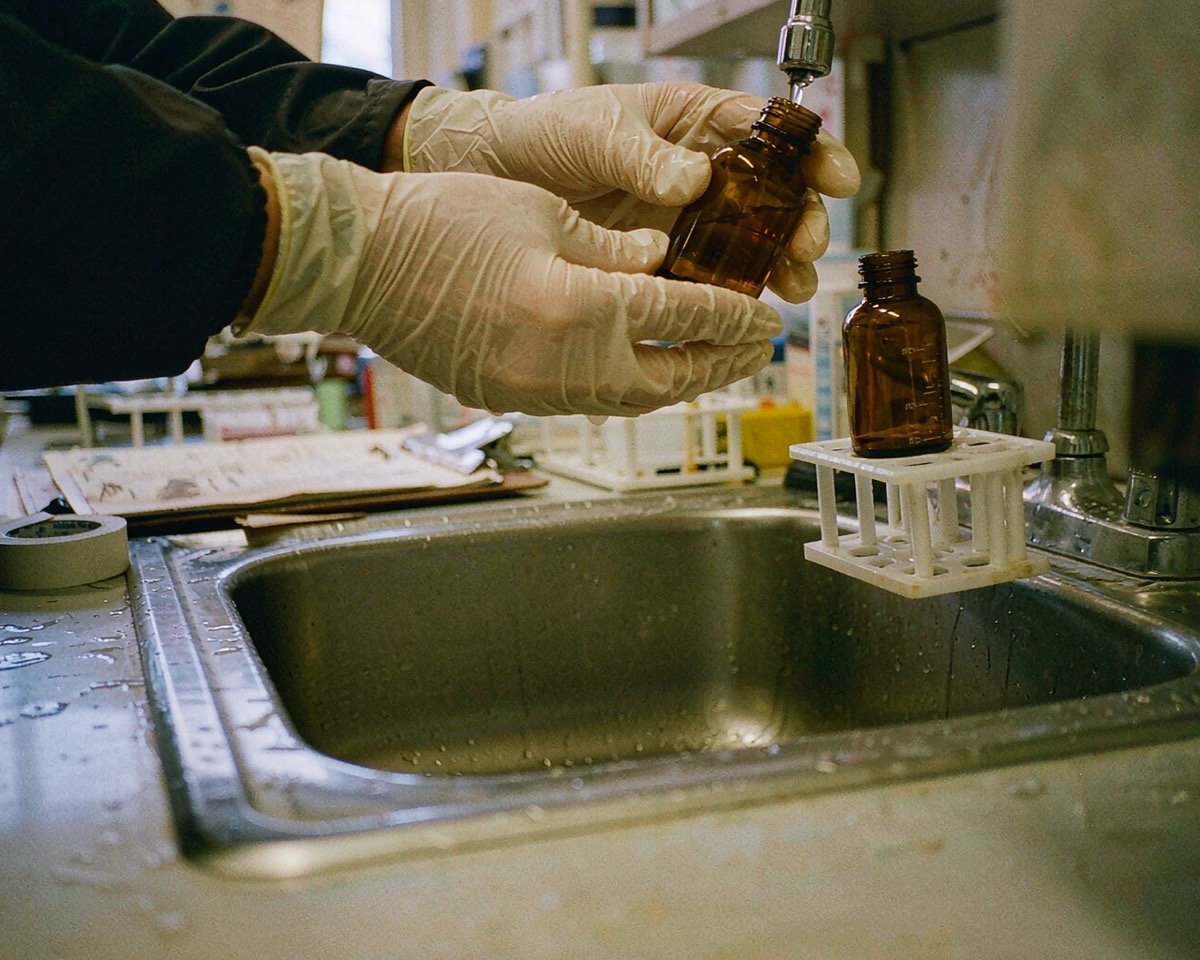
Reagent bottles, media bottles, and solvent reservoir bottles don’t need to be plastic. A borosilicate bottle survives hundreds of autoclave cycles, doesn’t leach anything into your buffers, and lasts years instead of weeks. Amber glass handles your light-sensitive reagents too.
We still run mobile phase from glass reservoir bottles that have been in rotation since before I joined the company. The plastic ones I used in a previous lab went cloudy and cracked within a year.
There’s a chemical argument beyond waste: glass is inert, so you eliminate extractables and leachables from your buffer storage entirely. For anything that sits on a shelf or feeds a pump for days, glass is the lower-risk choice, not just the greener one. The trade-offs (weight, breakage, cost per unit) are real, and we’ve written a full comparison of glass vs plastic reagent bottles if you want the details.
One more underrated benefit: glass bottles with proper closures keep reservoirs cleaner. Algae and biofilm growth in solvent reservoirs and media bottles is a classic warm-lab problem, and it forces you to dump entire bottles of buffer down the drain and start over. A bottle you can scrub and autoclave every few weeks ends that cycle, and the buffer you don’t discard is waste you never created. Start with the highest-turnover liquids on your bench: mobile phase, buffer, media. Those three alone probably justify a crate of borosilicate bottles.
3. Reuse Only What Regulations Allow
This is where a lot of green-lab advice falls apart for QC and GMP labs, so let’s be blunt. Some items are single-use by design: certified sterile products, anything that contacts your final sample in a validated method, syringe filters. Reusing those puts your data and your batch release at risk, and no tonnage number justifies it.
Outside those boundaries, there’s more room than people assume. The University of Exeter’s sustainable labs program (Laboratory plastics) lists items that tolerate autoclaving or chemical decontamination and can re-enter service: PP centrifuge tubes for non-critical buffers, tube racks, reservoirs, weighing boats. Their researchers even reuse a single pipette tip for a serial dilution, working from the most dilute sample back up.
My rule of thumb: reuse anything that never touches the sample or a sterile surface, validate everything that does. If a regulator would ask “who approved this?”, keep it single-use.
The audit angle helps here too. Walk your lab and mark each plastic item green, yellow, or red: green means reuse or autoclave freely (racks, spacers, troughs for non-critical buffers), yellow means reuse with a documented cleaning step, red means single-use no exceptions (sterile consumables, sample-contact items in validated methods). Most labs discover that the red pile is far smaller than they assumed, and the green pile is where the volume lives. Put the list on the wall so nobody has to make the call from memory at 6 p.m. on a Friday.
4. Buy in Bulk and Skip the Individual Wrappers
Individually wrapped consumables make sense in sterile fill suites. Everywhere else, they’re mostly packaging theater. A bulk-pack filter costs less per unit, ships with one carton instead of fifty sleeves, and generates a fraction of the waste. The same goes for tip refills that reload your existing racks instead of shipping a new plastic rack every time.
Packaging is a bigger share of lab waste than the product itself in some categories, and the Exeter team’s first “R” is refusing wasteful packaging before it reaches your door. Ask suppliers what they offer: consolidated packs, returnable cartons, take-back for shipping materials. Vendors notice when buyers ask, because it signals demand.
One caution from experience: match the pack format to your consumption rate. Bulk packs of sterile items have expiry dates, and a case that expires half-used is waste with extra steps. That’s the next problem on the list.
Price per unit also favors bulk more than people expect, because individually wrapped items carry the cost of the wrapper, the loading step, and the extra shipping volume. When we switched our routine 0.45 µm filters from single-wrapped to bulk packs, the unit price dropped enough to pay for the recycling bins I’d been asking for. Savings and waste reduction came from the same line item, which made the purchasing conversation remarkably short. If your supplier doesn’t offer a bulk format, that’s a fair question to put in your next quote round.
5. Join or Start a Lab Plastics Recycling Stream
Most labs get this backwards. The real barrier is segregation, not technology. Clean plastics that never touched biological material or hazardous chemicals (tip boxes, racks, reagent bottles, packaging) are ordinary #5 polypropylene and #2 HDPE. They’re recyclable today, in most municipal streams, if they’re kept separate from contaminated waste.
Dedicated lab-plastics programs make it easier. The EPA’s recycling basics (Recycle City and recycling resources) are a decent starting point for setting up streams, and suppliers have stepped in too: Thermo Fisher runs a mail-back program for used pipette tips (their conservation story), and Fisher Scientific distributes TerraCycle Zero Waste Boxes for tip boxes, tubes, and gloves in several countries. Polycarbonate and PP rigid plastics are the usual accepted streams.
If nothing exists on your campus, start with one bin and one waste stream: clean tip boxes. It’s the highest-volume, lowest-contamination-risk item in most labs, and a successful first stream gets you budget for the second. We cover the hazardous side in our guide to disposing of used HPLC vials and consumables.
Be realistic about what recyclers will take. Autoclaved plastics are usually out, because steam sterilization degrades and yellows the polymer, which is why segregation at the bench matters more than any downstream sorting. Label the bins with photos of what goes in, not just text, and empty them into the recycling stream yourself for the first month so you can catch contamination early. One glove in a clean PP bin can get the whole bag landfilled, so the training piece in item 9 starts right here.
6. Cut Over-Filtration and Redundant Transfers
Watch someone prep samples and count the plastic. Filter the sample into a tube, transfer to a vial, filter again “just in case,” filter the standards with a fresh filter even though it’s the same matrix. Every step adds a tip, a tube, or a filter to the bin, and each transfer loses a little analyte to the walls.
Filtration once, with the right filter, is the standard. If your mobile phase is prepared from HPLC-grade solvents, a second filtration pass does nothing except wear out a membrane. If your sample needs a coarse prefilter before the 0.45 µm, use a glass fiber prefilter and save the membrane filter, which is exactly what it’s for.
The quiet waste adds up fastest here because it’s procedural, not purchasing. We catalogued nine of these habits, from over-filtering to double-transferring, in our post on bench habits that quietly waste consumables. Fixing the procedure costs nothing and improves recovery as a bonus.
Pore size is another lever. Many labs filter everything through 0.22 µm when 0.45 µm is perfectly adequate for their HPLC method, and the finer membrane clogs faster, which means more filters per rack of samples. Match the membrane to the method, not to anxiety. The same goes for how much volume you push through: pushing a full 1 mL through a 13 mm filter when your injection needs 100 µL just means you paid hold-up volume for no reason. Ten minutes with your SOP, marking exactly which steps genuinely require filtration, will do more for your waste bin than any eco-branded consumable.
7. Fix Your Inventory So Nothing Expires
Remember those eleven expired boxes from the storage room? All of that was preventable. Labs over-order because lead times scare them, then the overstock expires in a back cupboard, and the whole lot goes to waste. Plastic, packaging, money, gone.
Three habits fix most of it. Use first-expiry-first-out on the shelf, the same way a kitchen does. Check stock before placing any order, which takes two minutes and saves a duplicate case. And store consumables properly, because heat, light, and humidity are what actually age a septa or a membrane before its date.
Storage conditions matter more than most buyers realize; our guide to storing lab consumables for maximum shelf life covers the specifics. Since we tightened our own rotation, I can’t remember the last time we threw out an expired filter. That’s the metric I’d track first, because every expired box is waste you already paid for twice.
Ordering cadence completes the picture. If lead times let you, order smaller quantities more often instead of a yearly pallet, and set par levels for your ten fastest-moving items so reorders trigger themselves. A simple buying calendar, mapping what you order to the months you actually need it, prevents the panic purchase that becomes next year’s expired box. None of this requires inventory software; a spreadsheet and an hour a month carried us a long way before we ever automated anything.
8. Choose Consumables Made From a Single Recyclable Material
A polypropylene bottle with a polypropylene cap is one material, one recycling code, easy fate. A multi-layer device with a PP housing, a PS body, and a silicone gasket is three polymers glued together, and no recycler will touch it. When you have a choice between functionally identical products, mono-material wins the end-of-life contest every time.
This is where product-level ecolabels help. My Green Lab’s ACT label (mygreenlab.org) scores lab products on packaging, end-of-life, and manufacturing impact, so you can compare two filters or two tip lines on sustainability without trusting a brochure. Their certification program also covers the lab itself, not just the products.
You don’t need to swap every SKU. Pick the five highest-volume plastic items in your lab, check whether a mono-material or PP-based alternative exists, and switch those. For us that was tube racks, reservoir bottles, and tip boxes, all easy substitutions that nobody on the bench even noticed.
Learn to read the recycling triangle on the product or its packaging, because it tells you the fate of the item in one glance. #2 (HDPE), #5 (PP), and #1 (PET) are widely recycled. Anything marked #7 is the “other” bucket, which often means mixed or exotic polymers and effectively means landfill. Polystyrene (#6), the rigid brittle plastic in many racks and plates, is technically recyclable but rarely accepted at the curb, which is exactly why the dedicated lab-plastics streams in item 5 exist. When two products perform identically in your method, the resin code is a legitimate tiebreaker.
9. Train the Team and Track the Waste
None of the above survives contact with a busy Monday unless the whole bench is on board. A new hire who’s never heard why the 15 mL tubes sit in front of the 50 mL ones will reach past them within a week. So put the why on one page, review it in onboarding, and keep it near the bins.
Then measure something. We weighed our lab waste stream for four weeks, which sounds obsessive but took about ninety seconds a day. The result surprised us: pipette tip boxes and packaging, not the tips themselves, made up the largest share of our clean plastic volume. That single data point redirected our whole effort toward bulk refills and recycling, and it gave me a number to show management when I asked for the recycling bins.
Waste data also tells you when a fix worked. Pick one metric (weight per week, cases of tubes per quarter, expired items per month), put it on the wall, and watch what happens after each change.
Ownership matters more than posters. Assign one person per lab, rotating yearly, to own the waste streams: check bin contamination, chase the recycling pickup, restock the right-sized tubes at the front of the shelf. Give the role a name and a mention in appraisals, because sustainability work that belongs to everyone belongs to no one. And celebrate the boring wins publicly; when our expired-items number hit zero for a quarter, I put it in the group chat with a photo of the empty quarantine shelf. Small, visible, repeatable. That’s how habits actually spread through a lab.
Conclusion
Cutting lab plastic waste isn’t one heroic decision. It’s a pile of small ones: a smaller tube, a glass bottle, a bulk pack, a second bin. Individually each change looks trivial; together they’re the difference between 5.5 million tonnes and something the next generation of researchers can live with. And not one of them, done with a little validation, will move your data.
Start with the two changes that cost nothing: right-size what you already order, and separate clean plastic from contaminated waste this week. Then work outward to glass storage and recycling streams as budget allows. If you’re weighing the bottle question first, our breakdown of glass vs plastic reagent bottles is the practical place to start.
Frequently Asked Questions
Can I reuse syringe filters to reduce plastic waste?
No. Syringe filters are single-use by design: their membrane loads up with retained particles and analyte, so a reused filter changes your recovery and can carry over contamination between samples. The plastic savings are pennies; the data risk is real.
Does switching from plastic to glass bottles affect my results?
For buffer and media storage, glass is usually the safer option because borosilicate is inert and adds no extractables. The main trade-offs are breakage risk and higher unit cost, so glass makes the most sense for long-lived items like reagent and solvent reservoir bottles.
What lab plastics are actually recyclable?
Clean rigid polypropylene (#5) and polypropylene copolymer items such as tip boxes, racks, and reagent bottles are accepted by most recycling streams and dedicated lab-plastics programs. Anything contaminated with biological, radioactive, or hazardous chemical waste must follow your institution’s disposal rules first, and autoclaving often degrades the plastic beyond what recyclers accept.
How do I convince management to fund green lab changes?
Bring numbers, not principles. A four-week waste audit with weights and disposal costs turns “we should be greener” into a line item, and most of the changes here (right-sizing, bulk packs, inventory discipline) also save money, which makes the conversation much shorter.
Will bulk-packed consumables compromise sterility?
Only if the sterility claim matters for your application. Bulk packs are fine for non-sterile consumables, and sterile bulk formats exist with proper lot documentation. Check the packaging claim on the spec sheet and match it to your method’s requirements before switching.