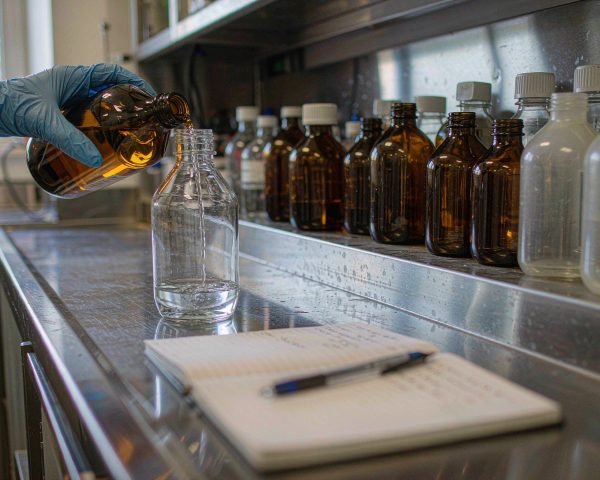

Last winter I watched a colleague carry a full 1 L glass media bottle across a wet cold room floor. She slipped, caught herself, and the bottle did not survive. The buffer did, because a PETG backup bottle was on the shelf that day. That little moment sums up this whole decision better than any spec sheet: glass is the better material until the floor is involved.
In short: choose glass (Type 1 borosilicate) when you need to autoclave, store solvents or strong acids and bases, or preserve sample purity over long storage. Choose plastic (PETG, PP, HDPE) when breakage risk, weight, or shipping matters more than heat and solvent resistance. Most well-run labs stock both and assign each reagent to a bottle by what will happen to it.
Here is how the two materials actually compare where it matters.
Read on for the tradeoffs, the chemistry exceptions, and the situations where the “wrong” bottle quietly ruins a reagent.
Where Glass Wins
Borosilicate 3.3 glass is the laboratory standard for a reason, and the reasons are physical.
- Heat tolerance. You can autoclave a borosilicate bottle at 121 °C repeatedly, and quality bottles withstand thermal shock above 90 K, meaning boiling-to-cold-room transfers that would crack lesser materials. Plastic bottles deform, cloud, or shed extractables when heated hard.
- Chemical resistance. Glass shrugs off acids, salt solutions, and most solvents, with hydrofluoric acid, hot phosphoric acid, and hot strong alkali as the famous exceptions. Plastic bottles swell, crack, or leach when filled with organic solvents like chloroform, toluene, or DMSO at high concentration.
- Inertness over time. The glass surface is non-porous and does not absorb reagents, so long-term storage is predictable. This is why regulators treat glass containers under their own quality chapter: USP <660> sets the requirements for glass containers used in pharmaceutical contexts, covering hydrolytic resistance and surface quality.
- Visibility and cleaning. Glass stays clear through hundreds of wash cycles. Plastic scratches, clouds, and eventually harbors residue in micro-scratches you cannot see.
If your reagent is a solvent, a strong acid, a high-pH buffer, or anything headed for an autoclave, the glass bottle is not really a choice. It is the answer. Our guide on why borosilicate reagent bottles last digs into the material science.
Where Plastic Wins
Plastic bottles are not the “cheap option.” They are the right option for a different set of problems.
- Breakage. PETG and PP bottles survive drops, freezer racks, and shipping. For cold rooms, field sampling, and anything a courier handles, plastic is simply the adult decision.
- Weight. A 2 L glass bottle weighs several kilograms empty. Multiply by a full shelf and plastic saves backs, shelving, and freight.
- Cost. Per unit, PETG and PP bottles usually cost less, and you do not cry when one breaks.
- Clarity on PETG. PETG specifically offers glass-like transparency, so you keep volume reading and contamination checks. HDPE is opaque, which is a feature for light-sensitive reagents but hides contamination.
Media bottles in PETG are popular for cell culture and large-volume buffer storage for exactly this mix; DWK’s media bottle literature draws the same line, glass for repeated autoclaving and long-term storage, PETG for lightweight breakage-resistant handling. Our article on media bottles for cell culture covers that use in detail.
The Chemistry Exceptions That Trip People Up
Both materials have failure modes, and they are not the ones people expect.
Glass fails on hydrofluoric acid (which etches it), hot concentrated alkali (which dissolves the surface), and extreme thermal shock beyond its rating. If your workflow includes HF digestion or hot 5 M NaOH, neither standard borosilicate nor most plastics are trivially safe; look at the compatibility chart, not the marketing.
Plastic fails on solvent contact, on heat, and on leachables. Two details worth knowing:
- PET and PETG can shed terephthalate-related compounds into contents, which is why USP <661.2> (the plastic packaging systems chapter) includes specific physicochemical tests for PET and PETG, such as total terephthaloyl moieties and ethylene glycol.
- Leachables are worse the longer the contact and the higher the temperature. A buffer stored in PP for a week is fine; a volatile analyte stored in the wrong plastic for a month is a method development mystery.
For pharmaceutical-adjacent labs, regulators have quietly moved here: USP’s plastic packaging chapters were revised to require proper characterization of plastic materials and systems, reflecting how much attention leachables now get. The same logic applies to syringe filters, where extractables are just as method-relevant.
Autoclaving: The Deciding Line for Most Labs
If you autoclave your reagent bottles, the decision is mostly made. Borosilicate handles repeated autoclave cycles indefinitely when the bottle is not overloaded or thermally shocked. Polypropylene survives autoclaving (it melts around 165 °C, so 121 °C cycles are within tolerance) but gradually ages, clouds, and becomes brittle. PETG generally does not autoclave; it is a clean-fill, aseptic-processing material.
A practical rule I use: anything that will be sterilized with media in it gets glass. Anything that will be sterile-filled once, shipped, and discarded gets PETG. Mismatch either direction and you pay for it, either in broken glass or in failed sterility.
Cost Over the Real Lifetime
Sticker price flatters plastic. Lifetime cost is more honest.
A borosilicate bottle might cost two to three times a PETG equivalent, but it survives hundreds of use-wash-autoclave cycles. A PETG bottle is often single-use or short-life. Over a year of media prep, glass usually wins on cost per use, unless breakage rates are high or the workflow is genuinely disposable.
Buy quality glass once, and the bottle outlasts the project. Buy the cheapest glass once, and you will learn about mold seams and uneven threads during autoclave cycle 40. Thread quality matters too, since a GL45 cap that cross-threads leaks steam and reagents in equal measure; quality manufacturers like DWK publish their thread standards openly, so verify before assuming a cap will fit.
A Simple Decision Framework
Ask four questions in order:
- Will it be autoclaved or heated? Yes → glass (or PP if weight dominates).
- Does it hold organic solvents or strong acids/bases? Yes → glass.
- Will it be dropped, shipped, or handled in a cold room? Yes → plastic (PETG if you need to see contents, HDPE if light protection matters).
- Is long-term storage of a sensitive reagent involved? Yes → glass, or validated plastic with extractables data.
Light sensitivity adds a twist: amber glass or amber PET both work, but the choice interacts with the questions above; our amber vs clear bottles comparison handles that pair separately.
One more habit that pays: when a reagent’s behavior mysteriously drifts (pH creep, new background peaks, degraded protein), write down the bottle material in the batch record. I have seen two drift investigations end the moment someone swapped a plastic bottle for glass, and one end the other way around. The bottle is part of the experiment whether you log it or not.
Conclusion
Glass and plastic reagent bottles are not competitors; they are specialists. Type 1 borosilicate wins on heat, solvents, and long-term inertness, and it is the only sensible answer for anything that goes through an autoclave repeatedly. PETG and PP win on breakage, weight, and unit cost, which makes them right for cold rooms, shipping, and single-use workflows. The failures that surprise people are the exceptions: HF and hot alkali eat glass, while solvents, heat, and time pull leachables out of plastic. Assign each reagent to a bottle by what will actually happen to it, log the bottle material in batch records, and the mysterious drift investigations mostly stop happening. Start with the autoclave question, because it splits the decision in half faster than anything else. For a broader view of sizes, threads, and cap options, our complete reagent and media bottles guide is the natural next read.
Frequently Asked Questions
Can you autoclave PETG media bottles?
Generally no. PETG softens well below autoclave temperatures and will deform, which is why it is used for pre-sterilized, single-use workflows. For autoclaving, use Type 1 borosilicate glass or polypropylene, and check the manufacturer’s rated cycle limits before committing a protocol to plastic.
Which is safer for storing strong acids and bases?
Type 1 borosilicate glass handles most acids and salt solutions well, with hydrofluoric acid and hot concentrated alkali as exceptions. Plastics like HDPE and PP can suit some aggressive chemicals (HDPE stores concentrated nitric acid commonly), so the honest answer is per-chemical: check a compatibility chart for the exact reagent, concentration, and temperature.
Why do plastic bottles turn cloudy over time?
Repeated washing, autoclaving (for PP), and solvent exposure create micro-scratches and surface degradation in plastics. The cloudiness is cosmetic at first, but those micro-scratches trap residue and can harbor contamination, which is why heavily scratched bottles should be retired even if they look structurally sound.
Are glass bottles always more expensive than plastic?
Per bottle, usually yes; per year of use, often no. A borosilicate bottle survives hundreds of autoclave-wash cycles while most PETG bottles are effectively single-use. For workflows with real reuse, glass wins on lifetime cost; for disposable, breakage-prone, or shipping-heavy workflows, plastic is the economical choice.