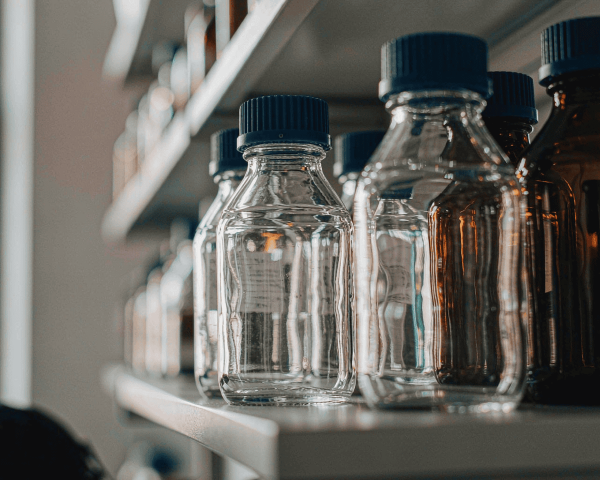

Some lab glassware gets replaced every year; good borosilicate reagent bottles get handed down like furniture. That’s not nostalgia — it’s chemistry. The same glass that holds your concentrated acid today will still be doing the job a decade from now, and here’s the science that makes that true.
The Short Answer
Borosilicate 3.3 glass lasts because its composition — roughly 80% silica and 13% boron trioxide with very low alkali content — gives it three properties at once: exceptional chemical resistance, high thermal shock resistance, and the highest hydrolytic resistance class (USP Type I). It resists nearly every lab reagent except hydrofluoric acid, hot concentrated phosphoric acid, and strong alkalis, and it survives autoclaving without degrading.
Read On
If you’re stocking a new lab, replacing old bottles, or just wondering why the glassware budget keeps shrinking, keep reading. I’ll explain what makes borosilicate bottles different, when they’re worth the premium, and when cheaper glass is genuinely fine.
What “Borosilicate 3.3” Actually Means
Let me decode the label first. “Borosilicate 3.3” refers to the glass’s coefficient of thermal expansion: about 3.3 × 10⁻⁶ per kelvin. That number is the whole story in miniature.
DWK Life Sciences’ glass types and properties page publishes the typical compositions: borosilicate 3.3 runs about 80.6% silica (SiO₂), 13% boron trioxide (B₂O₃), and only 4% sodium oxide (Na₂O) — versus soda-lime glass at roughly 69% silica, 1% boron trioxide, and 13% sodium oxide. The boron is the secret ingredient: it lowers the expansion coefficient and raises chemical resistance, while the low alkali content reduces what leaches out of the glass.
This formula wasn’t an accident. It was developed in the 1880s by German chemist Otto Schott, who set out to make a glass that could withstand high temperatures and temperature changes and resist acids and alkalis — work that eventually became the DURAN brand in 1938, as Fisher Scientific’s DURAN borosilicate explainer recounts. Over 130 years later, that same formulation is still the lab standard.
Chemical Durability: Why Your Reagents Stay Pure
Here’s what actually matters on the bench: the bottle shouldn’t eat your reagent, and the reagent shouldn’t eat the bottle.
Borosilicate 3.3 has very high resistance to attack from water, acids, salt solutions, halogens, and organic solvents. Only hydrofluoric acid, hot concentrated phosphoric acid, and strong alkaline solutions cause appreciable corrosion — that’s the shortlist, per DWK’s materials data. Everything else, it shrugs off.
The purity angle matters even more than the durability angle. Because the glass is over 80% silica, it’s remarkably resistant to acid attack; because its alkali content is low, very little sodium leaches out to raise your reagent’s pH or interfere with sensitive chemistry. For trace-metal analysis, cell culture media, or chromatography-grade reagents, that leach-resistance is the difference between clean data and contamination you can’t see. This is why high-quality reagent manufacturers insist on borosilicate for anything that touches the product — the bottle is part of the quality system, not just packaging.
Thermal Shock Resistance: Autoclave It Without Worry
The other thing your bottles do constantly is heat up and cool down. Sterilization, hot reagent preparation, and moving from the autoclave to a cold bench all slam glass with thermal stress.
The low expansion coefficient is what makes this survivable. When glass expands very little per degree of temperature change, the stress between the hot and cold parts of the bottle stays small — so the bottle doesn’t crack. This is precisely why Type I borosilicate glass is described as having high thermal shock resistance in USP General Chapter 660 for glass containers. In practice, borosilicate 3.3 bottles are routinely autoclavable at 121 °C (and some bottles with high-temperature caps at up to 134 °C), and they handle temperature differentials of well over 100 °C.
If you’ve ever autoclaved a soda-lime bottle and heard that little “tink” of glass cracking, you’ve seen the alternative in action. If you want the full autoclave protocol — cap loosened, timing, and what not to do — my sterilization guide for reagent and media bottles covers it step by step.
Hydrolytic Resistance and the Type I Classification
Now let’s talk about the classification that shows up on every spec sheet: USP Type I.
The USP classifies pharmaceutical glass containers by hydrolytic resistance — how much alkali the glass releases when exposed to hot, high-purity water. The test results sort glass into three types, and they’re not equal:
- Type I (borosilicate): high hydrolytic resistance, high thermal shock resistance, sterilizable before or after filling. Suitable for almost any preparation, aqueous or not, parenteral or not.
- Type II (treated soda-lime): high hydrolytic resistance on the surface only, from a special treatment — the composition underneath is still soda-lime.
- Type III (untreated soda-lime): moderate hydrolytic resistance; unsuitable for aqueous parenteral products.
That’s the framework in USP 660 as summarized by Consolidated Sterilizer Systems: Type I is the top tier, and borosilicate glass earns it by composition, not surface treatment. Type II’s resistance is a coating that can degrade over time; Type I’s is intrinsic, so it doesn’t wear off with repeated washing and autoclaving. That permanence is a big part of why borosilicate bottles last.
Amber Borosilicate: Light Protection Built Into the Glass
One more reason borosilicate bottles survive in your lab: they come in a version that protects the contents too.
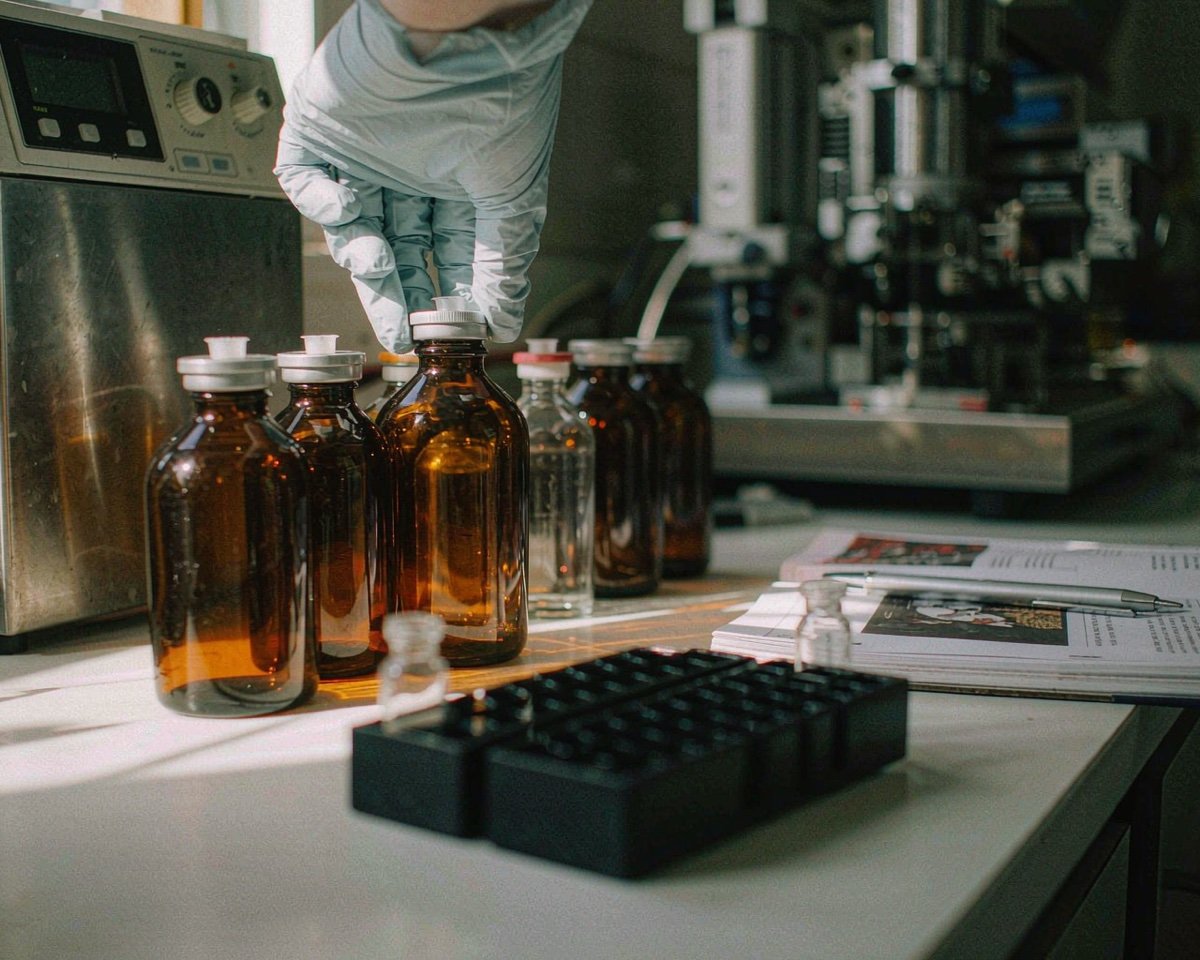
Amber borosilicate glass blocks UV and short-wavelength visible light up to about 500 nm, which protects light-sensitive reagents from photolysis — the breakdown of a chemical by light energy that weakens, discolors, or alters it. EduLab China’s reagent bottle explainer notes that the color is intrinsic to the glass rather than a coating or foil wrapper, so it can’t be scratched off or displaced. Silver nitrate, iodine, hydrogen peroxide, and potassium permanganate are classic examples of reagents that need this protection.
The durability angle here is subtle but real: a clear bottle wrapped in foil protects its contents until someone unwraps it and forgets to rewrap. An amber bottle protects them every single time, forever. If your lab stores light-sensitive reagents, the amber version of the same borosilicate bottle is usually worth the few extra cents. For the full comparison, my guide on amber vs clear reagent bottles walks through when each makes sense.
The Thread Standard That Makes Them Interchangeable
Durability isn’t just about the glass body — it’s about the whole system staying useful. And a big part of borosilicate bottles’ longevity is that the neck finish hasn’t changed in decades.
The GL45 thread is the de facto standard for laboratory media bottles, defined under ISO 4796-1, and it’s interchangeable across sizes and manufacturers: the same cap, pouring ring, and dispenser fit a 100 mL bottle and a 10 L bottle from different suppliers. Borosil Scientific’s GL45 reagent bottle line is a good example — uniform GL45 threads from 100 mL to 20 L, with polypropylene caps autoclavable at 121 °C. Standardization means your caps, septa, and bottle-top dispensers aren’t tied to one supplier, and the bottle stays useful long after cheaper, proprietary-format bottles get retired.
If you’re new to the GL45 system, this complete guide to GL45 media bottles explains the thread, the caps, and the accessories — and this breakdown of the GL45 mobile phase cap covers the HPLC-specific twist on it.
When Soda-Lime Glass Makes Sense (and When It Doesn’t)
Let me be honest: borosilicate isn’t always the right answer. Soda-lime glass is cheaper, and for dry powders, non-reactive solids, or general sample storage, it’s perfectly adequate — DWK’s materials data notes soda-lime is typically suitable for dry powders and general storage applications.
Choose borosilicate when any of these is true: the reagent is aqueous, acidic, alkaline, or temperature-sensitive; you autoclave the bottle; the contents need long-term stability; or the reagent’s purity matters for your analysis. Choose soda-lime when you’re storing dry, stable, non-aggressive materials and the bottle will live quietly on a shelf.
Conclusion
Borosilicate reagent bottles last because the glass itself was engineered to: high silica and boron content for chemical resistance, low alkali for hydrolytic stability, and a low expansion coefficient for thermal shock resistance. Those three properties earn it the USP Type I classification — the top tier for pharmaceutical-grade containers — and they make it the default choice for anything aqueous, acidic, autoclaved, or purity-sensitive. The premium over soda-lime is real but small, and it buys you bottles that don’t leach, don’t crack, and don’t need replacing.
When you’re setting up or restocking, buy borosilicate for the workhorse reagents and keep the GL45 standard thread so every cap and accessory stays compatible. And if you’re choosing between glass colors, the amber vs clear reagent bottle guide will help you match the bottle to your most light-sensitive reagents.
Frequently Asked Questions
What is a borosilicate reagent bottle?
A reagent bottle made from borosilicate 3.3 glass — roughly 80% silica and 13% boron trioxide — which gives it high chemical resistance, thermal shock resistance, and USP Type I hydrolytic resistance. It’s the standard choice for storing acids, solvents, and other lab reagents.
Why is borosilicate glass better than soda-lime glass?
Borosilicate has a much lower coefficient of thermal expansion (3.3 vs roughly 9 × 10⁻⁶/K), so it survives rapid temperature changes and autoclaving. It also has higher chemical and hydrolytic resistance, meaning less leaching into your reagents and no surface treatment that can wear off.
Can borosilicate bottles be autoclaved?
Yes. Borosilicate 3.3 bottles are routinely autoclavable at 121 °C, and bottles with high-temperature caps can go higher (up to 134 °C). Always loosen the cap before autoclaving to prevent pressure buildup, and let the bottle cool slowly afterward.
What reagents should not go in a borosilicate bottle?
Hydrofluoric acid, hot concentrated phosphoric acid, and strong alkaline solutions attack borosilicate glass appreciably. For those, use an appropriate plastic container such as HDPE or PTFE instead.
What does USP Type I mean for glass bottles?
It’s the highest classification for glass container hydrolytic resistance under USP General Chapter 660. Type I borosilicate glass has high hydrolytic and thermal resistance by composition, making it suitable for almost any preparation, including aqueous and parenteral products.