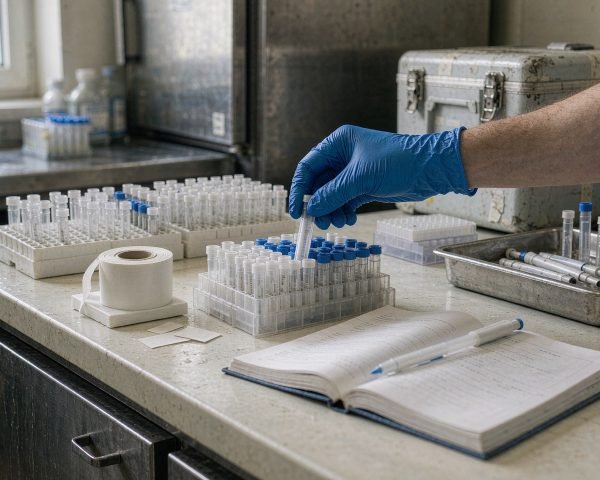

A CRO bench goes through more consumables in a month than most academic labs go through in a year. Every sponsor brings its own method, its own matrix, and its own audit checklist, and each one lands on the same stack of vials, filters, and bottles. I have walked enough contract labs to know the pattern: the science is rarely what slows a study down. Missing CoAs and a failed incoming lot are.
This guide covers what contract research organizations and commercial testing labs actually need from their consumables, why the contract setting raises the stakes, and how to build a supply setup that survives sponsor audits.
In short: a CRO or testing lab needs consumables that are (1) fit for validated methods, meaning low adsorption, low extractables, and consistent dimensions; (2) fully documented, with lot traceability, CoAs, and change control; (3) qualified under GLP or ISO/IEC 17025 purchasing rules; and (4) stocked against multi-project demand, because a stockout on one study can delay six others.
Read on for the product-by-product breakdown, the documentation sponsors ask for, and the supplier qualification steps that keep you inspection-ready.
What Consumables a Contract Lab Actually Burns Through
Start with an inventory reality check. In a typical contract lab the highest-volume consumables fall into five buckets.
- Autosampler vials, caps, and septa for HPLC, LC-MS, and GC work
- Syringe filters and sample prep consumables (plates, SPE cartridges, centrifuge tubes)
- Reagent, media, and solvent bottles, from 100 mL GL25 up to 20 L carboys
- Cryostorage consumables: cryovials, freezer boxes, labels that survive -80 °C
- General bench plasticware: pipette tips, reservoirs, gloves, waste containers
The ratios shift by service line. A bioanalytical CRO running plasma PK samples burns 2 mL vials and 0.2 µm filters at a pace a water testing lab would find absurd. A food testing lab goes through extraction tubes and SPE cartridges instead. A materials testing lab may need almost no chromatography consumables at all but huge volumes of specimen containers.
Whatever the mix, one thing holds: in a contract setting, every one of these items becomes part of the study record. The vial that held the sample is as much a piece of evidence as the raw data file.
Why the Contract Setting Raises the Stakes
In your own lab, you pick the method and you own the consequences. In a contract lab, the sponsor picked the method, the regulator will audit the data, and you are somewhere in the middle holding the paperwork.
Three things follow from that.
Client methods vary wildly
Monday you run a small-molecule PK assay in rat plasma. Wednesday a sponsor sends a peptide method that adsorbs to everything glass. Friday it is a volatile analyte that belongs in a headspace vial. Each method has its own consumable requirements, and a lab that stocks one “house vial” will eventually lose a week to surface chemistry it did not see coming. I keep coming back to a case I watched: a peptide method transferred from a sponsor produced a recovery cliff at low concentrations until someone swapped standard glass for low-adsorption vials. Two days of investigation, and the fix cost about $40 of product.
Sponsors audit your supply chain
Sponsor audits at CROs almost always walk the same path: raw data, then sample handling, then what touched the sample. When the auditor reaches for a vial box and asks for its CoA, “the distributor never sent one” is not an acceptable answer. The OECD GLP principles make management responsible for the suitability of facilities, equipment, and materials, and sponsors read that as your responsibility even when you bought the vials through a reseller.
The data has to hold up downstream
Contract data supports regulatory submissions. That means the FDA’s bioanalytical expectations for selectivity, sensitivity, and reproducibility apply to the whole workflow, and the consumables are inside that workflow, not outside it. Leachables from a cheap septum are not a “lab problem.” They are a regulatory problem.
Vials, Caps, and Septa for Bioanalytical and Analytical Work
The 2 mL autosampler vial is the workhorse, but “works in the autosampler” is a low bar. Here is what actually matters in contract work.
Glass quality and surface treatment
Type 1 borosilicate glass is the default, and for good reason: it is chemically resistant and behaves predictably across solvents. The subtlety is the glass surface. Sodium and boron can concentrate at the inner surface during forming, and leached sodium ions raise sample pH and create sodium adducts in LC-MS. Shimadzu’s own testing shows that in some commercial vials, sodium adducts accounted for more than 50% of the adduct signal for a test analyte, which directly cuts sensitivity when your method quantifies the protonated form. If you run LC-MS for sponsors, ask your vial supplier what they do about surface alkalinity.
For adsorption-prone analytes (peptides, oligonucleotides, some basic compounds), silanized or low-adsorption vials are worth the premium. See our guide on certified HPLC vials and what the certification actually means for how suppliers back these claims.
Dimensions and tolerance
Contract labs run methods transferred from many origins, which means many autosampler models. Neck finishes (9-425, 13-425, 18-400), total height, and shoulder geometry all affect whether the needle reaches the cone bottom without bending. Tolerance is where cheap and good vials separate: a 0.2 mm height excursion can be the difference between a clean draw and a bent needle at 2 a.m. in an unattended sequence.
Caps and septa
PTFE/silicone/PTFE laminated septa are the general default; pre-slit variants help HPLC needles but can leak volatiles in headspace work. Two details worth checking with any new supplier:
- Septa thickness and shore hardness, because resealability across 30+ injections depends on both
- Cap-to-vial thread engagement, because under-torqued caps are the number one cause of evaporation losses in long sequences
High-throughput bioanalytical work often moves into 96-well plates, and plates add their own qualification wrinkles: well volume consistency, seal integrity under heat, and polymer extractables. If a sponsor’s method uses plates, treat the plate and its seal as one system and qualify them together. A plate swap alone can shift an assay, and so can keeping the plate and changing only the seal film.
Headspace vials
For GC headspace work (residual solvents, blood alcohol, environmental volatiles), 20 mm crimp vials still dominate validated methods. Crimp quality is not a place to save money; a poorly seated aluminum cap leaks analyte and quietly wrecks reproducibility.
Filters and Sample Prep Consumables
Filtration is where contract labs burn money invisibly. The filter itself is cheap; the consequences of the wrong filter are not.
Matching membrane to matrix
- Aqueous buffers and mobile phases: PES or mixed cellulose ester
- Organic-heavy solvents: PTFE
- Protein and peptide samples: PVDF or low-binding PES, since nylon binds proteins aggressively
- LC-MS work: low-extractable membranes, because glycerol and wetting-agent leachables show up as background peaks in ESI
That last point deserves a war story. A lab I know chased mystery background peaks in an ESI method for a sponsor for three days before tracing them to a filter wetting agent that the method had never seen before. The filter was “fine” for HPLC-UV and terrible for the MS method it was applied to.
Extractables and leachables are part of method validation
Under ICH M10 expectations, carryover and matrix effects are part of validation, and filter leachables can masquerade as both. Vendors with documented low-extractable lines exist for this reason. When sponsors validate on your bench, your filter choice becomes part of their validation package, and switching filters mid-study becomes a change control event. This is why we tell contract labs to lock filter part numbers into the method transfer document.
Filter qualification for contract labs does not need to match a pharma E&L program in scope. A sensible version: run your blank, your standard, and your worst matrix through each new filter lot, compare the chromatograms, and file the overlay. Twenty minutes per lot. It catches the wetting-agent surprise above, plus the occasional fibers-in-filtrate surprise that paper documentation never reveals.
Bottles, Media, and Bulk Reagents
Contract labs prep a lot of their own buffers, media, and mobile phases, which makes bottle selection a real decision rather than an afterthought.
- Type 1 borosilicate media bottles (GL45 and friends) for anything that gets autoclaved or holds solvents
- Amber glass for light-sensitive reagents
- PETG or PP for large-volume, breakage-prone settings like cold rooms and shipping
- Dedicated solvent reservoir bottles for HPLC lines, with the correct caps and tubing fittings
Two rules that pay for themselves. First, label everything with received-and-opened dates, because a buffer that has been in the cold room since March is a QC finding waiting to happen. FDA GLP regulations (21 CFR 58) require reagents and solutions in laboratory areas to be labeled with identity, concentration, storage requirements, and expiration; auditors check this. Second, stop using one bottle for five different solvents. Residual solvent cross-contamination shows up at the worst possible time, usually during a sponsor’s confirmation run.
For a deeper dive, our reagent and media bottles guide covers sizes, threads, and caps, and our piece on CoA vs CoC documents explains what the paperwork inside the box should tell you.
Cryostorage and Sample Management
Biobanked samples are the contract lab’s version of a bank vault. When a sponsor asks for their retained samples back after two years, the storage consumables prove whether that request is answerable.
- Cryovials with silicone O-rings rated for liquid nitrogen vapor phase
- Freezer boxes with readable grids, because “somewhere in box 47” is not an inventory system
- Labels and ink rated for -80 °C and liquid nitrogen; standard labels fall off cryovials with depressing regularity
- 2D-barcoded tubes once volume justifies the reader hardware
Vial failure at -80 °C is quiet and expensive. A cracked cryovial does not announce itself; it just slowly desiccates the sample and everything around it. Buy these from suppliers who test for thermal shock and leakage, and qualify one batch before committing a study’s samples to them.
Documentation: The Part Sponsors Actually Grade
Here is the honest summary of contract lab audits: sponsors spend maybe 10% of their time on whether your consumables work and 90% on whether you can prove what you used.
The documents that matter:
- Certificate of Analysis (CoA), per lot, with measured values against specification
- Certificate of Conformance (CoC), stating the lot conforms to spec
- Lot traceability, ideally printed on every unit, not just the box
- Change notification, so a silent resin or mold change does not ambush a validated method
ISO/IEC 17025, the competence standard for testing labs, requires control over externally provided products and services, which in plain language means: qualify your suppliers, keep the records, and re-verify when something changes. Under GLP, the same logic applies through management’s responsibility for materials.
When a lot fails incoming inspection, the response matters as much as the failure. Quarantine, document, notify affected studies if used, and work the corrective action. We have a whole article on what to do when a consumable lot fails incoming inspection.
One habit that separates mature contract labs: they version their consumable specs the way they version methods. When a spec changes, even a packaging count, the spec document gets a revision number, and studies running after that date reference the new revision. It sounds bureaucratic until a sponsor asks whether study 27 used the same vial as the validation run, and you answer with a document number instead of a shrug.
The Regulatory Backdrop You Are Actually Operating Under
Depending on the service line, a contract lab answers to some subset of these frameworks.
GLP (nonclinical safety studies)
The OECD Principles of GLP govern most nonclinical contract work across its member countries, with the FDA’s 21 CFR Part 58 as the US regulatory version. The principles reach into consumables through requirements for reagent labeling, equipment and material suitability, and raw data documentation. Sponsors in OECD countries rely on the Mutual Acceptance of Data system, which means your GLP compliance (and by extension your materials discipline) is checked by national monitoring programs, not just by your sponsor.
Bioanalytical method validation
For PK and toxicokinetic work, the FDA’s M10 guidance (harmonized with ICH) defines what regulators expect for selectivity, accuracy, precision, and stability. Consumables sit inside this: the vial and the filter are part of the system that either preserves the analyte or quietly eats it.
ISO/IEC 17025 (testing labs)
Commercial testing labs (food, water, environmental, materials) usually hold ISO/IEC 17025 accreditation. Clause 6.6 on externally provided products and services is the consumables clause: you must define what you buy, verify it, and monitor supplier performance. Accreditation assessors ask for the purchasing records, so keep them boring and complete.
Sponsors layer on top
Beyond the frameworks, each pharma sponsor carries its own consumables expectations from past audits. Some will specify vial brands in the method. Some will require notification before any change of critical consumable supplier. Read the quality agreement; it usually tells you exactly what they will audit.
Supplier Qualification for Contract Labs
Formal supplier qualification sounds heavy, but at its core it is four questions:
- Can this supplier make the product consistently, with specs I can verify?
- Will they send a CoA per lot, and is it real (measured values, not boilerplate)?
- Will they tell me when they change something?
- Can they hold supply through my volume peaks?
The practical process most contract labs run:
- Define the acceptance spec for each critical consumable (dimensions, material, extractables claim, documentation set)
- Run an incoming inspection on the first lots, and spot-check ongoing lots at a defined frequency
- Keep a supplier file: certifications, CoAs, correspondence, and any deviations
- Re-qualify on change (new mold, new resin source, new factory)
Distributors or Direct from the Factory?
Where you buy matters as much as what you buy. Distributors add cost per unit but give you local stock, consolidated invoices, and someone to call when a lot fails. Buying direct from a manufacturer, including OEM factories, cuts unit cost meaningfully at volume, but the quality file burden moves to you: deeper incoming inspection, communication across time zones, and enforcing change notification. Many contract labs run both. Direct for high-volume stable SKUs where savings compound, distributor for the long tail where convenience beats margin. Either way, the qualification standard is identical; only the logistics change.
Vendor consolidation helps here. Six qualified suppliers means six files to maintain; three means three. On the other hand, single-sourcing a critical vial is its own risk, so most labs land on a primary plus a qualified backup for anything that can stop a study. That tradeoff, between file overhead and supply risk, is a judgment call, and it is fine to make it per-item rather than as one global policy.
For the evaluation criteria in detail, the mistakes that show up in lab audits, from labeling gaps to undocumented substitutions, are exactly the failures assessors see most often.
Consumables by Service Line
To make the volume concrete, here is how consumption actually splits across common contract lab service lines. These are rough profiles from watching labs operate rather than vendor data, but the pattern is stable.
| Service line | Highest-volume consumables | Special requirements |
|---|---|---|
| Bioanalytical CRO (PK/PD) | 2 mL vials, PTFE/silicone caps, 0.2 um filters, 96-well plates | Low adsorption, low extractables, LC-MS cleanliness |
| General pharma analysis | 2 mL and headspace vials, filters, solvent reservoirs | Dimensional tolerance across autosampler brands |
| Environmental testing | VOA vials, wide-mouth jars, filters, preservative-dosed containers | Method-specific certification and cleanliness |
| Food and feed testing | Extraction tubes, SPE cartridges, QuEChERS kits, vials | Lot consistency for method repeatability |
| Biobanking and sample management | Cryovials, freezer boxes, barcode labels | -80 C and LN2 ratings, traceability |
Two lessons fall out of the table. First, a procurement manager serving all five lines cannot buy “one good vial”; the requirements genuinely diverge, and the catalog needs to reflect that. Second, the special requirements column is where audits go. VOA vials without certificates, cryovials without temperature ratings, plates without extractables documentation: each is a finding that was avoidable at purchase-order time.
Building an Incoming Inspection Program
Incoming inspection does not have to be elaborate to be effective. What it needs is a defined, written, repeatable check that catches the failure classes that matter for your work.
A practical starter program:
- Documentation check (every lot): CoA present, measured values present (not boilerplate), lot number matches the box, cert date sane
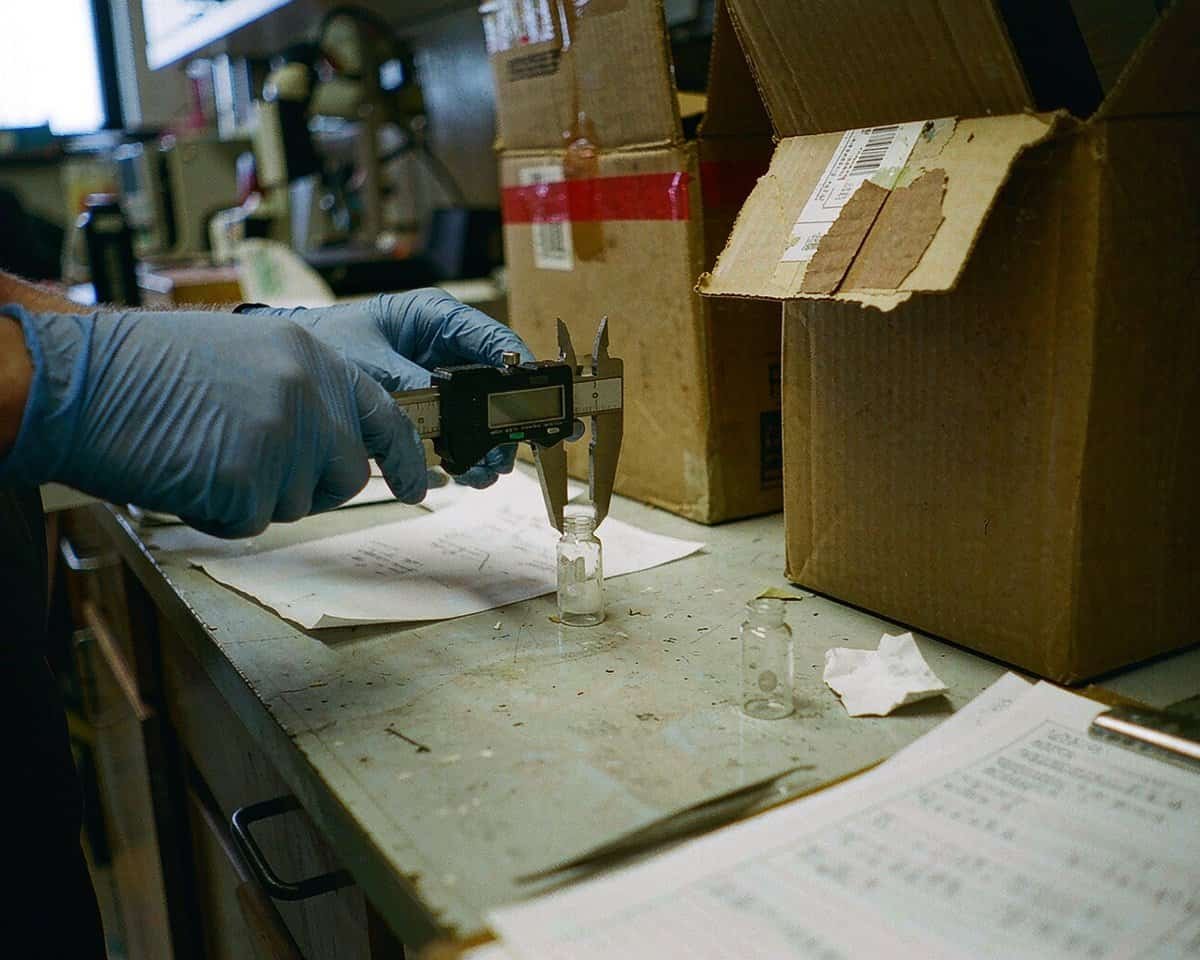
- Dimensional spot check (sampled): height and neck finish with a caliper against spec, five units per lot
- Functional check (sampled, always for new suppliers): fill a vial, cap it, run it through your autosampler; cap-fit problems show up here, not on paper
- Cleanliness (LC-MS labs): run blank solvent in a few vials and look for background peaks before the lot touches real samples
Log the results, even when everything passes. A year of no-findings records is what lets you defend a supplier when a sponsor asks why you trust them. And when something fails, the log turns an awkward phone call into a documented corrective action with a lot number attached. Most labs I visit over-invest in the inspection itself and under-invest in the logging; the log is the part auditors can actually see.
Cold Chain, Shipping, and Field Sampling
If your lab receives or ships biological or stability-sensitive samples, consumables extend past the bench into the cold chain. Insulated shippers and gel packs sized to hold 2-8 C for the label duration. Cryovials and freezer boxes rated for the actual storage temperature, not just “frozen.” Temperature indicators for shipments where an excursion would void the data. Absorbent and secondary containment that satisfies dangerous goods rules for diagnostic specimens.
The contract lab angle: sponsors increasingly specify shipping and storage consumables in the study plan, because a temperature excursion during inbound shipping can invalidate months of dosing work before your instrument ever sees the sample. I once signed for a sponsor’s sample shipment on a July afternoon and found the gel packs at room temperature with the courier sheet showing a 40-hour transit. That study’s first two time points were written off before the box was open. Buying this category on price alone is the same mistake as buying vials on price alone, at larger scale.
Training Bench Staff on Consumables Discipline
Systems fail at the bench, so train the people at the bench. Three habits to drill:
- Nothing gets used without a lot number recorded, ideally scanned from the box at the point of use
- Substitutions get flagged before use, not after; “we were out of the spec vial so I grabbed another” is a deviation, and it needs to be one on paper
- Anyone can stop and ask; a new tech who noticed the caps looked different once saved a client of mine from a full sequence rerun
Fifteen minutes at onboarding plus a laminated card at the bench covers most of it. The payoff is a lab where the consumables record is complete by default, which is the version sponsors love to see.
Budgeting and Inventory Across Projects
Contract labs have lumpy demand. One week three sponsors send studies at once; the next week the LC-MS queue is empty. Fixed reorder points smooth this better than gut feel.
What works in practice:
- Set reorder points per SKU from trailing usage, not per-project promises
- Keep a reserved “validation stock” of the consumables used in validated methods, so a routine order delay cannot force a change control event
- Track burn rate by service line; bioanalysis consumption and water testing consumption are not comparable, and shared procurement data hides that
- Review stock quarterly, because method mix changes and last year’s fast-mover is this year’s shelf-warmer
Consumables are usually a small slice of a contract lab’s budget, and that is exactly why they get mismanaged. Nobody cares until a $300 stockout delays a $300,000 study. Then everybody cares.
Choosing Quality Tiers Per Method
Not every consumable in the catalog deserves premium treatment, and pretending otherwise inflates budgets without buying protection. The tiered approach most mature contract labs settle on: validated and LC-MS methods get premium or certified consumables with full documentation, routine R&D and screening work gets mid-tier product, and anything disposable-adjacent (waste containers, general plasticware) gets bought sensibly on price. Write the tier into the method sheet so the decision gets made once, calmly, instead of at the bench under time pressure. Then revisit the tier assignments annually, because a method that started as a screen has a way of becoming a validated workhorse without anyone updating its paperwork.
The tiering also makes budget conversations easier. When someone asks why one vial costs three times another, the answer is a documented method-risk decision, not a preference. Avoid the opposite trap as well: upgrading everything to premium “just in case” has its own cost, and it is not only money. Premium certified lines sometimes carry longer lead times, and standardizing on them for trivial applications concentrates your supply risk on the products that genuinely need guaranteed availability.
Common Pitfalls (and How to Avoid Them)
- Buying on price alone for validated methods. The vial is 0.3% of the study cost and 100% of where the sample lives. Match the quality tier to the risk; suppliers like Thermo structure their vial lines into performance levels for exactly this reason, letting you pay for the tier the method needs.
- No incoming inspection. The first evidence of a bad lot should never be a sponsor’s deviation report.
- Documentation gaps. CoA filed in someone’s inbox is not a quality system. File per lot, linked to your inventory records.
- Uncontrolled substitutions. A tech grabbing “whatever 2 mL vial is in the cabinet” for a validated method is a change control event that nobody logged.
- Ignoring surface chemistry. The same vial is not equivalent across analytes. Adsorption and leaching are analyte-dependent, and sponsor methods will find the weak spot for you, expensively.
Conclusion
Contract research and testing labs live or die on repeatability, and repeatability runs through consumables more than most managers assume. The vial, the filter, and the bottle are inside every validated method you sell. Pick them for fitness (low adsorption, low extractables, right dimensions), document them so a sponsor auditor can trace any sample to its lot, and qualify suppliers under the same discipline you apply to your instruments, whether your framework is OECD GLP, FDA expectations, or ISO/IEC 17025. None of this is complicated. It is a system, and once it is running, it protects every study you take on. If you only tighten one thing this quarter, make it incoming inspection and lot documentation, because that is where the next audit will go. Then read our guide on what lot failures demand from your process and our breakdown of certification claims on vials to go one level deeper.
Frequently Asked Questions
What consumables do CROs use most?
Autosampler vials and caps, syringe filters, sample prep plasticware (tubes, plates, SPE), reagent and media bottles, and cryostorage vials lead the volume. The exact mix tracks the service line: bioanalytical labs burn 2 mL vials and 0.2 µm filters, while environmental and food testing labs go through specimen containers and extraction consumables.
Do consumables need to be GLP compliant?
The consumable itself is not “GLP compliant”; the lab’s use of it is. GLP (OECD principles, FDA 21 CFR Part 58) requires that reagents and materials be suitable, labeled, and documented. That translates into specs, incoming inspection, CoAs, and lot traceability for the consumables you use in GLP studies.
What documents should a vial supplier provide?
At minimum: a Certificate of Analysis per lot with measured values, a Certificate of Conformance, and material and dimensional specifications. For LC-MS or pharmaceutical work, ask for extractables data and, where relevant, USP <660> glass compliance. Suppliers who print lot numbers on individual units make your traceability much easier.
How often should a contract lab re-qualify suppliers?
Formally, whenever something changes: new factory, new resin, new mold, or a specification change. In practice, most labs review supplier files annually and rely on ongoing incoming inspection between reviews. An annual review plus event-driven re-qualification covers both GLP and ISO/IEC 17025 expectations.
Are cheaper OEM-compatible vials acceptable for sponsor studies?
Yes, if they are qualified like anything else: verify dimensions and materials, run incoming inspection, review CoAs, and confirm the method still performs (especially for LC-MS, where adducts and adsorption are sensitive to glass quality). Many sponsors accept qualified alternatives as long as the lab documents the equivalence check.