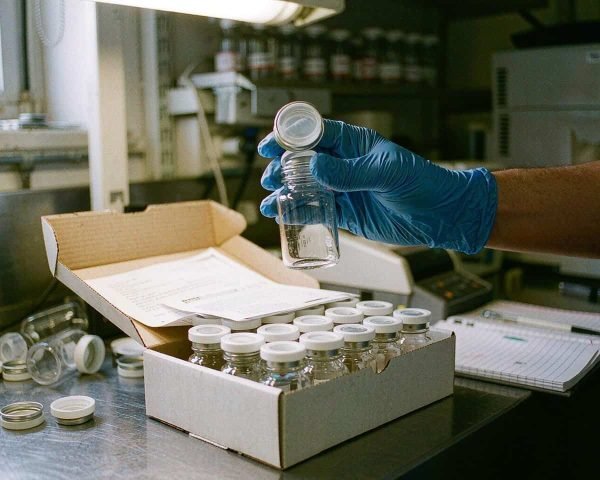

“Certified” on a vial box can mean three very different things, and the difference is money on one side and defensibility on the other. Here is what the certification levels actually cover, what they cost, and how to decide whether your method needs them.
Buy a case of HPLC vials and you’ll see the word certified on some boxes and absent from others, sometimes with a price gap of 20 to 40 percent. The word is doing real work, but it means different things to different suppliers, and buying on the word alone gets you either overpaying or under-protected.
The short answer: a certified vial is one whose manufacturer has tested samples from the production lot against defined criteria and documented the results, usually with a certificate tied to your box’s lot number. The three common tiers are dimensional certification, HPLC/GC performance certification, and LC-MS/GC-MS certification, each adding tests on top of the last. Whether you need them depends on your detection level and what your results must survive.
I didn’t always think this way. For years I bought the cheapest 9-425 screw vials that fit our autosamplers, and they were fine, until a low-level residue method started producing background variability that consumed two days of troubleshooting. The vials weren’t defective. They were simply inconsistent between lots in a way nobody had measured. After that episode I buy standard vials for routine work and certified vials for anything trace-level, and I’ve stopped re-litigating the decision every quarter.
What the Certification Levels Actually Mean
The tiered structure most major vendors follow is easiest to see in Thermo Scientific’s certified vial kits page, which describes three levels, and comparable programs exist across the industry, such as Phenomenex’s Verex certified vial line. The tiers differ in what was tested and documented.
Level 1: Specification certification
The base tier. The manufacturer verifies that the vials meet their physical specifications: dimensions, neck finish, volume, glass quality. Machine-vision inspection during production catches out-of-spec vials, and the guarantee you receive is that the product in the box will fit and function in your autosampler.
This is what “certified” means in the weakest sense, and it’s what you’re often getting from budget suppliers who use the word freely. It’s not worthless. Dimensional consistency is genuinely important, since a vial that sits wrong in the tray or seals unevenly creates problems no certificate can fix after the fact. It just doesn’t tell you anything about cleanliness or analytical performance.
Level 2: HPLC/GC certification
The middle tier adds lot-level performance testing. A sample from each production lot is tested by HPLC and GC against a defined panel of criteria, typically covering cleanliness (background peaks), septa resealability, dimensional verification, and sometimes adsorption checks. The certificate of conformance in the box ties your specific lot to those results.
What this buys you is consistency between lots. Routine quantitation usually doesn’t care, but long-running methods, contract lab work, and anything with system suitability criteria benefit from knowing that this lot was tested and passed.
Level 3: LC-MS/GC-MS certification
The top tier, aimed at trace work. On top of the level 2 tests, these vials are certified for low background in MS applications: low bleed from caps and septa, low extractables from glass treatment, and low adsorption at very low analyte concentrations (some vendors test down to ng/mL levels for adsorption). This is where the manufacturing and cleaning process genuinely differs, not just the testing, because you can’t test dirtiness away after packaging.
What the Certificate Itself Should Contain
A certificate worth the paper has four elements: what was tested, the acceptance criteria, the actual results for your lot, and traceability (a lot number matching the box, ideally with production date).
Watch for the difference between a certificate of conformance (CoC), which states the lot conforms to defined specs, and a certificate of analysis (CoA), which reports measured values. Both are legitimate. A CoA is the stronger document because it shows data rather than a claim. If a supplier’s “certificate” is a generic page without a lot number, it’s marketing collateral, and you should price the vials accordingly.
For glass quality specifically, the underlying standard is the pharmacopoeial classification of container glass by hydrolytic resistance, defined in USP General Chapter 660 on containers and glass. A vial made from USP Type I borosilicate has the high chemical resistance that chromatography work assumes. Certification sits on top of this: glass type is about the material, certification is about the lot-level proof.
When Certified Vials Are Worth the Premium
The honest decision framework comes down to three questions.
What is your detection level? If your analytes sit at ppm levels on UV detection, standard vials with good dimensional quality are almost always sufficient. If you’re quantifying at ppb or below on LC-MS/MS, background and adsorption differences between vial lots become method noise, and certified low-adsorption vials remove a variable you’d otherwise chase.
The second question is about consequences. What must your results survive? Regulated environments (GMP QC, contract labs, forensic work) live on documentation. A certificate that ties the lot in the box to tested results is cheap insurance against the audit question “how do you know the container didn’t contribute to the result?” Research labs defending a surprising result against a reviewer get real value from the same document.
How much does a failed run cost you? The math that makes certified vials rational is the same as for most quality products: a premium of a few cents per vial against the cost of re-running a 60-sample sequence, which includes instrument time, analyst time, and often the sample itself if it was consumed.
My own rule after the episodes described above: routine QC and teaching labs get standard vials. Validated methods, trace analysis, and anything a customer or regulator will read get certified.
When Standard Vials Are the Smarter Buy
There’s a case for the other side, and it’s not just budget.
High-volume routine work with robust methods and generous detection limits burns through vials by the thousand. At that volume, certified vials add cost with no measurable return, because the method never operates close to the edge where lot variability shows. Quality standard vials from a reputable manufacturer (with dimensional QC and a CoA available on request) hit the practical sweet spot.
The trap to avoid is unbranded vials with no documentation at all. The savings look attractive until a bad lot costs a week of troubleshooting. If a supplier can’t produce a CoA when asked, that tells you how they run everything else, and the questions worth asking any vial supplier will surface it in one email.
How to Actually Buy: Reading Past the Word “Certified”
Treat “certified” as a claim that requires a sentence of specifics. Ask what the certification covers: dimensions only, lot-level HPLC/GC testing, or MS-level background certification? Ask what document arrives in the box, and whether it carries the lot number. And ask whether certification applies to the septa and caps or just the glass, because in MS work the closure often matters more than the vial.
The vocabulary overlaps heavily with general spec-sheet reading, and the guide to the ten key terms on a lab consumables spec sheet covers most of what you’ll see quoted. If you’re matching vials to an autosampler rather than evaluating quality tiers, the 9-425 thread size explainer covers the most common neck finish, and the borosilicate vs soda-lime glass comparison explains why glass type is the foundation the certification sits on.
Conclusion
Certified HPLC vials are a documentation product as much as a physical one: the glass is similar, but the proof travels with the box. Specification certification guarantees fit, HPLC/GC certification adds lot-level consistency, and MS certification adds the low-background guarantees that trace work runs on. Match the tier to your detection level and what your results must survive, read what the certificate actually covers rather than trusting the word on the box, and keep standard vials in the workflows where they perform identically. If you take one habit from this article, make it this: before you pay the certified premium, ask the supplier to email you a sample certificate, because thirty seconds with that document tells you more than any product page.
Frequently Asked Questions
Are certified HPLC vials necessary for routine analysis?
Usually no. Routine methods with UV detection at comfortable concentration levels run fine on quality standard vials with dimensional QC. Certified vials earn their premium in trace-level work, validated methods, and regulated environments where lot-level documentation matters.
What is the difference between a CoA and a CoC for vials?
A certificate of conformance states that the lot meets defined specifications. A certificate of analysis reports the actual measured results for your lot. A CoA is the stronger document because it contains data, and either way the certificate should carry the lot number printed on your box.
What does “MS certified” mean on a vial?
It means the vial and closure were additionally tested for low background in mass spectrometry applications: low bleed from septa, low extractables from the glass, and low adsorption of analytes at very low concentrations. The manufacturing and cleaning process differs from standard vials, not just the testing.
Do certified vials cost much more?
Typically 20 to 40 percent more than standard equivalents, varying by brand and tier. The rational comparison is not against zero but against the cost of one re-run or investigation caused by vial variability, which is usually larger than a year’s worth of the premium on a single method.
Can I mix certified and standard vials in the same batch?
Avoid it for anything quantitative near your detection limits, because lot-to-lot differences become unexplainable between-sample variability. For routine work at robust levels it’s harmless, but keeping one vial type per method is the cheap discipline that prevents the confusing afternoon later.