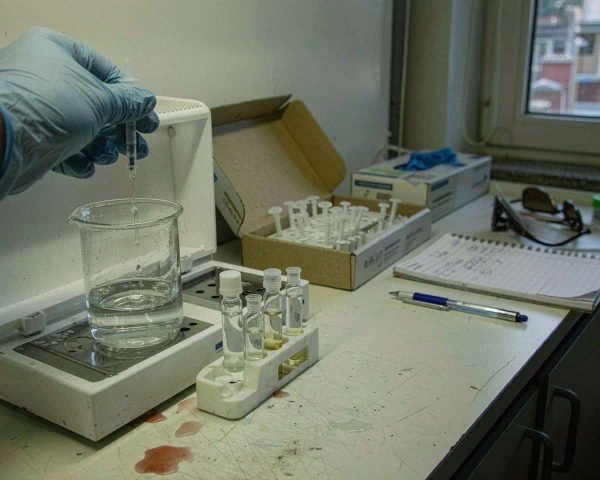

Syringe filters can add invisible background chemicals to your filtrate, and at trace levels those chemicals land exactly where your analytes live. Here is what extractables and leachables are, when they matter, and the four practical habits that keep them out of your data.
Pour a blank through a cheap syringe filter, run it on LC-MS, and you may see more peaks than the blank deserves. Those extra peaks are the filter talking. The membrane and housing release small amounts of chemicals into the liquid passing through, and analysts call them extractables and leachables.
The answer, in short: extractables are compounds that can be forced out of a filter under aggressive lab conditions, leachables are the subset that actually ends up in your sample under normal use, and they matter most in trace analysis, LC-MS, and any method where your targets share chemistry with plastic additives. I learned the cost of ignoring them while running a trace-level method where a ghost peak at the retention time of our internal standard traced back to the wetting agent in a housing membrane. Three days of investigation, solved by pre-rinsing the first 1 mL of filtrate to waste.
Extractables vs Leachables: The Difference That Matters
The two terms get used interchangeably, and they shouldn’t be.
Extractables are everything that can come out of a filter material when you attack it with strong solvents, heat, and time. Leachables are the compounds that actually migrate into your sample under the milder conditions of real use. A regulator would say the extractables profile is the worst-case inventory, and leachables are the realistic subset.
For a daily bench decision, the useful framing is this: you don’t need to know the full extractables profile of your filter. You need to know whether anything leaches into your sample at a level your method can see. The formal frameworks behind this thinking come from pharma, where USP General Chapter 1663 on assessment of extractables sets out how packaging and delivery systems (filters included) are assessed. Food and environmental labs borrowed the logic rather than the paperwork.
What Actually Leaches from a Syringe Filter
Three families of compounds do most of the damage.
Surfactants and wetting agents. Many membranes are treated to be immediately wettable, and the treatment can bleed into the first milliliters of filtrate. On LC-MS these show up as broad peaks or elevated baseline, often with characteristic masses that repeat across every sample filtered the same way. The fix is almost embarrassingly simple: discard the first portion of filtrate.
Oligomers and plastic additives form the second family. Polymer housings (polypropylene, usually) can release small amounts of oligomers, and some membrane chemistries carry residual monomers or plasticizers. These are the classic ghost peaks, appearing at low levels in every chromatogram from the same filter lot.
Metal ions and particulates. Less visible but real for ICP-MS work and for methods sensitive to catalytic degradation. Glass-filled housings and some membrane supports contribute trace elements.
The amount that leaches depends on the sample itself. Aggressive solvents (DMSO, concentrated acetonitrile), high pH, and high extracting power pull more out. Aqueous buffers at neutral pH are gentle. This is why the same filter is innocent in one method and a problem in another, and why filter choice is a method decision rather than a purchasing one. The trade-offs between filter membrane chemistries exist partly for exactly this reason.
When Extractables Deserve Your Attention
Not every method cares. Here is the honest triage.
Ignore-ish territory: routine assays where your analytes sit at mg/L levels and your detector doesn’t see background below 0.1%. If the leachables are invisible at your detection level, they are not a problem, whatever the certificate says.
Take it seriously territory: LC-MS and GC-MS at trace levels, where the detector amplifies everything the filter releases. Forensic and toxicology work, where a leachable can be mistaken for an analyte. Bioanalytical methods, where regulatory expectations for cleanliness are explicit. And any method where your analyte is chemically similar to plastic additives (surfactants, phenols, amines), because coelution becomes a genuine risk rather than a theoretical one.
The formal E&L world exists because injectable drug products touch filters and packaging directly, so regulators demand data. Testing labs like Intertek and the USP 1663/1664 assessment frameworks define how that evidence is generated. Bench analysts don’t run these studies, but understanding the vocabulary helps when a client or auditor asks what your filter contributes to the result.
Four Habits That Keep Filter Background Out of Your Data
1. Pre-rinse and discard the first filtrate
This is the single highest-value habit in sample filtration. Push 0.5 to 1 mL of sample or solvent through the filter and discard it, then filter the portion you keep. The first fraction carries most of the surfactant and loose particulates. Costs: half a milliliter of sample. Saves: ghost peak investigations.
2. Match the membrane to the solvent, not just the analyte
A membrane can be analytically perfect and chemically wrong for your solvent. PTFE handles aggressive organics and doesn’t leach much into them, but it’s hydrophobic and needs wetting for aqueous work. Nylon is convenient and broadly compatible but can adsorb proteins and leach more into strong solvents. PVDF sits in the middle with low background in both worlds. If your sample preparation guide doesn’t already specify, decide once per method and write it down.
3. Request extractables data for critical methods
Filter manufacturers publish extractables profiles for their products, sometimes per lot for certified lines. For routine work you never need this. For a validated bioanalytical method, a one-page extractables statement from the manufacturer closes a question before it’s asked. Vendors who publish this data freely (most major brands do) generally have the cleaner products anyway.
4. Keep one filter lot per study
Filter lots vary like any manufactured product. Filtering early study samples with lot A and late samples with lot B invites a bias nobody can explain later. Note the lot on your bench sheet the way you note column serial numbers. The same discipline applies to preventing filter breakthrough, where pushing too hard or too fast can force unfiltered sample past the membrane entirely.
What the Regulators Actually Expect
If you run GLP or GMP work, the expectations are written down. Drug product leachables assessment (the USP <1664> framework) and device-focused extraction studies under ISO 10993 use filter-relevant logic, and contract labs performing these studies follow published method designs, like the comparative extractable study designs aligned with USP and ISO 10993 used in injectable packaging work.
For everyone else, the expectation is implicit but real: your method should demonstrate that the filter contributes nothing detectable to the result. A filtered blank through your exact filter, at your exact detection level, is the evidence. One injection, one chromatogram, filed with the method. That single document answers most auditor questions about filtration.
Conclusion
Extractables and leachables sound like a pharma compliance topic, but the practical version belongs to every trace-level lab: filters release small amounts of chemicals, your detector can see them, and a few habits keep them out of the data. Pre-rinse and discard the first filtrate, match the membrane to the solvent, ask for extractables documentation when the method is critical, and keep filter lots consistent within a study. If you only change one thing this week, make it the pre-rinse; it costs nothing and removes the most common source of filter-related ghost peaks. For a broader look at where filtration sits in the workflow, the guide to syringe filters for HPLC sample prep connects this topic to the rest of the sample preparation chain, and the pore size explainer covers the other half of the filter decision.
Frequently Asked Questions
What is the difference between extractables and leachables in syringe filters?
Extractables are all compounds that can be pulled from the filter under aggressive conditions (strong solvents, heat, long contact). Leachables are the compounds that actually migrate into your sample during normal use. For bench work, leachables are what matter, and a filtered blank shows you what they are.
How do I remove surfactant contamination from syringe filters?
Discard the first 0.5 to 1 mL of filtrate before collecting your sample portion. Most surfactant and wetting-agent residue transfers in that first fraction. For very sensitive LC-MS work, some analysts pre-rinse with solvent and then with sample before collecting.
Which syringe filter membrane has the lowest extractables?
PTFE and PVDF are generally the low-background choices, with PTFE best for organic solvents and PVDF strong for both aqueous and organic samples. Nylon is convenient but tends to contribute more background in aggressive solvents, and it adsorbs proteins. The cleanest answer for your method is a filtered blank with your actual solvent and detector.
Do syringe filter extractables affect HPLC-UV methods?
Usually no. UV detection at typical analyte concentrations is far less sensitive to filter background than MS. Extractables become visible mainly in trace UV work below the low-µg/L range or when a leachable absorbs at your wavelength and coelutes with a peak. A filtered blank still settles the question in minutes.
What is a filtered blank and how do I use one?
A filtered blank is your sample solvent (or a blank matrix) pushed through the exact filter type and lot you use for samples, then injected under your method conditions. Everything that appears in the chromatogram is filter background. Keep the chromatogram with the method file; it’s the evidence that your filtration step is analytically invisible.