
Most people spend hours choosing an HPLC column and about ninety seconds choosing the bottle that feeds it. Then they wonder why a weekend run died at 3 a.m. on Saturday because the mobile phase ran out or the pump aspirated air. The reservoir bottle is doing more work than its price suggests.
Short answer: look for Type 1 borosilicate glass (borosilicate 3.3), a GL45 threaded neck, a conical base with a central cavity for the inlet filter, and a sealed cap with PTFE ports and a 0.2 µm hydrophobic vent filter. Size it to your longest unattended run, choose amber glass if your mobile phase carries light-sensitive additives, and make sure the cap grips your tubing so the pickup depth never drifts.
Each of those choices has a failure story behind it. Here’s what to check before you buy, and why.
Material: Why Borosilicate 3.3 Is the Default
Solvent bottles are almost universally made from borosilicate 3.3 glass, and the reason is extractables. Your mobile phase will sit in this bottle for hours or days, and anything the bottle leaches becomes a baseline artifact at best and a ghost peak at worst. Borosilicate 3.3, the glass specified by ISO 3585 and classified as USP Type 1 neutral glass, has an exceptionally low inorganic ion extractables profile and effectively zero organic extractables. That’s exactly the profile you want when the liquid inside is your entire analysis.
DWK’s DURAN reservoir bottles, the reference product in this category, state this explicitly: low inorganic extractables, no organic extractables, plus lot traceability through a retrace code on every bottle. That last part matters more than it sounds. If you ever need to trace a contamination event back through your consumables, a lot code turns a week of guessing into an afternoon.
What about plastic? HDPE and PP bottles are fine for some reagents, and they survive drop hazards better, but most plastics leach or absorb something, and they’re poor matches for the strong organic solvents that live in HPLC solvent cabinets. For a solvent reservoir, glass is the default for good reason.
The Base Shape Nobody Thinks About
Here’s a detail that separates a real HPLC reservoir bottle from a repurposed media bottle: the bottom.
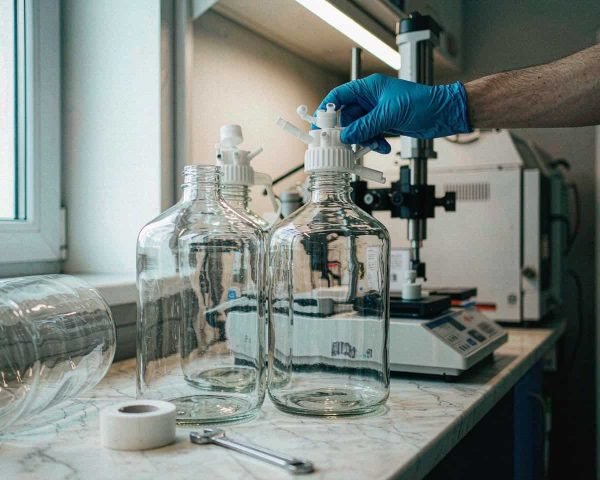
The reference design in this category uses a conical base with a central cavity that collects the last of the solvent directly over the pickup point. The point is practical. Flat-bottom bottles leave a puddle of mobile phase that the inlet filter can’t reach, and the classic workaround, tilting the bottle to squeeze out the last 50 mL, is how solvent spills and air bubbles happen.
DWK describes the design intent directly: the central cavity allows the most efficient delivery of mobile phase without tilting, and the larger reservoir sizes support longer unattended runs without the risk of running dry mid-analysis. Anyone who has come in Monday morning to find a sequence that aborted overnight because a channel ran dry will recognize why that matters. The pump doesn’t just stop. It aspirates air, the pressure trace goes wild, and whatever runs after that point in the sequence is data you can’t use.
The conical base also helps cleaning and ultrasonic degassing, since the geometry drains rather than pooling rinse water in the bottom. Small thing. You notice it weekly.
Caps: The Part That Does the Real Work
The bottle is the cheap half. The cap assembly is where reservoir systems succeed or fail, and it deserves most of your attention when comparing products.
A properly engineered reservoir cap does several jobs at once. It seals the bottle so solvent vapor stays in and lab air stays out. It holds one or more solvent lines at a fixed depth so the pickup point doesn’t drift when you thread or unthread the cap. And it lets air back into the bottle, in a controlled way, as the pump draws solvent out.
That last job is the one people forget. As solvent leaves the bottle, negative pressure builds inside. A sealed cap with no air inlet will fight your pump, and an open cap lets unfiltered lab air, dust, and microbes fall into your mobile phase. The engineering answer is a vent fitted with a 0.2 µm hydrophobic PTFE filter: air flows in, particles and vapor don’t. Reservoir system guides consistently call this out as the feature separating a real HPLC cap from a screw lid, along with chemically inert PTFE fluid paths and an O-ring seal at the bottle neck that survives contact with aggressive solvents.
Check the port design too. Ports should grip the tubing positively so its depth stays fixed, because a drifting pickup line means intermittent air aspiration once the solvent level drops below the line’s new height. And match the port count to your setup: a single-channel isocratic system needs one, while quaternary gradient systems and shared reservoirs want four to six.
If you’re weighing cap types more broadly, our comparison of vented versus solid reagent bottle caps covers when a vent belongs on a bottle and when it’s a liability, and the GL45 mobile phase cap explained digs into the most common cap standard in chromatography labs.
Sizing: Match the Bottle to the Run
Reservoir bottles commonly come from 1 L up to 10 L, and the sizing logic is simple: the bottle should outlast your longest unattended run with margin.
A 1 L bottle is comfortable for daytime analytical runs that get checked between batches. Gradient methods with high aqueous content burn solvent faster than you’d think, and the standard move is 1 to 2 L per channel for routine analytical work. Labs running overnight sequences, prep-scale flow, or instruments shared across multiple methods step up to 5 or 10 L, precisely so nobody has to refill at 2 a.m.
Oversizing has its own cost, though. Mobile phase doesn’t improve with age, and a 10 L bottle of aqueous buffer that takes three weeks to empty is a three-week microbial incubation. Size for the run, and remember that buffer replacement schedules apply regardless of bottle size.
Amber or Clear?
Clear glass shows the solvent level at a glance, which is genuinely useful for a reservoir you check daily. Amber glass protects light-sensitive contents, and that’s not a niche concern: mobile phases carrying certain additives, derivatives, or photosensitive analytes degrade measurably under lab lighting over a weekend.
The decision is the same one you make for sample vials, just at bottle scale. If your mobile phase is plain water, acetonitrile, methanol, or robust buffers, clear glass is fine and more convenient. If light sensitivity is part of your method’s risk profile, amber is the safer default. Our amber versus clear bottle guide walks through that tradeoff in detail.
A Failure I Keep Seeing
The most common reservoir failure I run into isn’t dramatic. It’s the mismatched cap: a decent bottle wearing a cap cobbled together from loose fittings, with the solvent line held by friction and no vent filter at all. It works. Until a long run, when the lab air warms, the level drops, the line slips up 5 mm, and the pump starts sipping air with a sound like a straw hitting the bottom of a milkshake.
The fix costs less than a column. A matched cap with gripped ports, a vent filter, and a bottle sized for the run quietly removes an entire category of overnight failures. We stock proper GL45 bottle options for exactly this reason, and if you’re upgrading a whole solvent cabinet, our complete reagent and media bottle guide covers the wider bottle landscape beyond reservoirs.
Conclusion
A solvent reservoir bottle looks like the simplest object in your HPLC lab, and the buying decision is easy to rush. Look past the shape: borosilicate 3.3 glass with lot traceability, a conical base that feeds the inlet filter instead of pooling solvent, a sealed GL45 cap with gripped PTFE ports and a 0.2 µm vent filter, and a capacity matched to your longest unattended run with amber glass for light-sensitive phases. Each of those details exists because somebody’s overnight run died without it. Choose them deliberately and the reservoir disappears from your list of things that can go wrong at 3 a.m., which is exactly where you want it.
Frequently Asked Questions
What is an HPLC solvent reservoir bottle?
It’s the bottle that stores and feeds mobile phase to your HPLC pump. A proper one is made from low-extractables borosilicate 3.3 glass, uses a standard GL45 threaded neck for interchangeable caps, and is designed so the solvent inlet filter can draw from it efficiently without pulling in air.
Why do HPLC reservoir bottles have a conical base?
The conical base channels the last of the solvent into a central cavity right where the inlet filter sits. That means the pump can draw nearly all of the mobile phase without tilting the bottle, which prevents spills, air bubbles, and mid-run interruptions on long unattended analyses.
Do I need a vent filter on my solvent bottle cap?
Yes, for sealed reservoir systems. As the pump withdraws solvent, negative pressure builds inside the bottle, and a 0.2 µm hydrophobic PTFE vent lets air in to equalize while blocking dust, microbes, and vapor from contaminating your mobile phase. An unvented sealed cap will fight the pump; an open cap invites contamination.
What size solvent reservoir bottle should I buy?
Size the bottle to outlast your longest unattended run with margin. Around 1 to 2 L per channel covers routine analytical work, while overnight sequences, prep-scale systems, or instruments running long gradients justify 5 to 10 L. Avoid oversizing aqueous buffers, since long-drawn-down bottles encourage microbial growth.
Can I use a regular media bottle as an HPLC solvent reservoir?
You can, with the right cap, and many labs do. The tradeoffs are the flat base, which leaves solvent the inlet filter can’t reach, and cap compatibility, since media bottles share the GL45 thread. For long unattended runs, a dedicated reservoir bottle with a conical base and a matched HPLC cap is the safer setup.