
A chemist once told me her ICP-MS run failed overnight because the lab loaded 15 mL tubes into a rack meant for 50 mL vials. The probe came down empty, the sequence kept running, and by morning they had 200 rows of beautiful zeros. That entire mess came down to a consumable that most people never think about: the sample cup.
The Short Answer
A sample cup is a small vessel, usually 0.5 to 4 mL of polystyrene or polypropylene, that holds a specimen or reagent for an analyzer’s probe. They feed clinical chemistry, hematology, and immunoassay analyzers, plus ICP autosamplers, TOC analyzers, elemental analyzers, and autotitrators.
Read on, because the details are where cups quietly cost labs money. A cup that fits the rack but not the probe, or a polystyrene cup filled with acetone, will ruin a run faster than most instrument faults.
What a Sample Cup Actually Is
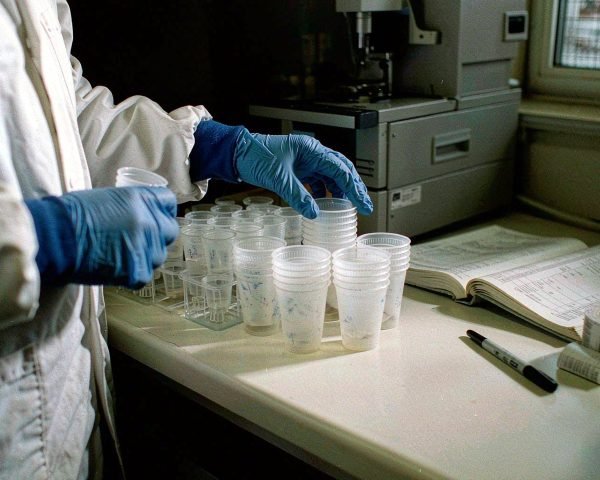
A sample cup is a disposable, single-well vessel with a defined outer diameter and height. It sits in a rack slot, and the analyzer’s probe dips into it to pick up a precise volume. That’s the whole job. No caps to seal, no septa to pierce, no threads to match. Just a vessel that has to hold its liquid and sit at the right height.
Sizes cluster in a narrow range. The common clinical formats are 0.5, 1, 2, and 4 mL, with the 2 mL cup as the everyday workhorse. A typical 2 mL cup stands about 38 mm tall with an outer diameter near 16 to 17 mm. Fisherbrand’s auto-analyzer cups, for example, span 0.25 to 4 mL with a 17.25 mm diameter in the standard Thermo Fisher catalog listing. Those dimensions sound trivial until a cup is 0.5 mm too wide for your rack. Then it becomes the only thing you talk about.
I learned this the hard way early in my career. We ordered a “compatible” 2 mL cup for a Roche-style chemistry line. It fit the rack. It did not clear the probe’s home position by about 2 mm, so the sampler arm clipped the rim on every third cup. We lost two days to random short-sample flags before someone stood there and watched it happen.
Which Analyzers Use Sample Cups
The honest answer: almost anything with an autosampler and a liquid probe. But the cup styles split into two families, and mixing them up is the most common buying mistake I see.
Clinical analyzers
This is the classic sample cup world. Clinical chemistry analyzers from Roche, Beckman Coulter, Sysmex, and their peers pull serum, plasma, urine, and CSF from small polystyrene cups seated in sample racks. Hematology analyzers use similar cups for diluted whole blood. Immunoassay platforms often demand specific cup geometries because their probes aspirate tiny volumes from the bottom of the well. Barcoded cups exist for high-throughput lines, where the instrument reads the barcode on the cup itself and tracks every aliquot. On many systems, the cup sits inside a primary tube rack position, so the cup’s height determines how deep the probe can reach. A 2 mL cup filled to 0.8 mL may sit below the probe’s minimum reach on some platforms. I once chased a hemolysis flag for a full afternoon before realizing the cup was overfilled, and the serum layer sat right where the probe’s level sensor triggered an alarm.
If you work on the clinical side, our clinical diagnostics consumables guide covers the full ecosystem around these instruments. Lab Tests Online’s CMP overview gives a good feel for how one carefully handled specimen feeds an entire panel of automated results.
Atomic spectroscopy autosamplers
ICP-OES and ICP-MS instruments, plus AA, use cups too, but the format shifts toward tubes and larger volumes. Agilent’s integrated autosampler for ICP-MS runs 15 and 50 mL polypropylene tubes in numbered racks, and you order the tray and the tubes as separate matched parts on the Agilent autosampler supplies page. PerkinElmer’s S20-series autosamplers take interchangeable racks for tube diameters from 13 to 30 mm, described in the S23 autosampler spec sheet. The probe reaches deeper, the volumes run higher, and the material is almost always polypropylene because these samples are acidic digests.
So when someone says “sample cup” around an ICP-MS, they may mean a 15 mL PP tube, a small 4 mL cup, or a micro well plate. Ask which tray the instrument runs before you order anything. Our ICP-MS sample prep guide walks through the full consumables chain for these instruments.
Other instruments that surprise people
TOC analyzers use small vials and cups where cleanliness grades make or break the blank, so the cup choice there is really a contamination decision. Elemental analyzers take small cups for solids or liquids depending on configuration. Water labs run autotitrators that sip from sample beakers and cups on racks, following EPA-approved analytical methods for compliance work. Some dissolution baths use cups to hold media aliquots for the autosampler that feeds the UV or HPLC.
Materials: Polystyrene vs Polypropylene
The material choice is simpler than it looks once you know one fact: polystyrene is clear and brittle, polypropylene is translucent and tough.
Polystyrene (PS) has excellent optical clarity. Clinical analyzers often optically check volume or inspect the specimen, so PS dominates there. It handles aqueous samples beautifully. Put a solvent like acetone, toluene, or concentrated acid in it and it will craze, crack, or leach. Never put an organic solvent in a PS cup.
Polypropylene (PP) tolerates almost everything: acids, alkalis, most organics. It’s the default for ICP autosampler cups because those samples are acid digests. The tradeoff is optical clarity. PP is hazy, so if your analyzer “reads” the cup optically, PP can interfere.
Low-adsorption treatments matter when your analyte sticks to plastic. Proteins, peptides, and some trace metals adsorb to virgin polypropylene surfaces. If your results drift low at low concentrations, the cup wall may be eating your sample. Cleanliness grades also split along the same line: clinical cups come sterile or non-sterile, while ICP-grade cups emphasize trace-metal cleanliness and lot certification. Match the grade to the risk, and pay for it only where the data demands it.
Practical Guidance That Saves Runs
Match the volume to the analyzer’s minimum. Every probe has a minimum dead volume below the liquid. If your analyzer needs 1 mL of aspiration depth and you load a 2 mL cup filled to 0.9 mL, the probe sucks air. Aspirate from the bottom of a conical cup when volumes are tight. A 2 mL cup filled to 0.8 mL can be fine or can starve the probe, depending on the cup’s base geometry and the probe’s reach. Check both numbers, not just the nominal size.
Use lids when runs are long. An uncovered cup loses volume to evaporation, and volatile analytes concentrate unpredictably. In a 12-hour overnight sequence, an open cup in a warm autosampler can shift results enough to fail QC. Drop-on caps or covers exist for most standard cup formats, and they cost pennies. Our guide to preventing evaporation in autosampler vials covers the same physics.
Check dimensions against the rack, not the brochure. Cups vary by tenths of a millimeter, and rack slots vary too. Stackable racks save bench space, but a stack that wobbles at 3 a.m. is nobody’s friend. Buy cups and racks as a matched pair when you can, and run a full dry sequence with water before you commit a batch.
Don’t reuse cups. Washing sounds green and frugal. It isn’t worth it. Residual liquid hides in the base, adsorbed analyte resists rinsing, and carryover from a high-concentration sample into a low one can skew results far beyond your reporting limits. A cup costs a few cents. A rerun or a corrected patient report costs hours. The reuse debate ends the moment you price out a carryover investigation, a topic we also cover for chromatography in our autosampler errors article.
Conclusion
Sample cups look like the simplest consumable in the lab, and that’s exactly why they get blamed for problems nobody saw coming. The winning habit is a check before any new cup order. Confirm the outer diameter and height against the rack. Confirm the fill volume against the probe’s minimum aspiration depth, and the material against the sample chemistry. Polystyrene for clear, aqueous clinical work. Polypropylene for acids and solvents. Low-adsorption when your analyte clings. Get those right and the cup disappears from your list of worries, which is where a consumable should stay. If you’re planning a broader consumables restock, our ICP-MS sample prep guide and the clinical diagnostics consumables guide are the natural next reads.
Frequently Asked Questions
What are sample cups made of?
Most are disposable polystyrene or polypropylene. Polystyrene is clear and suits aqueous clinical specimens, while polypropylene resists acids and organic solvents, which makes it the standard for ICP and other spectroscopy autosamplers.
Can sample cups be reused?
No, and most manufacturers design them as single-use. Washing rarely removes adsorbed analyte or residual liquid in the base, so reuse risks carryover between samples. At a few cents per cup, a rerun caused by contamination costs far more than replacement.
What size sample cup does an ICP-MS autosampler use?
It depends on the tray. Common formats range from 4 mL cups up to 15 and 50 mL polypropylene tubes, and Agilent’s integrated autosampler, for example, runs 15 and 50 mL tubes in dedicated trays. Always match the tube or cup to the specific tray and probe depth.
Do sample cups need to be sterile?
Only for applications where microbial contamination matters, such as certain clinical or cell-based assays. Many clinical chemistry cups are used non-sterile because the analyzers’ reagents and wash steps handle bioburden. For trace-metal or TOC work, cleanliness certifications matter more than sterility.
Why did my analyzer flag a short sample even though the cup was full?
The probe may not reach the liquid. Analyzers have a minimum aspiration depth, so a cup that’s too tall, seated wrong in the rack, or overfilled past a level sensor can all trigger flags. Compare the cup’s dimensions and fill height against the instrument’s probe specification.