
Liquid handling automation saves hours, but only when the consumables feeding it behave. Pick right and the robot hums for years. Pick wrong and you get drift, retries, and reruns. I’ve made most of these mistakes so you can skip them.
An automated liquid handler is only as good as the consumables feeding it. This list covers the nine decisions that decide uptime and data quality: tips, retention and conductivity, reservoirs, source vials, reagent bottles, pump tubing, filters, waste, and labels.
Each one takes minutes to get right and costs days to get wrong.
1. Pipette tips: universal or robot-verified?
This is the biggest spend and the biggest lever. A bench pipette tolerates a so-so tip. A 96-head robot does not. One crooked tip means a plate where some channels ran dry or dripped.
Universal tips are molded to generic specs. Robot-compatible tips are molded, inspected, and lot-tested against specific workstations. Thermo Fisher runs every production lot of its automation tips through four checks: visual, dimensional, functional (tested on the actual workstation), and purity. Their tolerances run 400% tighter than standard tips, with typical pipetting CVs of 1% to 3%. Platforms like Agilent’s Bravo dispense anywhere from 300 nL to 250 µL through disposable tips, and that kind of range leaves no room for sloppy tip geometry. Automation tip quality control is documented, so read it before you buy.
Robot-verified tips cost more per rack. They repay it in retries you never have to schedule.
Two rules I’ve learned the hard way. Calibrate by lot. When a new lot arrives, spot-check it gravimetrically. I once watched a 300 µL tip set to 280 µL deliver 271 µL, consistently, from a bargain lot. The mold had drifted, and twenty minutes of checks caught it. Then match the tip to the head. Tecan LiHa, Hamilton, Beckman Biomek, and Eppendorf heads each have their own collar geometry. A tip that “fits” can still seal badly and eject late.
Filtration is the last piece. Any PCR, qPCR, or cell work gets filtered tips. An aerosol that reaches the head costs you a decontamination day. Filtered automation tips come sterile and certified free of DNase, RNase, and DNA, so check the lot certificate rather than the box claim. Also buy racks, not bulk bags, for automation. Racks feed directly into most auto-loading tip carriages. Bulk bags mean hand-loading, and hand-loading is where contamination and bent tips creep in.
2. Tip surface: low-retention and conductive
Two surface properties change your data more than brand names do.
First, retention. Proteins and surfactants cling to plain polypropylene. SDS, Tween, and similar detergents lower surface tension so liquid films the tip wall and never fully exits. Eppendorf’s pipetting knowledge hub describes low-retention tips with a hydrophobic inner surface that breaks that film and delivers more of the aspirated volume, with reagent savings the company pegs at up to 5% depending on the liquid. Low-retention tip guidance belongs anywhere proteins or detergents touch the tip.
Second, conductivity. If your system uses liquid level detection, it needs conductive tips. Capacitive LLD sends a tiny signal down the tip and reads the moment it touches liquid. Non-conductive tips blind the sensor. The robot then plunges to a default depth, aspirates air off foamy media, or dunks into the well floor. Conductive tips also feed volume tracking on electronic heads, which helps you catch a partial aspirate before it poisons a plate.
Sartorius lot-tests every batch of its tips for DNase, RNase, and endotoxin and publishes downloadable certificates by lot number. Lot-level certificates matter more than marketing copy when an auditor asks why the CV changed in March.
My rule: conductive tips for any LLD-enabled method, low-retention for anything containing protein or detergent, and both when the assay needs them. The rack costs a bit more. The reruns cost far more.
3. Reservoirs and troughs
Reservoirs look interchangeable. They aren’t.
Three decisions hide in a plastic trough. Sterile or not: anything touching cells or feeding PCR gets sterile, individually wrapped reservoirs. Non-sterile is fine for buffer prep. Divided or single: divided troughs, usually with eight lanes, let one trough feed a full row of channels with different reagents. Single-basin reservoirs suit bulk buffer. Dead volume: every reservoir keeps a few milliliters it can’t reach, and cheap troughs keep more. A plate filler sipping air mid-fill is how you get a row of bubbles.
Walls matter more than you’d think. Tall walls slow automated pipetting because tips travel farther on every aspirate. Shallow walls fill faster but hold less working volume, so match the depth to your longest run.
Autofill reservoirs deserve a mention. These are troughs shaped like SBS microplates with overflow control, built for continuous plate filling. Thermo Fisher builds its automation reservoirs to the standard plate footprint so the robot’s labware map doesn’t change between plates and reservoirs. That one design detail removes an entire labware-definition headache.
Lidding matters too. Open reservoirs evaporate and collect dust over a 14-hour run. Use lids the robot can grip, or skip the lid and top off right before the long runs.
One habit from my bench days: pre-charge reservoirs in the same order every time and note the volumes on the deck sheet. When a fill goes wrong, you want to know the last known good state without guessing.
4. Source vials and plates
Where does the robot drink from? Two camps, and most labs run both.
Two mL autosampler vials are the default for LC and LC-MS workflows. They’re cheap, standardized at 12 x 32 mm, and every deck holder supports them. For precious samples, add low-dead-volume inserts. A standard 2 mL vial needs roughly 100 to 300 µL before the needle path draws reliably, while a conical insert pulls that floor down toward 50 µL or less. If your sample costs $400 a microliter, the insert pays for itself on the first run. Inserts come in conical, spring, and flat-bottom shapes. Conical ones concentrate the last 10 µL right where the needle can reach it.
Ninety-six-well plates win on throughput. Deep-well plates hold 0.5 to 2 mL per well for serial dilutions, and PCR plates hold 20 to 300 µL for reaction setup. I’ve written a full guide on how autosamplers use 96-well plates if that’s your main format.
One warning about mixing camps: your labware definitions have to match physical reality. A 1.1 mL plate registered as a 2 mL deep-well plate is how tips end up jammed into the well floor. Measure your actual labware, record the real volumes, and keep the deck map honest. Vials win on solvent robustness, plates win on throughput, and neither forgives a sloppy definition.
5. Reagent and media bottles
Bottles sit on the deck all day, so get three things right.
Thread standard first. GL45 is the de facto cap standard for laboratory media bottles, a 45 mm thread that fits most bottle-top dispensers, bottle-top filters, and mobile-phase caps. If your deck holds bottles from three vendors, standardizing on GL45 ends the cap mismatch for good. I’ve covered the details in my GL45 media bottle guide.
Dispensing next. A bottle-top dispenser on a GL45 thread delivers repeatable 1 to 50 mL aliquots into reservoirs without the robot handling bulk bottles. Keep bulk stock off the deck and refill small bottles instead. Decks are for working volumes, not storage.
Caps last. Vented caps matter for cell culture media and anything living. A sealed bottle goes vacuum-locked as liquid leaves, and peristaltic lines then collapse or cavitate. Vented caps with 0.2 µm hydrophobic membranes let air in while keeping microbes out. Amber glass protects light-sensitive reagents, and borosilicate handles solvents and acids that cloud polypropylene.
One detail people skip: bottle footprint. Round bottles roll when a robot arm brushes them. Square ones stay put, and that difference shows up on busy decks. Square bottles also stack better in storage and register more predictably on labware maps, which is why most automation decks prefer them.
6. Tubing and pump consumables
Peristaltic pumps only work if the tubing recovers after every squeeze. Three materials cover most labs.
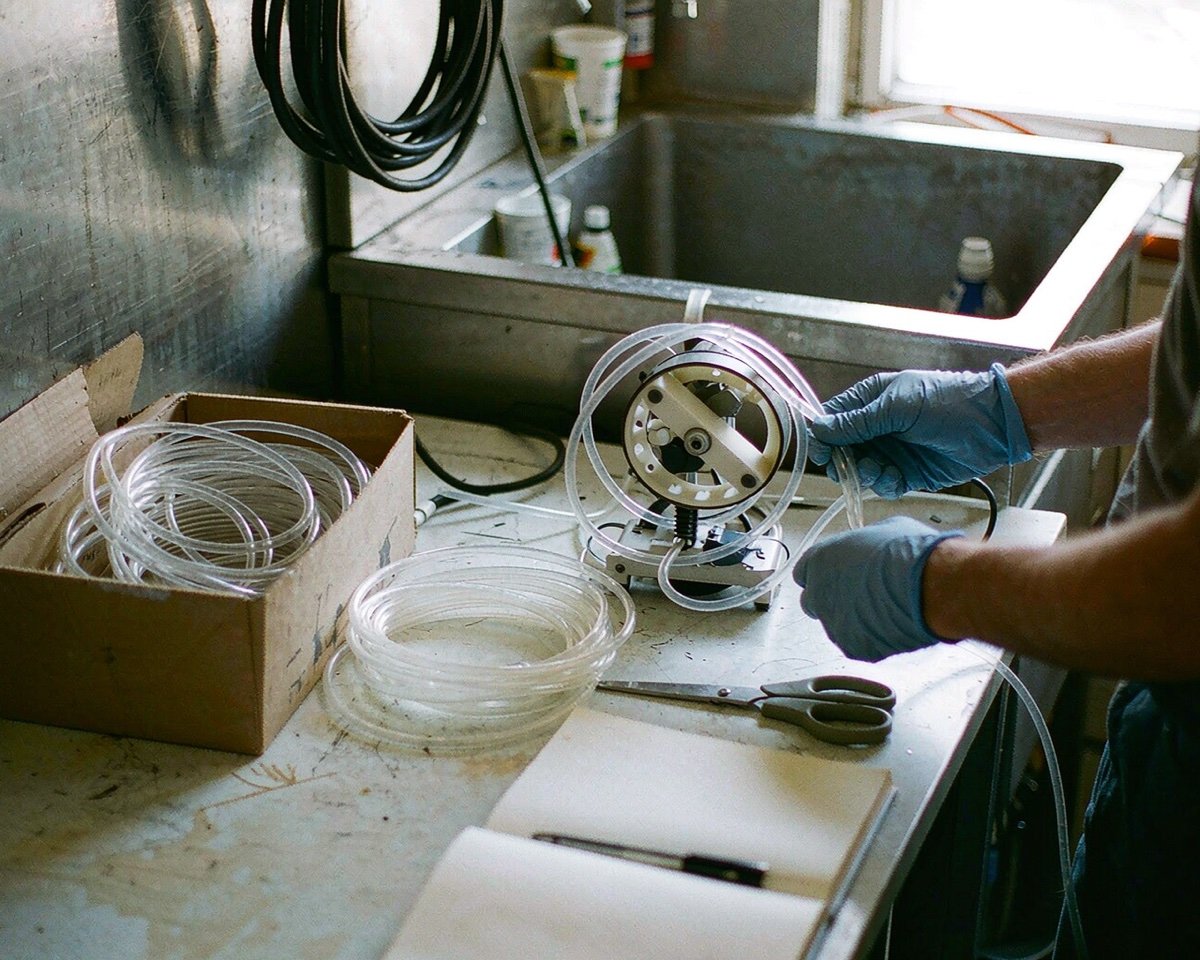
Silicone is the default. Cheap, biocompatible, and flexible, but weak against solvents. Platinum-cured beats peroxide-cured for purity. PharMed BPT is a styrene-ethylene-butylene-styrene copolymer built for pumping: biocompatible, USP-compliant, opaque, with low gas permeability and far longer flex life than silicone. Cole-Parmer’s PharMed BPT specifications spell out the bioprocess credentials. PTFE doesn’t recover after squeezing, so it’s wrong for peristaltic heads. Use it in static lines and piston-pump paths where solvents would attack silicone or PharMed.
Replacement is a scheduling decision, not a visual one. Set intervals by pump hours, inspect weekly, and keep spares racked. I learned this the hard way. We ran silicone media lines until they turned the color of weak tea, and a burst line at hour 9 of an overnight fill drowned a deck tray. Now I swap silicone every 90 days and PharMed every 6 months regardless of looks, and two pre-assembled spare sets live on the shelf.
Mind the fit too. Tubing stretched into a wrong-ID pump head changes flow rate silently. Label every tubing set with its size and install date. A forty-cent label beats a rerun.
7. Filter tips and filter plates for built-in filtration
Some workflows want filtration inside the automation loop, not at the bench before it.
Pore size comes first. 0.22 µm is sterilizing-grade for buffers and media. 0.45 µm clarifies particulates from lysates and dirty environmental samples. Filter plates put 96 of these membranes over a deep-well footprint so the robot can pull a full plate through by vacuum or centrifugation at once.
Membrane choice matters as much as pore size. Hydrophilic PTFE handles aqueous and high-organic mixes, including DMSO-heavy compound libraries, because it resists solvents yet wets with water. PVDF suits protein work with its low binding. Nylon adsorbs proteins aggressively, so skip it for assays sensitive to sample loss. PES is the everyday choice for cell culture feeds.
Filtration can also live at the vial level. Restek’s Thomson filter vials fold the membrane into the insert, so you filter and load in one step. The standard version keeps dead volume around 120 µL, and the Nano version drops it to 8 µL, which lets you filter a 10 µL precious sample and still pull a 2 µL injection. See Restek’s filter vial specs for the membrane and dead-volume options.
Design against the failure mode: clogging mid-plate. If sample clarity varies, pre-filter or use a glass fiber prelayer. A stopped vacuum pull at plate 14 of 40 is a bad way to spend an afternoon. One more tip for protein-heavy samples: pre-wet hydrophobic membranes with buffer before the run. Dry PVDF rejects aqueous samples until it’s wetted, and the robot has no patience for that.
8. Waste management
Waste sounds boring until it stops a run.
Sizing first. Waste bottles should hold more than the total dispensing volume of your longest unattended run, with margin. A robot filling 40 plates at 200 µL per well puts roughly 800 mL somewhere. Undersized waste bottles are the most common cause of “run failed at 3 a.m.” in walk-away logs.
Vapor protection next. Organic solvent waste on a deck needs a vented cap or vapor trap, not a sealed jug. Sealed bottles pressurize from vapor and pump-back, then the cap pops or solvent pushes backward into the system. Charcoal vapor traps protect the deck and whoever walks past it.
Segregation, always. Halogenated and non-halogenated solvent waste go to different bottles from day one, and acids and oxidizers get their own. Mixing them is a safety violation in most facilities and wrecks disposal pricing. Label waste bottles as rigorously as reagent bottles, with contents and start date.
Autosampler waste has its own quirks: needle wash overflow, drain lines, and small waste vials that fill silently mid-sequence. My guide to autosampler waste vials covers that side. Before any walk-away run, check waste levels. It’s a ten-second habit that saves entire nights. And keep a secondary containment tray under any solvent waste bottle on a deck that moves plates over it. Cheap insurance.
9. Barcode labels that survive the machine
Automation reads labels, and a misread is worse than a failure because it arrives dressed as data.
Three things kill labels on automated decks: cold, solvents, and handling. Deep-well plates go to -80 °C and sometimes into liquid nitrogen, where standard labels lift or the adhesive gives up. Cryogenic labels rated to -196 °C stay put through freeze-thaw cycles. Solvent resistance matters wherever acetonitrile or DMSO can splash. Use thermal-transfer printed labels with resin ribbons rather than anything handwritten.
Readability is the other half. Barcodes need flat application on flat scan zones, since wrinkles on curved tube walls create scan failures. Robot readers scan fixed positions under fixed lighting, so test your labels through the actual reader before committing a lot. If your reader scans plate bottoms or side positions, place labels exactly where the scanner expects them, every time.
Track more than sample ID when you can. Printing consumable lot numbers onto the label lets you trace a bad lot after the fact instead of guessing. My guide to labels that survive freezers and solvents walks through material choices. The payoff is boring in the best way: walk-away runs that come back with every plate accounted for.
Conclusion
Liquid handling automation rewards labs that sweat consumables. None of these nine decisions is hard on its own. Robot-verified tips, low-retention and conductive surfaces, sane reservoirs, right-sized vials and inserts, GL45 bottles, scheduled tubing swaps, matched filters, managed waste, and reader-proof labels each remove one failure mode. Stacked together, they remove most of the reasons an automated run fails overnight.
Start with the tip decision, since tips touch every aspiration your robot makes. Then fix waste and tubing, because those fail loudly and expensively. Work down the rest over a quarter and lock each win into your deck SOPs. If you want to go deeper on source labware, my guides to 96-well plates and GL45 media bottles cover the two labware standards most decks lean on. Small decisions, repeated daily, are what uptime is made of.
Frequently Asked Questions
Do automated liquid handlers need special pipette tips?
Usually yes. Bench pipettes tolerate generic universal tips, but 96- and 384-channel heads need consistent collar geometry, straightness, and sealing to aspirate a full plate at once. Robot-compatible tips are lot-tested for fit and performance on specific workstations. Generic tips are not.
What consumables does a liquid handling robot use?
The core set is pipette tips (often conductive or filtered), reservoirs and troughs, source labware such as autosampler vials and 96-well plates, reagent bottles, peristaltic tubing where the system pumps media, filter tips or filter plates, waste bottles, and barcode labels. Wash station fluids and vacuum consumables round out integrated systems.
Can I use cheaper third-party tips on my Tecan or Hamilton?
Many aftermarket tips are made to match specific heads and work fine, but verify before buying in bulk. Run a gravimetric check against your current tips and confirm seating and ejection on your exact head. Keep one validated lot through method validation before switching a regulated method.
How often should peristaltic pump tubing be replaced?
On a schedule, not by appearance. Silicone typically lasts weeks to a few months in regular service, while PharMed BPT runs considerably longer. Set intervals by pump hours, inspect weekly for swelling, discoloration, and flat spots, and keep a pre-assembled spare set ready.
Why do I need conductive pipette tips?
Conductive tips are required for capacitive liquid level detection. The sensor reads liquid contact through the tip, so non-conductive plastic blinds it and the robot falls back to fixed-depth aspiration. That means aspirating air, plunging into well floors, and missed error detection.