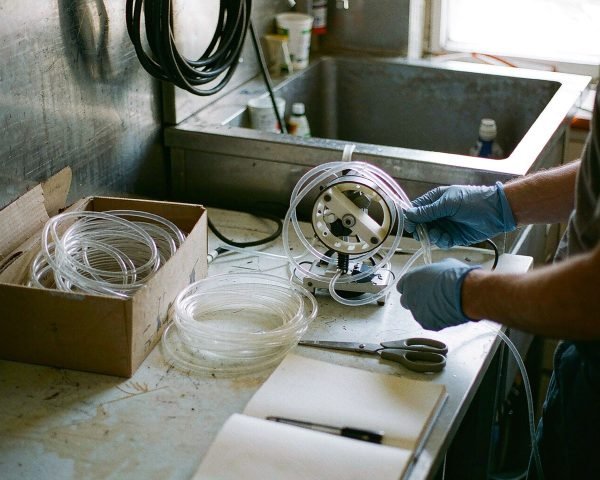

A reader emailed me last month about a media-fill line that kept drifting out of spec. New pump, new operator, same recipe. The culprit was a tube that had taken a set and was delivering about 10% less than the calibration assumed.
The short answer: Choosing peristaltic pump tubing hinges on chemical compatibility, bore size, and speed. Silicone suits aqueous work, PharMed BPT or C-Flex lasts longer, Viton handles aggressive solvents. Match the wall to your pump head, then pick the biggest bore you can run at low rpm.
In a peristaltic pump, the tube is the pump. Everything else just squeezes it, so the tube decides your flow rate and your purity. Treat it as a consumable you spec deliberately, not an accessory you grab from the drawer.
How a Peristaltic Pump Actually Moves Fluid
The mechanism takes one sentence to explain. Rollers compress the tube and push the fluid forward; the tube’s elastic recovery then refills behind each roller. That recovery is the suction stroke. No recovery, no suction.
Two consequences follow. First, the tube must be a true elastomer with strong memory, because it gets squeezed thousands of times per hour. Second, occlusion matters. The rollers must flatten the wall completely against the housing, or the pump slips and flow drops. The tube carries all of that stress, which is why Watson-Marlow notes that suction lift, pressure, life, flow rate, and efficiency are all largely determined by the tubing in its tubing selection guide.
Tubing Materials, Compared
Start with silicone. It’s the default for aqueous buffers and media. It’s cheap and biocompatible, and it goes through an autoclave without complaint, but flex life is short and gas permeability is high, so dissolved gases move through the wall. For cell culture, that CO2 loss matters more than most people expect. Platinum-cured silicone costs a bit more and leaves fewer extractables than peroxide-cured grades, which is why it dominates biopharma. If you’re feeding a bioreactor, pair it with the right vessel setup; our media bottles for cell culture guide covers the container side.
PharMed BPT and C-Flex. Thermoplastic elastomers built for peristaltic duty. Tube life runs two to three times longer than silicone. Spallation stays low, and gas permeability drops as well. This is my pick for long cell-culture runs and anywhere I don’t want to change tubes mid-process. Masterflex rates PharMed BPT for up to 1,000 hours at 2.7 bar in its tubing formulation guide.
Tygon-style lab tubing comes next. Formulations like Tygon E-LAB (E-3603) and E-LFL are the general lab workhorses with broad chemical resistance and long tube life, plus full transparency for flow checks. Saint-Gobain’s pump-life data for E-LFL shows how hard back pressure hits tube hours in its datasheet: roughly 1,000 hours at 5 psi but only about 150 at 25 psi. Pressure is a life multiplier you can’t ignore.
Viton and other fluoroelastomers. The solvent answer. Hydrocarbons and fuels are fine, as are many aggressive organics. Two catches: ketones and amines attack Viton, and it costs several times what silicone does. Cole-Parmer’s tubing team makes the same point about silicone swelling and cracking in solvents, and recommends solvent-specific formulations instead in its aggressive-chemicals guide.
PTFE is the odd one out. Chemically it’s near-perfect. Mechanically it’s wrong for this pump. PTFE is a plastic, not an elastomer. Crush it with a roller and it stays flattened instead of springing back, so the pump loses its suction stroke and slip gets worse with every pass. Repeated flexing also work-hardens it until it cracks. I use PTFE for static transfer lines and never inside a pump head.
One caution that applies to every material: compatibility charts are usually room-temperature, static-contact ratings. Pumping adds mechanical stress, and mixtures behave differently from single chemicals. When in doubt, run a 48-hour immersion test with your actual fluid.
Sizing: Bore, Wall Thickness, and RPM
Flow rate in a peristaltic pump is simple math. Flow equals volume per revolution times rpm, and volume per revolution is set by the bore. An L/S 16 (3.1 mm ID) pushes roughly 3 ml per rev on a typical head, so at 60 rpm you get around 180 ml/min. Need more? Go up a bore size before you crank the speed.
That matters for life because every roller pass is a fatigue cycle. Halve the rpm and you halve the cycle count for the same volume. Watson-Marlow’s rule of thumb says it plainly: large bore at low speed for maximum tube life, small bore at high speed for maximum accuracy, with the full trade-offs laid out in its tubing brochure. I follow it. My dosing setups run L/S 16 at 60 rpm rather than L/S 14 at 200 rpm, and tubes last the full quarter.
Wall thickness is the other half. Most lab pump heads, including Masterflex L/S-style ones, expect a 1.6 mm wall. A 3.1 mm wall won’t occlude fully in that head, so the pump slips. A thin wall in a head adjusted for thick gets over-squeezed and dies fast. Match the wall to the head, always. High-pressure jobs call for thicker-wall or reinforced formulations, not more occlusion.
Keep an eye on the reservoir side too, since tubing problems often start upstream. Our solvent reservoir bottles guide covers caps and fittings that feed the tube cleanly.
Tube Life: Creep, Set, and Replacement Schedules
Peristaltic tubing fails in two ways. Fatigue is the obvious one: cracks, then a leak or a burst. The quiet one is creep, sometimes called set. The wall takes a permanent flattening and the recovery stroke weakens, so flow drifts down while the pump looks perfectly fine. On one fermenter I inherited, the feed pump slowed 15% overnight because the tube had taken a set. Nothing was broken. The tube was just tired.
My replacement triggers:
1. Flow drift. Replace when flow drops about 10% from your baseline. Time it into a graduated cylinder now and then so you have a number.
2. Set or hours. Visible flattening that doesn’t spring back within a minute of releasing the head, or hitting your tracked hour count. General guidance runs from 100 to 1,000 hours depending on the material and how hard the pump works, so log your own hours and you’ll find your number.
Rotate the tube 180° in the head between changes to spread the wear. Keep sealed spares on the shelf, stored away from sunlight and ozone sources like motors, and rotate stock first-in, first-out. A tube is cheap. An overnight run lost to a burst is not.
Five Mistakes That Shorten Tube Life
Wrong wall for the head. Covered above, but it’s the number one killer, so it bears repeating.
One tube, two solvents. Extractables and absorbed fluid from the first solvent end up in the second. Swap the tube when you swap the fluid, especially for mobile phases and anything feeding an analyzer.
Over-tightening the head. Cranking the occlusion down “for security” crushes the tube and multiplies fatigue. Set it so the pump just stops slipping, then stop turning.
Ignoring tube memory. A tube left compressed for weeks takes a set before its first real run. Release the head or remove the tubing whenever a pump sits idle.
Trusting a chart instead of your fluid. Charts are a starting point. Your temperature and concentration matter, and so does the duty cycle.
Conclusion
Tubing selection comes down to matching three things: the chemistry of your fluid, the bore that delivers your flow at low rpm, and the wall your pump head expects. Silicone for aqueous work, PharMed BPT or C-Flex when you need tube life, Tygon-style formulations for general lab duty, Viton for solvents. Replace on flow drift and tracked hours, not on bursts. If you’re building out the fluid path around the pump, two of our guides pair well with this one: GL45 media bottles for the reservoir end, and bottle-top dispensers when a pump is overkill for the volume you actually move. Get the tube right and the pump becomes the most boring instrument in the lab. That’s exactly what you want.
Frequently Asked Questions
What tubing is best for peristaltic pumps?
There’s no single best tube; it depends on the fluid and the duty cycle. Silicone works well for aqueous, biocompatible applications, PharMed BPT or C-Flex gives much longer life, and Viton or Tygon Chemical formulations handle aggressive solvents. Always check a compatibility database for your specific fluid first.
How long does peristaltic pump tubing last?
Anywhere from about 100 to 1,000 hours, depending on the material and how hard the pump works. Saint-Gobain’s data for Tygon E-LFL shows roughly 1,000 hours at 5 psi but only about 150 hours at 25 psi. Track your own hours and replace on a schedule before the tube bursts.
Can you use PTFE tubing in a peristaltic pump?
Not really. PTFE is a plastic with almost no elastic recovery, so after a roller compresses it, it stays flattened and the pump loses suction. It also cracks under repeated flexing. Use PTFE for static lines and choose a fluoroelastomer or fluoropolymer-lined pump tube for aggressive chemicals.
Does tubing size affect flow rate?
Yes, directly. Flow equals the tube’s volume per revolution times rpm, and a bigger bore moves more fluid per revolution. The smart trade is a larger bore at lower rpm, which delivers the same flow while cutting fatigue cycles and extending tube life.
How do I know when to replace peristaltic pump tubing?
Watch for a flow rate that has dropped about 10% from baseline, flattening that doesn’t spring back when you release the head, or any visible cracks and swelling. If you run scheduled production, replace on tracked hours rather than waiting for a failure.