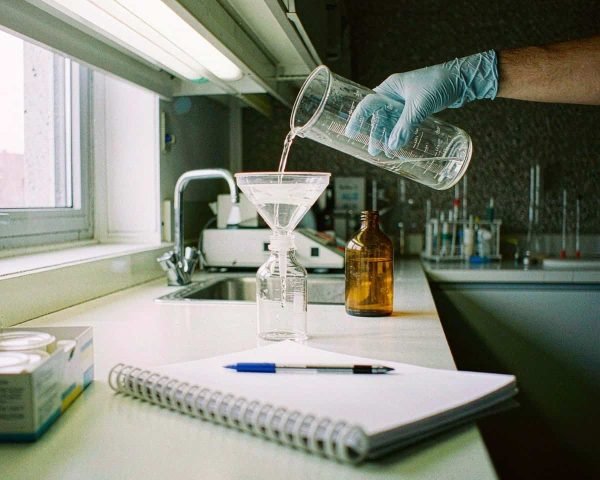

If you’ve ever chased a pressure spike that appeared halfway through a batch, there’s a decent chance the answer was sitting in your solvent bottle, not in your instrument. Filtration is one of those five-minute habits that quietly decides whether your Friday runs look like your Monday runs.
Short answer: yes, filter it. Any mobile phase you mixed yourself, and every aqueous buffer, should go through a 0.45 µm or 0.22 µm membrane before it touches your pump. Sealed, HPLC-grade organic solvents are the only common exception. Filtration protects pump seals, inlet frits, and the column frit from particles, and it removes the microbial load that grows in buffers left on the bench.
Here’s where it gets more nuanced, because “filter everything” is not quite the whole story. Which bottle needs the filter, which membrane to grab, and how often to refresh what’s behind the filter are three different decisions, and labs get all three wrong in different ways.
What Particles Actually Do to Your System
An HPLC pump is a precision machine with very little tolerance for debris. Particles in the mobile phase score the plunger, chew up pump seals, and lodge in the inlet solvent filter. Downstream, they settle into the column inlet frit, and that’s when you see it: pressure climbing a few bar per day until the column is dead or the system shuts down on overpressure.
Agilent is blunt about this in their system guidance. Their LC maintenance guidance states that all prepared organic solvents, mixtures, and aqueous buffers must be filtered through a 0.2 µm filter, calling it the preferred method to remove the insoluble fraction and avoid blockages in capillaries and filters. That’s not a suggestion from a fussy application chemist. It’s the failure mode they see in service tickets.
The cost math is lopsided. A 47 mm membrane filter costs a fraction of what a column costs, and less than the technician-hour it takes to diagnose a pressure problem that crept in over two weeks. Agilent’s own product notes for solvent filtration assemblies make the same point: filtering before analysis reduces wear on the plunger, prevents column and capillary blockage, extends seal life, and lowers background noise in the chromatogram.
One more thing particles do that nobody budgets for: they seed microbial growth. Bacteria and algae love aqueous buffers in the pH 4 to 8 range, and once a biofilm establishes itself inside a bottle or a solvent line, flushing it out is miserable. If you’ve ever seen ghost peaks on a clean system, an older buffer bottle is one of the first places I’d look.
Which Mobile Phases Need Filtering (and Which Don’t)
The rule I use, and it’s served me well:
Filter these:
- Aqueous buffers, every time, no exceptions. Phosphate, acetate, formate, citrate, anything with salts.
- Anything you mixed yourself. Water plus acetonitrile, water plus methanol, additive-containing phases. Mixing introduces particles from the water, the graduated cylinder, the bottle, and the air.
- Mobile phases with additives that may not fully dissolve: ion-pair reagents, TFA at low concentrations, buffers near their solubility limit.
Skip filtering these:
- Sealed bottles of HPLC-grade or LC-MS-grade acetonitrile and methanol. The solvent left the manufacturer through their own filtration train, and every step you add after opening the bottle is a new chance to contaminate it. In my experience, pouring LC-grade solvent through a cheap membrane adds more risk than it removes if the flask or the membrane isn’t clean.
The distinction confuses people because the answer section above says “yes, filter it.” The honest version is: filter anything that was ever open, mixed, or aqueous. Don’t filter sealed chromatography-grade organics into a flask you haven’t rinsed.
One habit worth stealing from Agilent’s maintenance guidance: they recommend replacing aqueous mobile phases and bottles daily, and organic mobile phases at least every second day. Not topping off. Replacing. Pouring fresh buffer into yesterday’s buffer is how biofilms get their start, and no amount of filtration fixes a bottle that’s been refilled for two weeks.
0.45 or 0.22? Match the Filter to Your Column
Both pore sizes remove particles. Which one you should reach for depends on the packing material in your column, and Waters puts the rule plainly in their filter selection guide: for column particles larger than 3 µm, use a 0.45 µm filter; for sub-3 µm packing, use 0.2 µm.
That maps neatly onto hardware generations. A classic 5 µm analytical column was designed around a 0.45 µm filtration habit. A 2.1 mm ID column packed with 1.7 µm particles has much smaller interstitial channels and a much less forgiving frit, so 0.22 µm is the floor, not the upgrade.
If you run mixed methods on one instrument, just standardize on 0.22 µm for everything aqueous and self-mixed. It costs a little more per membrane and it works everywhere. The difference between 0.22 and 0.45 micron filters comes down to flow resistance and filtration fineness, and for mobile phase bottles the flow penalty of the finer membrane rarely matters, since you’re usually filtering at vacuum or gravity speeds anyway.
Membrane chemistry matters too. PTFE membranes handle organic solvents but are hydrophobic, so they need wetting for aqueous phases. Nylon, PES, and mixed cellulose ester membranes are the usual picks for aqueous buffers. If you want the fuller version of that decision, the syringe filter chemistry guide for HPLC sample prep walks through it membrane by membrane.
The Failure That Made Me a Believer
I inherited a method once where the pressure climbed about 8 bar every week like clockwork. Nothing else moved. Retention times were stable, peaks looked fine, and the service engineer found nothing wrong with the pump.
The cause was the buffer bottle. Someone had been topping off the same 1 L of phosphate buffer for about ten days, filtering it faithfully each morning, I’ll grant them that. The filtration was fine. The bottle itself was growing a biofilm that shed slowly into the inlet filter, and the weekly pressure step was the frit clogging a little more.
We tossed the bottle, started making fresh buffer every second day, and the pressure curve went flat. The filter membrane had been doing its job on particles. It can’t do anything about what grows in the bottle between filtrations. When pressure misbehaves on an otherwise healthy system, HPLC pressure troubleshooting starts with the mobile phase supply, and this story is the reason.
A Simple Routine That Covers 90% of Labs
If you only change one thing this week, change how often buffer gets replaced. The filtering part most labs already do.
A routine that works:
- Make aqueous buffer fresh, in clean glassware, at most every two days. Daily is better in warm labs.
- Filter it through 0.45 µm (standard HPLC) or 0.22 µm (sub-3 µm columns, UHPLC) into a clean, dedicated bottle.
- Keep a set of bottles per solvent channel so bottles get fully emptied, rinsed, and dried on rotation.
- Never top off. Empty, rinse, refill.
- Leave sealed LC-grade organics alone until they’re in use.
That’s it. No new hardware, no method changes. The pumps and columns that survive on this routine are the ones still giving reproducible retention times three years in, and pump preventative maintenance is really a stack of habits like this one.
Conclusion
So, should you filter your mobile phase before use? Filter every aqueous buffer and every phase you mixed yourself, through 0.45 µm for standard columns and 0.22 µm for sub-3 µm packings. Leave sealed chromatography-grade organic solvents unfiltered, because the bottle is cleaner than your filtering setup. And pair the filtration habit with fresh bottles on a fixed replacement schedule, since the microbes and the precipitates that actually kill columns live in bottles that never get emptied. The whole routine costs a few membranes a week. A new column, a pump seal kit, and two days of downtime cost considerably more. If your lab is tightening up its solvent handling, the complete syringe filter and filtration guide for HPLC sample prep is a good next read, and it pairs well with a look at what pump maintenance habits your filtration is actually protecting.
Frequently Asked Questions
Do I need to filter HPLC-grade acetonitrile or methanol?
Usually no. Sealed, chromatography-grade organics are pre-filtered by the manufacturer, and transferring them through your own glassware can introduce particles. Filter them only if you’ve opened, mixed, or added something to the bottle.
Can I filter mobile phase through the same membrane twice?
No. A used membrane is loaded with whatever it caught, and pushing fresh solvent through it can release particles back into the liquid. One membrane, one filtration, then discard it.
How long does filtered mobile phase last?
Aqueous buffers are best used within 24 to 48 hours, since microbial growth starts quickly in the pH 4 to 8 range. Pure organic phases or water/organic mixes keep longer, but replace anything that’s been open for more than a couple of days.
Should I filter or degas my mobile phase, or both?
Filtration removes particles; degassing removes dissolved gases that cause pump cavitation and baseline noise. Vacuum filtration through a membrane does both at once, which is why many labs filter and degas in a single step before filling solvent bottles.
What happens if I don’t filter my mobile phase at all?
You might get away with it for weeks using pre-filtered organics on a robust system. But with aqueous buffers or hand-mixed phases, expect rising pressure, clogged inlet filters, shorter column life, and occasional blockages that shut down runs mid-sequence.