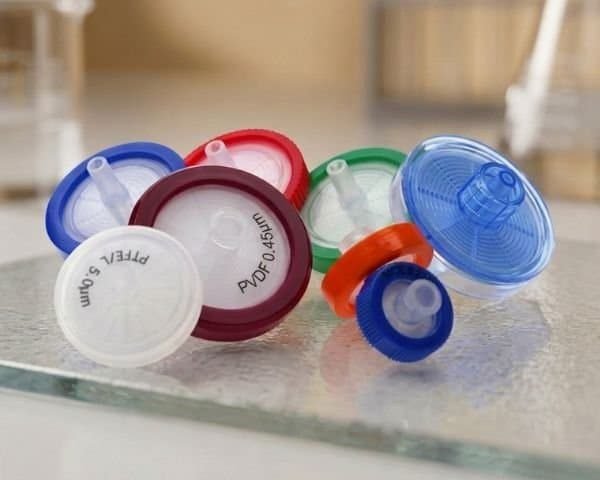

I’ve watched plenty of analysts grab a syringe filter without a second thought — whichever box happens to be closest. That habit quietly costs labs money in clogged filters, re-run samples, and even damaged columns. Let me clear up the 0.22 vs 0.45 question once and for all.
The short answer: A 0.45 µm syringe filter clarifies samples by removing particulates — it’s the workhorse for routine HPLC prep. A 0.22 µm filter is sterilizing-grade, removing most bacteria, and it protects high-sensitivity instruments like UHPLC and LC-MS. Pick 0.45 for clarification, and 0.22 when you need sterility or an ultra-clean sample.
That’s the quick version. Now let me show you exactly why the difference matters, when each one is the right call, and the two-step trick that keeps fine filters from clogging.
What Pore Size Actually Means
A syringe filter’s pore size is the diameter of the tiny openings in its membrane. That single number decides which particles get trapped and which ones pass through.
A 0.45 µm filter removes particles larger than 0.45 micrometers. A 0.22 µm filter removes particles larger than 0.22 micrometers. Because the 0.22 pores are smaller, they catch finer debris — and they catch almost all bacteria, which is exactly why 0.22 is the sterilizing standard.
Here’s the trade-off that matters in real life: smaller pores trap more, but they also clog faster and flow slower. So the “finer” filter isn’t automatically the “better” one. It depends entirely on what you’re trying to accomplish.
When to Use a 0.45 µm Filter (Clarification)
Reach for a 0.45 µm filter when your goal is to remove particulate matter — dust, precipitates, or suspended solids — before injection. This is the workhorse for routine analytical work.
Common uses include:
- Routine HPLC and GC sample preparation
- Environmental water and soil testing
- Food and beverage analysis
- Clarifying buffers and solvents
The advantage is speed. Larger pores let liquid flow faster with less back pressure, and they’re far less likely to clog on a dirty sample. For most standard HPLC columns — the ones packed with 3 µm or 5 µm particles — a 0.45 µm filter is plenty to protect the column frit from particle damage.
Phenomenex puts it plainly: 0.45 µm filters are generally used to remove particulates from samples and mobile phases, while a 0.20 µm filter is reserved for sterile filtration.
When to Use a 0.22 µm Filter (Sterilization)
Reach for a 0.22 µm filter when you need sterile filtration or an exceptionally clean sample.
Common uses include:
- Sterilizing buffers, media, and reagents for cell culture
- Filtering injectable solutions and pharmaceutical products
- Preparing samples for sensitive detectors (UHPLC, LC-MS)
- Microbiology and molecular biology work
Why 0.22 specifically? Most bacteria fall between roughly 0.2 and 5 µm, so a 0.22 µm membrane traps them. The FDA’s guidance on aseptic processing describes sterile filtration through a sterilizing-grade filter of 0.22 µm (or smaller) as the accepted approach when a product can’t be terminally sterilized.
One thing a filter can’t do is remove viruses. Viruses are far smaller than 0.22 µm and slip right through both pore sizes. Sterile filtration targets bacteria and molds, not viruses — that’s a job for ultrafiltration or nanofiltration.
The Real Difference: Flow Rate vs. Cleanliness
Here’s the core trade-off in a sentence: 0.45 filters fast but leaves finer particles behind; 0.22 filters clean but flows slow and clogs easily.
If your sample is viscous or full of particulates, a 0.22 µm filter may clog before you finish filtering it. A 0.45 µm filter will usually push straight through. That’s why so many labs default to 0.45 for everyday work and reserve 0.22 for the specific cases that genuinely need it.
The Two-Step Trick for Dirty Samples
When a sample is heavily loaded with particles, don’t fight a single fine filter. Pre-filter first.
Filter through a 0.45 µm membrane, then pass the filtrate through a 0.22 µm membrane. The coarse filter catches the big debris, so the fine filter only has to handle the small stuff. This extends the life of the finer filter and prevents it from bursting under pressure.
Filter manufacturers build for exactly this scenario. Merck notes that Millex syringe filters with a graduated glass-fiber prefilter are designed for faster filtration of hard-to-filter, particle-laden samples.
Does Column Size Change the Answer?
Yes. Match your filter to your column.
Standard HPLC columns pack 3–5 µm particles, and their inlet frits are forgiving. A 0.45 µm filter protects them just fine. UHPLC columns, on the other hand, pack sub-2 µm particles, and their frits are far more sensitive. A 0.22 µm filter is the safer choice there, keeping sub-micron particles away from the column.
The same logic applies to your detector. If you run LC-MS or another high-sensitivity system, finer filtration means fewer stray particles and cleaner baselines. Thermo Fisher describes syringe filtration as a step that removes interfering materials and fine particles while protecting delicate instruments and prolonging column life. If cleaner, more reproducible separations are your goal, the key factors that improve HPLC resolution are worth a read too.
What About the Filter Diameter?
Pore size gets all the attention, but diameter matters for volume and hold-up.
- 4 mm filters suit tiny samples under 2 mL.
- 13 mm filters handle 1–10 mL, which covers most HPLC vials.
- 25 mm filters handle 10–100 mL.
- 30 mm filters suit larger or more viscous volumes.
Smaller filters also mean lower hold-up volume — the liquid trapped inside the filter after you’re done. If your analyte is precious or limited, a smaller filter wastes less of it.
A Quick Way to Choose
Ask yourself three questions, in order:
- Do I need sterility? If yes, use 0.22 µm.
- Is my sample viscous or loaded with particles? If yes, start with 0.45 µm (or a pre-filter) and step down to 0.22 µm if needed.
- Am I protecting a sensitive instrument? If you run UHPLC or LC-MS, lean toward 0.22 µm.
That’s it. Most of the time, question one is the only one you need.
Conclusion
The 0.22 vs 0.45 decision comes down to purpose, not price. A 0.45 µm filter clarifies your sample quickly and keeps routine HPLC flowing. A 0.22 µm filter sterilizes and protects sensitive systems. Neither one is “better” — each solves a different problem, and using the right one saves you clogged filters, re-runs, and column damage.
If you’re still sorting out which filter fits your workflow, I’d start with our guide on choosing the right syringe filter for a deeper look at membranes and sizing. And when you want your prep step to actually improve your results, this walkthrough on proper HPLC sample preparation will help. Get the pore size right, and your whole method gets a little more forgiving.
Frequently Asked Questions
What is the difference between a 0.22 and 0.45 micron filter?
A 0.45 µm filter removes particulates for clarification and flows faster. A 0.22 µm filter is sterilizing-grade, removing most bacteria while flowing slower and clogging more easily. Choose based on whether you need clarification or sterility.
Is a 0.22 micron filter always sterile?
The 0.22 µm pore size is the sterilizing-grade standard, but the filter only sterilizes when it’s used correctly and is itself sterile. Non-sterile 0.22 µm filters still remove bacteria from the sample, but they aren’t guaranteed sterile out of the box.
Can I use a 0.45 micron filter for HPLC?
Yes. For routine HPLC with standard 3–5 µm columns, a 0.45 µm filter is usually enough to protect the column from particulates. Reserve 0.22 µm for UHPLC, LC-MS, or when you need sterile filtration.
Do 0.22 micron filters remove viruses?
No. Viruses are far smaller than 0.22 µm and pass through both 0.22 and 0.45 µm membranes. Removing viruses requires ultrafiltration or nanofiltration, not a syringe filter.
Why does my 0.22 micron filter keep clogging?
Smaller pores trap more particles, so dirty or viscous samples clog them quickly. Pre-filter with a 0.45 µm (or glass-fiber) filter first, then finish with 0.22 µm to extend filter life.