
# Polymer Testing Lab Consumables: The Complete Guide
Polymer testing labs burn through dies, pans, crucibles, and crystals faster than most budgets expect, and the wrong consumable quietly corrupts data long before anyone notices. This guide maps every major plastics test to the supplies it actually needs, so you can buy with confidence.
Polymer testing labs measure everything from tensile strength to melting behavior against standards like ASTM D638 and D1238. Each test consumes specific supplies, from dogbone dies and DSC pans to ATR crystals. Matching the consumable to the method protects accuracy and budget.
Below I go test by test through the lab, flag the items buyers get wrong most often, and close with a starter list you can hand straight to purchasing.
What a Polymer Testing Lab Actually Does
Ask five people what a polymer lab does and you’ll get five answers, so let me pin down the scope first. A polymer or plastics testing lab characterizes materials for product development, incoming material qualification, failure analysis, and regulatory compliance. The clients range from an automotive Tier 1 verifying a bumper fascia compound to a food packaging producer checking migration limits on a new film.
The test menu is wider than most people assume. On the mechanical side you have tensile, flexural, and impact testing, each with an ASTM and an ISO twin. On the thermal side, differential scanning calorimetry (DSC) measures glass transition, melting, and crystallization behavior, while thermogravimetric analysis (TGA) tracks filler content and decomposition. Then there is the identification bench, where FTIR tells you whether the mystery pellet is nylon 6 or nylon 6/6. Add melt flow rate, hardness, density, ash content, color and gloss, UV aging, and migration testing for food contact materials, and you have a full working week.
Here is the point I want to land early: almost none of these instruments can produce trustworthy data without the right consumable around them. A DSC cell is only as good as the pan sitting on the sensor. A tensile frame is only as good as the specimen the die cutter produced. That is why this guide exists.
For orientation, here is the map of tests to standards to consumables that I’ll work through section by section.
| Test | Common standards | Consumables that matter most |
|---|---|---|
| Tensile | ASTM D638, ISO 527 | Dogbone dies, cutters, jaw faces, adhesives |
| Flexural | ASTM D790, ISO 178 | Span supports, specimen cutters |
| Impact (Izod/Charpy) | ASTM D256, ISO 179 | Notching broaches, mounting adhesives |
| Melt flow rate | ASTM D1238, ISO 1133 | Barrel cleaning material, spare dies |
| DSC | ASTM D3418, ISO 11357 | Aluminum pans, lids, encapsulation press dies |
| TGA | ASTM E1131 / supplier methods | Alumina and platinum crucibles |
| FTIR | ASTM E1252 practices | ATR crystals, KBr pellets, solvents |
| Hardness | ASTM D2240, D2583 | Spare durometer indenters, test blocks |
| Density | ASTM D792, ISO 1183 | Immersion liquids, gradient column floats |
| Ash content | ASTM D2584, ISO 3451 | Muffle furnace crucibles |
| UV/weathering | ASTM G154, ISO 4892 | Exposure racks, radiometer consumables |
| Migration (food contact) | EU 10/2011 | Simulant glassware, seals, foil |
Mechanical Testing: Where Specimens Are Born
Mechanical testing consumes more lab-made parts than any other bench in the building, because the specimen itself is the consumable. Get the specimen wrong and nothing downstream can save the result.
Cutting Dies and the Art of a Clean Dogbone
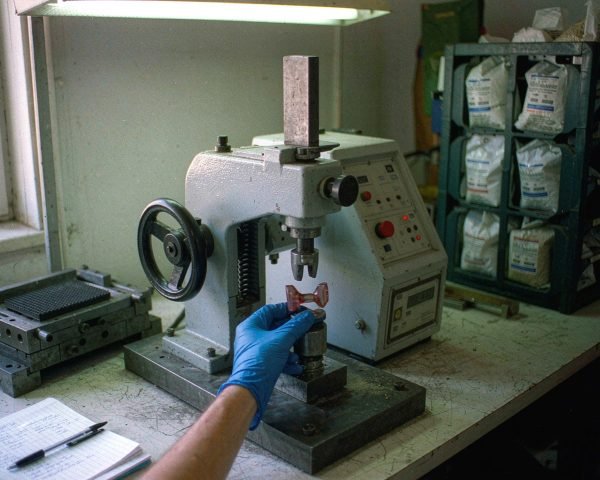
ASTM D638 expects dumbbell-shaped specimens pulled at defined speeds after defined conditioning. The ASTM D638 standard page spells out the dimensions: a Type I specimen is a specific hourglass profile, nominally 3.2 mm thick, cut or molded to shape. Most labs produce these with matched steel dies pressed through sheet stock, or by injection molding straight into the dogbone geometry.
Die quality is where I see quiet failures. A die that has gone a few thousand cuts past its sharpening date starts leaving burrs and a slightly ragged cut edge. Plastics are notch sensitive, so a burr on the shoulder becomes a stress riser, and the specimen breaks early in the narrow section instead of yielding the way the material sheet expects. If your elongation-at-break numbers have been drifting down for six months, check the die before you blame the resin.
For thin film work under ASTM D882, you swap the dogbone for rectangular strips cut with a sharp razor or a film cutter, and blade sharpness matters even more because film tears. For hard thermosets, glass-filled compounds, and composites, a die press will not do the job at all. That is precision cutting territory: abrasive and diamond blades on a cut-off saw, then grinding to dimension. Buehler’s precision cutting blade guide is a useful reference for matching blade type to material, and their polymer-specific options exist for a reason: soft, gummy thermoplastics clog an aggressive blade fast.
Microtomy has a place too. When someone needs to inspect a coating layer or a weld line under the microscope, we cut sections down to roughly 10 microns on a microtome. For optical work on a filled compound I might target a 180 µm thin section, thick enough to handle and thin enough to transmit light. Blades for this are consumables in the strictest sense: one hardened screw, one dull edge, and you buy another.
Grips, Jaw Faces, and What Actually Wears Out
The grips themselves are instruments, capital equipment you buy once. The jaw faces bolted inside them are consumables, and they wear. Serrated faces for rigid plastics blunt, smooth faces for films pick up embedded fragments, and a worn face means slippage that shows up as a low modulus.
Pneumatic side-action grips have become the default for ISO 527-2 work, and the Instron guide to ISO 527-2 tensile testing makes a point I agree with from experience: constant air pressure keeps clamping force steady even as the specimen thins under load, which manual screw grips can’t guarantee. If you run hundreds of specimens a week, pneumatic grips plus a stock of spare jaw face sets pays for itself in fewer reruns.
One trick worth passing along: for very slippery thermoplastics like UHMWPE, some labs wrap the grip ends in emery cloth or use tabbed specimens so the jaw has something to bite. The tabs and cloth are cheap; the rerun isn’t.
Also count extensometer-related supplies here. Clip-on extensometer knives wear, video extensometer markers (the dotted tape you apply to the gauge length) get consumed by the sheet, and both belong on the buying list for a busy tensile bench.
Impact Tests and the Adhesive Problem
Izod and Charpy testing under ASTM D256 looks simple: notch the bar, swing the pendulum, read the number. The consumables hide in the details. Notching is done with a plastic notching machine that uses a single-fly cutter or broach, and the cutter is a consumable with a defined service life. A dull cutter smears the notch root instead of cutting it, and a smeared notch absorbs energy differently, which quietly inflates your impact values.
Adhesives are the sneakier failure. Some labs bond specimens to mounting fixtures for testing or for polishing cross-sections, and cyanoacrylate is the usual choice. I once watched a full Izod campaign fall apart because the adhesive tube had been open for two years. The bond held long enough to fixture but let go partway through the swing, and we repeated roughly 30 specimens before we proved the adhesive, not the compound, was brittle. Adhesive shelf life is a consumable spec. Buy small tubes, date them when opened, and store per the datasheet.
Thermal Analysis: DSC Pans and TGA Crucibles
Thermal analysis is where consumable choice has the most direct effect on data quality, because the pan or crucible sits directly on the sensor and everything about the measurement flows through it.
Choosing DSC Pans Without Guessing
A DSC measurement under ASTM D3418 or ISO 11357 uses a sample of roughly 2 to 10 mg sealed or crimped into a pan, heated at typically 10 °C per minute. The pan types multiply from there, and each answers a different question:
• Standard aluminum pans with crimped lids: the everyday workhorse for polymers, giving good thermal contact and low signal time constant.
• Hermetic aluminum pans: sealed under pressure to hold volatile samples or suppress evaporation endotherms. TA Instruments rates its standard hermetic aluminum pans to about 300 kPa internal pressure.
• Pin-holed lids: let vapor escape in a controlled way when you want to vent moisture without losing the sample.
• Lightweight low-mass pans: for thin films and powders where every milligram of pan mass blurs the transition.
The TA Instruments guide to choosing DSC pans is old but still the clearest one-page summary of the tradeoffs, and it makes an honest point: hermetic pans buy you containment at the cost of slightly worse thermal contact and resolution.
Now the anecdote I promised. We lost a week of instrument time to baseline drift that nobody could explain. It turned out to be the third pan in the autosampler tray: someone had reused it after a nylon run, and the moisture the polymer had absorbed was bleeding out during everyone else’s scans. One reused pan, five days of garbage data. Since then our rule is simple: aluminum DSC pans are single use, no exceptions, and we keep the autosampler stocked from a fresh box.
Two buying notes. Match the pan to the instrument’s press: the encapsulation press takes interchangeable die sets, and a die set for Tzero pans will not crimp a standard pan properly. And never mix pan lots mid-method validation: pan mass and geometry vary slightly between lots, and your baseline subtraction notices.
TGA Crucibles: Reusable, Fragile, and Worth Cleaning
TGA runs hotter and harsher. Alumina (ceramic oxide) crucibles in the 70 to 150 µL range are the standard choice for polymer work, and unlike aluminum DSC pans they can be cleaned and reused: burn out the residue, cool, weigh, check for cracks. Platinum crucibles are the premium option where the sample would react with alumina or where you need clean performance at high temperature; the Mettler Toledo thermal analysis crucible range shows the typical spread of crucibles in aluminum and alumina, with platinum reserved for special cases.
Reusability makes crucibles a different kind of purchase. You buy fewer of them, but each one carries a service log: how many firings, what chemistry ran in it, when it cracked. Platinum ones cost enough that a chip on the rim is a genuine incident. Handle them with dedicated tweezers, clean them on a dedicated schedule, and track them like the small capital items they are.
Here is a quick comparison to keep the two purchases straight.
| Attribute | DSC aluminum pan | Hermetic DSC pan | TGA alumina crucible | Platinum crucible |
|---|---|---|---|---|
| Typical use | Melting, Tg, crystallinity | Volatile or self-pressurizing samples | Filler content, decomposition | Reactive or high-temp samples |
| Reusable? | No | Rarely | Yes, after burnout | Yes, with care |
| Pressure rating | Ambient | Up to about 300 kPa | Ambient | Ambient |
| Rough cost per piece | Low cents | Slightly more | A few dollars | Tens to hundreds |
| Failure mode if wrong | Poor contact, drift | Venting, bulging | Sample-spillover noise | Chemical attack, scratching |
FTIR Identification Supplies
FTIR is the identification bench, and its consumables divide into what the technique touches directly: the crystal, the pellet, and the solvent.
ATR Crystals and Their Limits
Attenuated total reflectance (ATR) has mostly replaced pellet transmission for polymer ID because you press a pellet or film against the crystal and read a spectrum in seconds. The crystal itself is the consumable-in-residence. Diamond ATR is the default because it resists nearly everything a polymer lab can throw at it. Germanium appears when you need shallow penetration for strongly absorbing or curved samples. Zinc selenide is cheaper and delivers nice spectra, but it scratches and reacts with strong acids, so it dies early in a messy lab.
Crystal replacement is a real budget line: a diamond ATR top can cost as much as a mid-range instrument accessory. Treat the crystal surface like a weighing pan: clean after every sample with a lint-free wipe and solvent, never scrape solids across it, and log who damaged what. I’d argue the single cheapest habit in an FTIR lab is cleaning the crystal immediately, every time, no exceptions.
KBr Pellets, Presses, and the Old Ways That Still Pay
Transmission spectroscopy through potassium bromide (KBr) pellets still earns its keep for powders and for building spectral libraries under controlled conditions. The consumables: KBr powder (FTIR grade, stored dry, because it is hygroscopic and wet KBr ruins spectra), pellet dies in 13 mm and similar sizes, a hydraulic press, and cleaning solvents. Wet KBr is such a common problem that some labs keep the bottle in a cabinet desiccator permanently.
Solvent choice matters more than people expect. Isopropanol and acetone are the usual crystal cleaners, but residue from cheap solvent shows up as mystery bands in the fingerprint region. Buy spectroscopy-grade solvent, not the general-purpose drum. For calibration and verification, certified polystyrene film is the daily check standard, and it too wears out and gets replaced on schedule.
Melt Flow Index: Small Consumables, Big Drift
The melt flow indexer looks like the simplest instrument in the lab: heat the barrel, load the resin, time the extrusion. ASTM D1238 governs it, and the ASTM D1238 standard page is worth reading beyond the procedure, because its troubleshooting appendix reads like a list of consumable failures.
The die is the heart of the matter. The standard die has an orifice of 2.0955 mm diameter and 8 mm length. That orifice wears. A die worn even slightly wider shifts the measured melt flow rate, and since melt flow rate is an empirical parameter defined by that exact geometry, a worn die means you are no longer measuring ASTM D1238. A lab running polyethylene at 190 °C or polypropylene at 230 °C all day should inspect the die on a schedule and replace it rather than argue about it.
Barrel cleaning burns through supplies every run. After each test, the barrel gets cleaned at operating temperature, usually with the next charge of the test material itself or with a suitable cleaning composition, then swabbed out. The standard explicitly warns against hard scraping tools that could scratch the bore, so soft cleaning material, lint-free cloth, and patience are what you stock. Piston tip wear is slower but real, and the cutting tool that snips extrudate off the die exit is a genuine consumable: one blade edge per shift, sharper or duller.
A balance note too: Procedure A requires weighing the extrudate cuts to 0.001 g, so a calibration-quality analytical balance near the instrument is part of the effective setup. Skimp there and your MFR precision evaporates.
If you want this test broken down further, I wrote a full guide to what consumables melt flow index testing needs, including the barrel cleaning routine step by step.
Hardness, Density, and Ash: The Quiet Bench Tests
These three tests lack the drama of a pendulum or a furnace ramp, but they run constantly and each has its own supply list.
Hardness: The Indenter Is an Instrument, the Spares Are Consumables
Shore hardness testing per ASTM D2240 presses a shaped indenter into the polymer and reads spring force. The indenter geometry (truncated cone for Shore A, hardened sphere for Shore D) is precision instrument territory: it is not a consumable, and I’d push back gently on any article that lists durometer indenters alongside razor blades. What you do stock is around the instrument: calibration test blocks or reference specimens for daily verification, spare load springs where the model allows, and the soft presser foot surfaces that wear against rough samples.
Barcol hardness per ASTM D2583 for rigid plastics works the same way: the impressor is calibrated as an instrument, while replacement parts like the needle indicator assembly sit closer to consumable territory. For a fuller treatment of what this test family actually consumes, see what consumables hardness testing needs.
Density by Immersion and Gradient Column
Density testing per ASTM D792 or ISO 1183 consumes immersion liquids (distilled water, ethanol solutions, or wetting agents like a drop of dish soap to kill bubbles), plus filter paper for blotting, plus the hydrometer floats or calibrated glass beads that populate a density gradient column. Gradient columns are precision consumable systems: the two-liquid mix ages, thermal drift shifts the calibration floats’ positions, and every few months the column gets rebuilt and recalibrated. Plan for the liquids and the float replacement when you budget this bench.
Ash Content Crucibles
Ash testing per ASTM D2584 or ISO 3451 burns the polymer off and weighs the inorganic residue. This is crucible territory again, but the demands differ from TGA. Porcelain crucibles handle routine glass-filler work cheaply. Quartz crucibles suit work where trace contamination matters. Platinum stays reserved for aggressive chemistries. The consumables around them: crucible tongs with fresh tips, desiccators with working silica gel for pre- and post-weighing storage, and lint-free wipes, because fingerprint salts are measurable ash.
For crucible-heavy workflows in other materials labs, the complete guide to ceramics testing lab consumables picks up where this section stops.
Conditioning, Storage, and the Unpopular Consumables
Nobody photographs the conditioning room, yet several standards refuse to work without it. Tensile testing per ASTM D638 assumes specimens conditioned per ASTM D618, typically 23 °C and 50% relative humidity for at least 40 hours. That means the consumables are the infrastructure: a conditioned room or cabinet, calibrated hygrometers, desiccators with indicating silica gel for the dry side, and desiccant that gets regenerated or replaced on a schedule you actually follow.
Sample intake consumes its own stream of supplies. Pellets and resin samples arrive in everything from sealed boxes to open coffee tins (yes, really), and they leave your lab in labeled containers: zip-close sample bags for pellets, wide-mouth HDPE or glass bottles for powders, and foil-lined caps where moisture matters. Labels and marker pens count too. A sample that cannot be traced back to a lot number is not evidence of anything.
Then the general bench stream: nitrile gloves (powder-free, changed between materials to prevent cross-contamination), lint-free wipes, razor blades and scalpels, spectroscopy-grade cleaning solvents, PTFE tape, and adhesive supplies covered earlier. None of these are exciting. All of them stop the lab when they run out on a Friday afternoon.
Reference Materials and Daily QA
Instruments drift, and reference materials are how you notice before your customers do. Budget for a genuine reference-material line, not a wishful one.
For DSC, calibration standards are metals with certified melting points: indium at 156.6 °C is the daily standard, with zinc and tin extending the range. These are certified materials with certificates and expiry; treating them as infinite-life lab supplies is how labs end up calibrating against oxidized lumps. Buy fresh, store dry, and retire them per the certificate.
For FTIR, the certified polystyrene film I mentioned earlier verifies wavenumber accuracy, typically checked against the 1601 cm-1 band. For melt flow, some resin suppliers offer reference resins with assigned MFR values, and running one weekly catches die wear and temperature drift in a single test. Durometer verification uses reference blocks, tensile needs traceable load cell checks (service, not consumable, but scheduled alongside), and balances need class-appropriate check weights.
Beyond physical references, the paperwork stream is consumable-adjacent: certificates of analysis for every lot of pans, dies, solvents, and adhesives you buy. Auditors in ISO 17025-accredited labs will ask where a pan came from and what lot it was. Keep the certificates with the boxes, not in a drawer someone will eventually clean out.
Buying for a Polymer Lab Without Waste
Procurement for a polymer lab has a specific failure pattern: bulk-buying the wrong items and just-in-time-fumbling the right ones. A few habits from watching this go well and badly.
Buy single-use items by consumption rate, not by case price. Aluminum DSC pans are cheap per piece and burn at a known rate, so a quarterly stock covering your scan volume plus margin is safe. Adhesives, KBr powder, and silica gel expire or degrade, so buy those small and often, and date everything on arrival.
Standardize consumables per instrument, then buy from fewer suppliers with deeper stock. Pan-and-press compatibility is the classic trap: one supplier’s pans, one press configuration, one trained method. Every second compatible brand you introduce multiplies the ways a lab tech can quietly crimp a pan wrong.
Insist on lot traceability and certificates for anything that touches the measurement path. For single-use pans this sounds fussy until the day an entire month of DSC data gets questioned and the only answer that saves you is “same lot, same certificate, same method.”
Finally, price consumables per specimen, not per box. A platinum crucible amortized over 500 firings might be cheaper per test than porcelain you replace monthly. The box price and the test price are different numbers, and procurement managers who compute the second one buy better.
A Starter List for a New Polymer Lab
So what should you actually order first? If you’re standing up a bench that covers tensile, DSC, TGA, MFI, FTIR, and the quiet tests, this is the list I’d hand to purchasing, sized roughly for a lab running a few hundred specimens a month:
• [ ] Dogbone die (ASTM D638 Type I) plus 2 spare cutting edges and a sharpening schedule
• [ ] Notching cutter for Izod/Charpy bars plus 2 spares
• [ ] DSC pans: 1,000 standard aluminum pans and lids matched to your press, 100 hermetic, 100 pin-holed lids
• [ ] Encapsulation press with die sets matched to each pan type
• [ ] DSC calibration kit: indium, zinc, tin, each with certificates
• [ ] TGA crucibles: 50 alumina with lids, 4 platinum, dedicated tweezers, cleaning schedule posted
• [ ] FTIR: diamond ATR crystal (spare on order), KBr powder in small bottles, 13 mm pellet die, polystyrene calibration film
• [ ] Spectroscopy-grade isopropanol and acetone, lint-free wipes
• [ ] MFI spares: 2 dies, 2 pistons, barrel cleaning material, extrudate cutters, check-weight set
• [ ] Tensile bench: spare jaw face sets for each grip type, extensometer markers, emery cloth
• [ ] Durometer test blocks, spare impressor parts per your model
• [ ] Crucibles for ashing: 20 porcelain, tongs, desiccator with indicating silica gel
• [ ] Conditioning: cabinet or room at 23 °C / 50% RH, calibrated hygrometer, 2 bench desiccators
• [ ] Intake and storage: sample bags, wide-mouth bottles, foil-lined caps, label tape, permanent markers
• [ ] Consumables stock: nitrile gloves, adhesives in small tubes (dated), razor blades
Sized this way, the whole list costs less than most single instruments, and it removes almost every consumable-caused rerun I’ve watched over the years.
Conclusion
Polymer testing runs on consumables that look trivial until they fail: a worn die orifice that redefines ASTM D1238 for you, a reused DSC pan that poisons an autosampler week, a two-year-old adhesive that turns an impact campaign into a rerun queue. The fix is rarely spending more. It is buying the right item for each method, in quantities matched to consumption, with certificates and shelf lives respected. Start with the map earlier in this guide, compare it against your own bench, and note which supply line would stop your lab first if it ran dry today. That line is where your next purchase order belongs. From there, the deep dives on what consumables thermal analysis (DSC and TGA) needs and what consumables creep and fatigue testing needs take the two benches where consumable mistakes cost the most data.
Frequently Asked Questions
Can I reuse aluminum DSC pans after cleaning?
Usually not safely. Washing and re-crimping changes the pan mass and surface, and residual polymer or absorbed moisture shifts baselines and transition enthalpies. Treat standard aluminum pans as single use, and reserve genuine reuse for TGA alumina or platinum crucibles, which tolerate burnout cleaning.
How many DSC pans should a lab keep in stock?
Base it on scan volume with margin: if you run 200 samples a month, hold roughly a quarterly supply plus 20%, which for most labs means several hundred pans. Hermetic and pin-holed variants run at lower volume, so 100 of each usually covers the year.
Which consumables affect ASTM D638 tensile results the most?
The die or cutter that shapes the dogbone comes first, because burrs and ragged edges act as stress risers. Jaw faces come second, since worn faces let specimens slip and fake a low modulus. Both are cheap compared with the reruns they cause.
Are hardness indenter parts consumables?
The indenter itself is a calibrated instrument component, not a consumable, and replacing it usually requires recalibration. What you stock around it is consumable: verification test blocks, reference specimens, and model-specific spare parts such as load springs or indicator assemblies.
Do I need different pans for DSC and TGA?
Yes, almost always. DSC typically uses thin aluminum pans optimized for thermal contact at moderate temperatures, while TGA uses alumina or platinum crucibles that survive decomposition temperatures and can be cleaned and reused. The geometry, material, and price points barely overlap.