
# What Consumables Does Melt Flow Index Testing Need?
Melt flow index (MFI) testing looks like one of the simplest tests in a materials lab: melt the resin, push it through a hole, weigh what comes out. But that little machine eats through a surprising range of small consumables, and skipping them shows up directly in your data.
Melt flow index testing needs a standard die (2.0955 mm bore) and piston, barrel cleaning rods with cotton cleaning tape, purging resin, die plugs for high-flow or moisture-sensitive polymers, a cut-off tool or timer and knife, a balance readable to 1 mg, and heat-resistant gloves. Keeping spares of the worn parts matters as much as the resin itself.
Read on for the full list, what each item actually does, when to replace it, and where labs tend to overspend or underspend.
The Short Answer: What Gets Consumed
An extrusion plastometer, the machine behind the ASTM D1238 melt flow rate test, is mostly durable steel. But around that steel sits a working set of consumables that touches every single run:
• Standard die (orifice 2.0955 mm bore, 8.000 mm long) and the matching piston
• Barrel cleaning rod plus cotton cleaning tape, pads, or swabs
• Brass brushes and die cleaning wire or reamers
• Purging resin or cleaning compound for the polymer you just ran
• Die plugs (nozzle plugging devices) for high-flow and moisture-sensitive materials
• Cut-off knife, or a motorized cutter, and a timer for Procedure A
• A laboratory balance readable to 1 mg
• Heat-resistant gloves and, ideally, a bench exhaust or fume extraction
None of these are optional in practice. I’ll go through each and explain why.
The Die and Piston: Wear Parts With a Standards Problem
The die is the heart of the test, and its dimensions are specified almost absurdly tightly. Per Dynisco’s practical rheology guide, the standard die bore is 2.0955 ± 0.0051 mm and 8.000 ± 0.025 mm long, the barrel bore is 9.5504 mm, and the piston land runs 6.35 mm at 9.4742 mm. Temperature has to hold within ±0.2 °C and the applied load within ±0.5%.
The catch is that a die is technically a wear part, but labs treat it like a fixture. Fillers in glass-filled or mineral-filled compounds, hard scraping with steel tools, and corrosion from left-behind polymer all enlarge or roughen the bore. Since flow rate scales with bore diameter, a slightly worn die reads high, and it reads high forever.
My opinion, stated plainly: if you buy one spare part for your melt flow indexer, buy the spare die, and store it sealed. A spare die costs a fraction of one disputed release test.
The piston has the same story. Its tip rides inside the barrel at 190 to 300 °C under full load, hundreds of cycles a week. Nicks or carbon buildup on the tip change the effective bore clearance. Inspect both under magnification when results drift, and record die and piston serial numbers in your test log so a drifting trend can be traced to the hardware.
Cleaning Consumables: Rods, Tape, and Brushes
Between runs, the barrel must be purged and then physically cleaned while it’s still hot. This is where the real recurring spend sits.
Cotton cleaning tape is the workhorse. Vendors like Göttfert supply it on rolls (typically 50 mm wide, tens of meters per roll), and you wrap it around a tapered cleaning rod, run it through the hot bore, and repeat with fresh tape until it comes out clean. The Tinius Olsen MP1200 page lists pneumatic clean-and-purge attachments for labs that want to automate this step, but the tape and pads are consumed either way.
The classic rookie mistake is reaching for a steel brush. A scratched bore never recovers, so my default recommendation is brass or bronze brushes only, plus dedicated die cleaning wires for the 2.1 mm orifice. For stubborn or carbonized residue, a mild polishing paste made for the purpose works; aggressive abrasives shorten die life.
Some polymers make cleaning harder. PVC can leave corrosive residue, fluoropolymers need their own protocol, and PET is notoriously sticky, which is why high-temperature instruments ship with dedicated cleaning creams and go/no-go gauges to check bore wear. If you switch polymer families often, budget the cleaning materials for each family rather than sharing one kit.
Purging Resin and Die Plugs
Purging is the cheapest consumable in the set and the most ignored. A cheap PE or PP purge resin, matched to be safe at your test temperature, flushes the previous material out of the barrel and protects the die from carbonized leftovers. For moisture-sensitive polymers like PET, ISO 1133-1 recommends considering Part 2 of the standard, which adds a preconditioning step with dried air or nitrogen; the purge and the inert-gas overlay work together there.
Die plugs (sometimes called nozzle plugging devices) sound trivial and aren’t. They close the orifice during warm-up so molten material can’t ooze out before the test starts, which matters enormously with high-flow grades. Procedure C in ASTM D1238, for materials flowing above 50 g/10 min, uses a half-size die specifically to keep fast-flowing resins manageable, and the plug does the rest.
I once watched a lab spend two days chasing a batch of recycled PP that read 15% low across three consecutive lots. There was a supplier dispute and round after round of retests. The cause was a die plug left off during warm-up, so the most fluid fraction of the resin dripped out before the timer ever started. The fix cost nothing; the dispute did not.
Cutting, Weighing, and Sample Handling
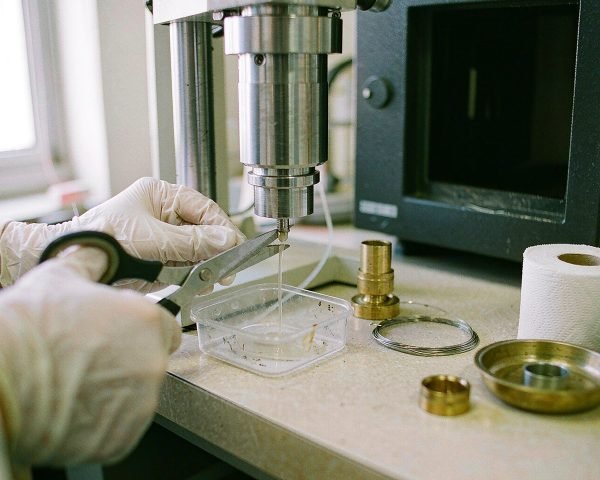
Procedure A is a manual cut-off test: after the preheat (typically 4 to 7 minutes depending on the material), the full test load goes on the piston, and you slice the extrudate at timed intervals with a knife. A cheap digital timer accurate to 0.1 s and a sharp, non-scratching blade are consumables in the practical sense; blades get gummed up and get replaced constantly.
The extrudate strands then get weighed individually to the nearest milligram, and the flow rate is calculated as 600 × mass ÷ cut time in seconds. That means your balance calibration is part of the measurement chain. A benchtop balance readable to 1 mg, verified with check weights, is non-negotiable.
Two smaller items round out the bench set: sample conditioning, since resin absorbed from humid storage flows differently than dried resin, and heat-resistant gloves, because the barrel, piston, and die are all at 190 °C or higher. Glove choice is a bigger topic than people expect, and we’ve covered it separately in our guide to glove choice and sample contamination. For a full rundown of how consumables fit into other materials-testing workflows, see our metals and materials testing consumables guide.
Replacement Cadence and Buying Tips
What gets replaced, roughly how often? In my experience:
| Item | Typical replacement trigger |
|---|---|
| Standard die | Damage, drift vs. reference material, or per your instrument calibration schedule |
| Cleaning tape/pads | Every cleaning cycle (truly consumed) |
| Brass brushes/wires | Bent bristles or flattening, usually months |
| Purging resin | Every polymer change |
| Cut-off blades | Dulling or gumming, every few weeks of routine use |
| Piston | Scratched tip or buildup that won’t polish off |
A note on verification: certified reference PE granulate with a known MFR exists precisely so you can check the whole system, die included, against a number. Run it monthly and after any die change, and your consumable budget suddenly gets an audit trail.
When buying, watch two things. Match die and piston to your standard: ASTM D1238 and ISO 1133 “address the same subject matter” but, as ASTM itself notes, differ in technical content, so a mixed hardware set can quietly put you out of compliance. And treat the cheap items (tape, purge resin, blades, plugs) as bulk purchases with shelf space reserved; they cost little but stop a run completely when missing. The instrument makers’ own configurators, like the Instron CEAST melt flow line, make a decent checklist of what a complete consumables kit looks like, even if you buy the generic versions elsewhere.
If you’re also running DSC or TGA on the same polymers, the consumables logic there parallels this article: small items, outsized effect. That’s covered in our thermal analysis consumables guide.
Conclusion
Melt flow index testing hides its consumable bill in plain sight. The die and piston look permanent and quietly wear; the cleaning tape, purge resin, and blades look trivial and get consumed by the dozen. Between those poles sits the real management task: keep certified reference material on hand to catch drift, keep brass off-limits to steel brushes, keep a spare die sealed in its box, and log which die and piston produced which result. The test itself takes twenty minutes, but its credibility rests on hardware tolerances of a few microns, so treat the small parts with the respect you’d give a calibration standard. If your lab runs several instruments and you’re building a checklist before an audit or a new install, our pre-run consumables checks pair well with this list.
Frequently Asked Questions
How often should a melt flow index die be replaced?
There’s no fixed interval. Replace it when a certified reference material gives a drifted result, when the bore shows visible scratches or scoring, or when your calibration schedule flags wear. Filled polymers shorten die life considerably.
Can I clean the barrel with a steel wire brush?
Don’t. Steel scratches the polished bore and piston land, and that scratch raises flow readings permanently. Use brass or bronze brushes with cotton cleaning tape.
What purge material should I use between polymers?
A stable, inexpensive resin that’s safe at your test temperature, most commonly PE or PP purge pellets. For oxygen- or moisture-sensitive materials, purge under the inert-gas overlay your instrument offers.
Why does my MFR read high even on fresh resin?
The usual suspects are a worn or oversize die bore, residue in the barrel or die, or a balance that’s drifted. Check the die with a go/no-go gauge, re-clean thoroughly, then run certified reference material before blaming the resin.
Does ASTM D1238 give the same result as ISO 1133?
They measure the same quantity but differ in technical content, so results are not automatically interchangeable. Report the standard you actually used, and keep your hardware consistent with that standard.