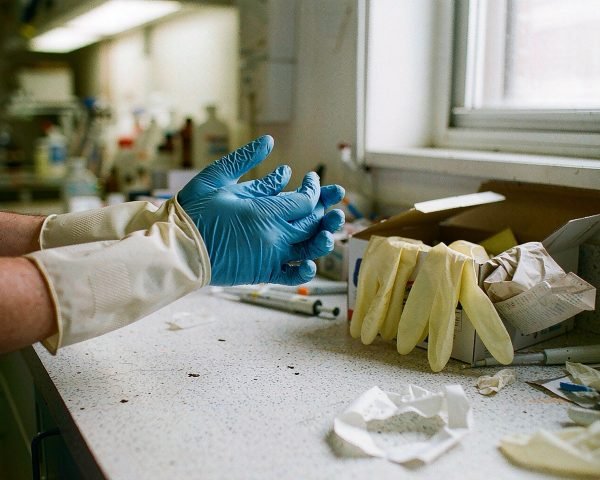

# Glove Choice and Sample Contamination: What Labs Get Wrong
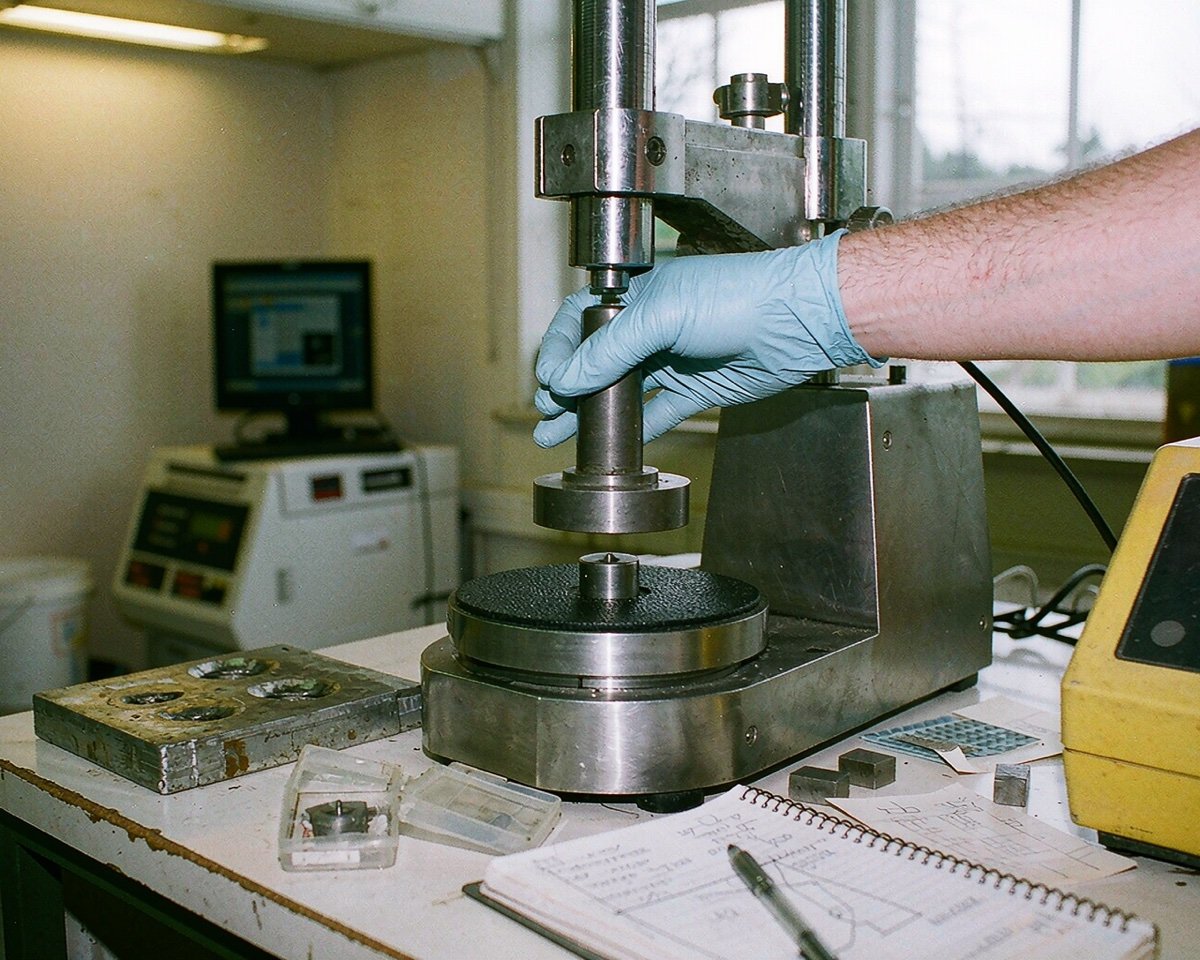
Every lab I’ve worked in treats gloves as safety equipment, and that’s correct as far as it goes. What most labs miss is that a glove is also the dirtiest object that ever gets within centimeters of your sample. It touches vial caps, weighing paper, pipette tips, and the bench they all rest on.
The short answer: gloves shed contaminants: sulfur accelerators, surfactant residues, powder, skin oils. Powder-free nitrile rated to ASTM D6319 is the sensible lab default, changed often and kept away from sample-contact surfaces when traces matter.
The contamination path is rarely dramatic. Nobody dips a gloved hand into a beaker. It works through touch: a gloved fingertip drags residue across a vial cap or a spatula handle, and the analyte concentration quietly shifts. Here’s where that actually happens, and the decisions that stop it.
The Case That Made Me a Believer
A case reported in LCGC reads like a troubleshooting detective story, and it changed how I think about gloves. A lab developing a drug-product method kept finding an unknown peak in their samples. They ruled out the column, the mobile phase, and the vial cap liners. When they finally extracted a piece of the nitrile glove the analysts wore, out came a dominant peak at the same retention time, with a matching UV spectrum, later confirmed by LC-MS as naphthalene-2-sulfonate, an emulsifying agent used in nitrile rubber production, showing up at m/z 207 in negative mode.
The unsettling part is why the peak had stayed hidden for over two years. During method development, the analyst habitually wiped their gloved hands with isopropyl alcohol wipes to kill static before weighing powders. That unproceduralized habit was cleaning the glove surface, and the contamination only appeared once stability testing dropped the habit. The glove hadn’t changed. The procedure had.
Read that again if you’ve ever dismissed glove sourcing as a purchasing detail. In my experience, that’s exactly how these failures arrive: not as a crisis, but as an unexplained peak that costs a week and never quite gets attributed. If you’ve got an unexplained peak in your own chromatograms right now, my honest advice is to check what the analyst touched before you check the method.
What’s Actually on Your Gloves
Nitrile gloves are not pure nitrile. They’re a vulcanized rubber product containing curing agents, and several of those additives are exactly the kinds of small organic molecules that show up in chromatography.
The numbers are on record. A NIOSH-led survey published in Contact Dermatitis screened 38 brands of off-the-shelf latex and nitrile exam gloves for sulfur-containing vulcanization accelerators and found levels ranging from undetectable up to 7.35 mg/g of glove material. The same study found powdered gloves carried significantly higher accelerator levels than powder-free gloves from the same manufacturers. That’s a real mass of extractable chemistry sitting millimeters from your samples, and brands vary enormously, which is the point: your glove’s cleanliness is whatever your supplier’s formulation happens to be.
Powder itself earned a ban in medical settings. The FDA banned powdered medical exam gloves in 2016 after finding the powder could cause inflammation and tissue reactions, and while labs aren’t hospitals, the logic transfers directly: cornstarch powder carries glove residue onto everything it touches, including your sample containers. Any lab still using powdered gloves for analytical work is buying contamination on purpose.
There’s a second, less obvious contaminant: you. Skin oils, hand lotion, and sweat transfer through and onto glove surfaces during donning. The most common “glove contamination” event in a wet lab is probably just someone adjusting their glasses and then handling the outside of a sample vial.
Nitrile, Latex, or Vinyl: Picking the Base Material
For most analytical labs this is a three-way choice, and one of the options deserves to lose.
Latex fits beautifully and protects well, but it carries two problems for a lab: natural rubber proteins trigger allergies in a meaningful share of people, and the FDA requires clear labeling for it precisely because of that. Vinyl (PVC) is cheap and fine for brief, dry tasks, but it fits loosely and generally performs worse against solvents. That leaves nitrile, which has become the lab default for good reasons: no latex proteins, decent chemical resistance, good dexterity, and a mature supply chain.
Buy against a standard rather than a brand name. ASTM D6319 is the specification for nitrile examination gloves, covering dimensions, tensile strength, and leak rates, and it’s the same standard the FDA’s review process leans on for medical gloves. A glove made to a published spec behaves predictably between lots. A no-name glove with no cited standard is a formulation that can change silently between orders.
For trace work, go one step further and look for gloves marketed as low-extractables or chemistry-tested, and, more importantly, test them yourself against your method. A blank that involves handling consumables with fresh gloves will tell you more about your actual risk than any datasheet. The FDA’s overview of medical gloves is a decent primer on how these products are classified, what the labeling must disclose, and why the powdered-glove ban happened in the first place.
Where Gloves Actually Contaminate Samples
Gloves rarely touch your sample directly. They contaminate everything that will.
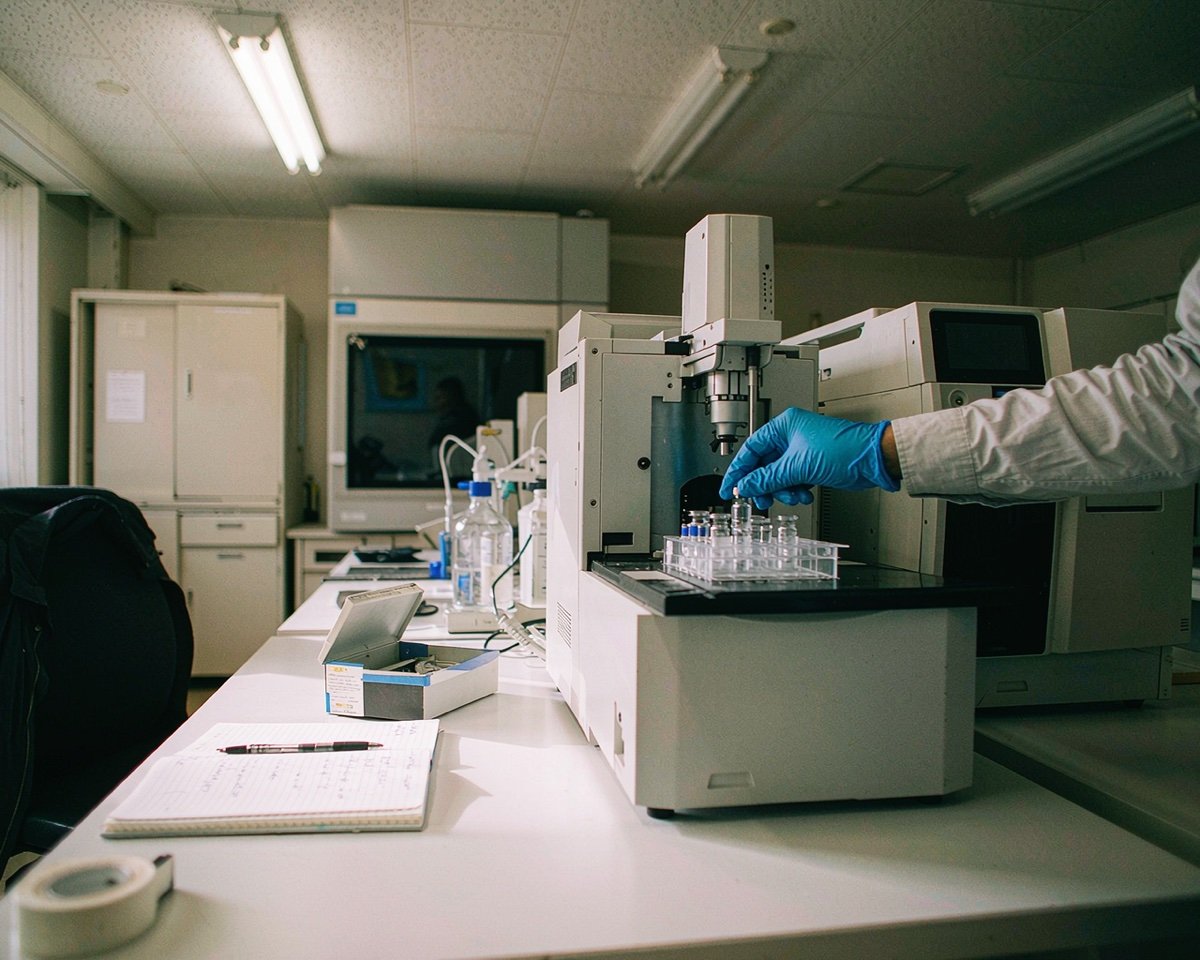
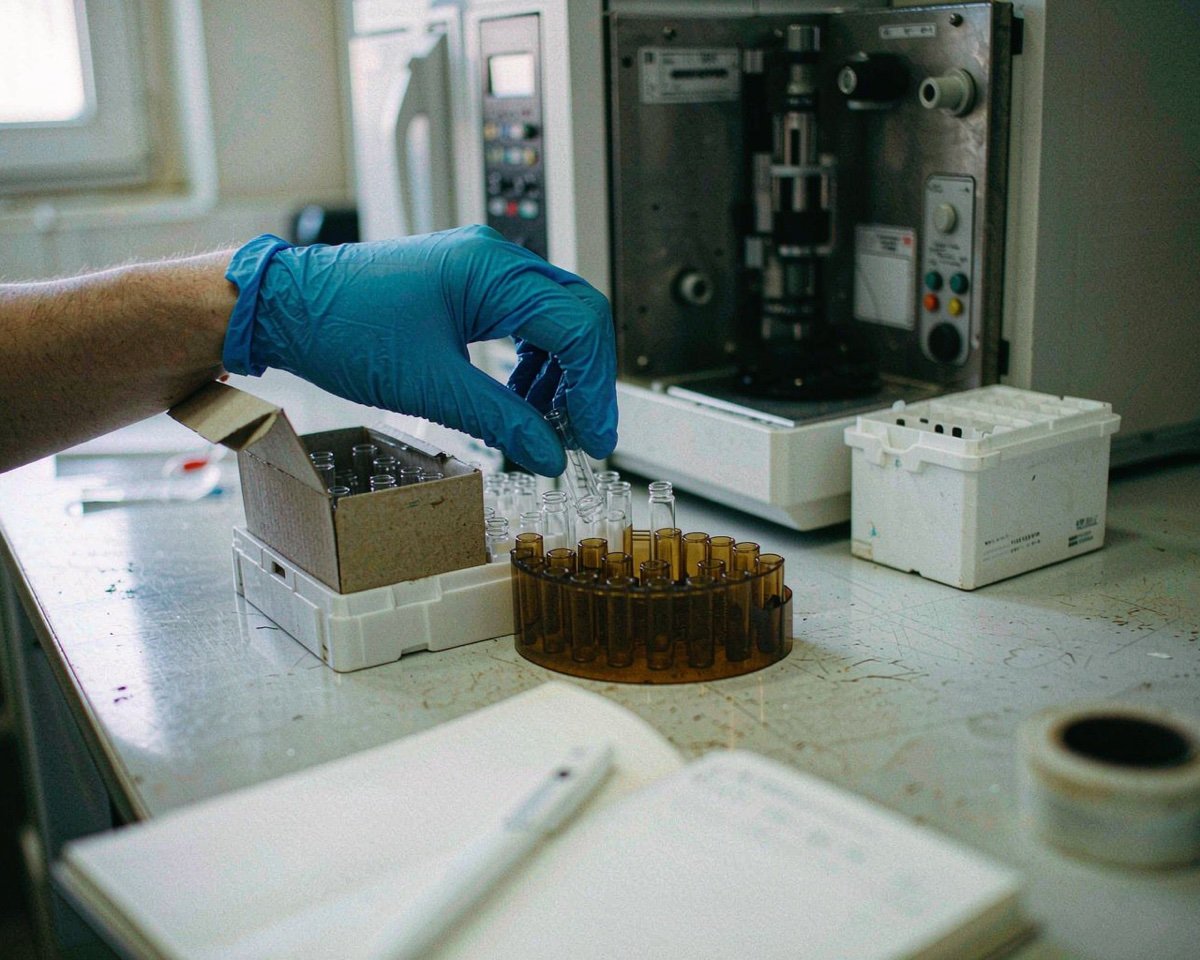
Watch the sequence of a normal sample prep: hands open the vial package, adjust the rack, handle the cap, hold the syringe barrel, rest on the bench, maybe adjust the balance doors. Every one of those surfaces now carries whatever the glove carried. The vial cap is the dangerous one, because the septum gets pierced and its underside meets your sample or your mobile phase.
The high-risk surfaces, in my experience, are vial septa, pipette tip racks, spatulas and weighing paper, and the inside of centrifuge tube caps. All four get touched constantly by gloves that just handled a phone, a door handle, or a reagent bottle someone else opened bare-handed.
The mitigation isn’t paranoia, it’s traffic control. Establish one rule and keep it: gloved hands never touch anything that will contact sample or mobile phase directly. Forceps for septa, a clean wipe under the vial rack, gloves changed after touching anything communal. If you only change one habit this week, make it “fresh gloves before sample prep, not just at shift start.” A glove two hours into a shift has handled the phone, the door, and the coffee machine, and it is not the same glove you put on this morning.
For work where background at trace levels is fatal (PFAS, oligonucleotides, low-level bioanalysis), some labs double-glove, removing the outer pair right before touching sample-contact surfaces. It feels excessive until you run the blank that proves it wasn’t.
A Glove Protocol That Survives Real Shifts
Protocols fail when they fight human nature, so build this one around the actual day.
Specify the glove: powder-free nitrile, made to ASTM D6319 or an equivalent spec, from a brand you’ve blank-tested against your most sensitive method. Write the brand and part number into the consumables spec so procurement can’t substitute silently. Then re-verify with a fresh blank whenever the lot changes, because “same glove” is a claim, not a guarantee, as the accelerator survey above makes clear.
Define the change points rather than a schedule. New gloves at the start of sample prep, after touching anything communal (phone, keyboard, fridge handle), after any solvent splash, and always before handling septa or standards. This mirrors the logic in sterile-consumable handling: once a pack is open, its contents share fate with every hand that touches it, which the Mastelf guide to storing opened sterile consumables covers in practical detail.
Finally, keep the IPA wipe habit, but make it deliberate. The LCGC case shows surface-wiping gloves can suppress contamination enough to hide it during method development. Do it on purpose, for the tasks that warrant it, and write it down. An undocumented clean habit that later disappears is worse than none, because your validated method inherits a protection it never actually claimed.
And for the labs running DNA, RNA, or low-biomass work: gloves protect your samples from you even more than they protect you from samples. Nuclease-free technique, including frequent glove changes, is part of the consumable spec there, not an optional extra. The Mastelf guide to DNase- and RNase-free consumables explains who genuinely needs the certified versions.
Conclusion
Glove choice is one of the cheapest contamination controls you own, and one of the most ignored. The failure pattern repeats across labs: a reasonable default glove, purchased on price, worn far too long, touching every surface between the door and the septum. Nothing dramatic happens, which is the problem. Ghost peaks drift in, recoveries wobble a few percent, and nobody traces it back to a 7.35 mg/g accelerator load or a m/z 207 emulsifier from the glove surface. Fix it in three moves: specify powder-free nitrile to a published standard, change gloves at defined touchpoints rather than on shift schedule, and blank-test any new lot against your most sensitive method before it touches real samples. Then extend the same thinking to everything else that touches your samples; the Mastelf walkthrough of how samples get contaminated before injection is the natural next read, and if a suspicious peak has already found you, the Mastelf guide to handling contaminated samples helps you work the problem backward.
Frequently Asked Questions
Can nitrile gloves really contaminate HPLC or LC-MS samples?
Yes, and it’s documented. A case in LCGC traced an unknown chromatographic peak to naphthalene-2-sulfonate, an emulsifier in nitrile rubber, extracted from the gloves analysts wore. NIOSH research has also measured sulfur vulcanization accelerators in nitrile gloves at up to 7.35 mg/g. Whether it reaches your chromatogram depends on your sensitivity, your matrix, and how much the gloves touch sample-contact surfaces.
Are powder-free gloves always the right choice for lab work?
For analytical work, yes, virtually always. Powder carries glove additives and manufacturing residue onto anything it touches, and the FDA banned powdered medical gloves in 2016 over safety concerns that apply by analogy to sample handling. Powdered gloves offer no analytical advantage and one measurable disadvantage.
How often should I change gloves during sample prep?
Change at defined events, not on a clock: at the start of sample prep, after touching anything communal such as phones, door handles, or keyboards, after any splash, and always before handling septa, standards, or sample-contact surfaces. A glove mid-shift has collected residues from everything it touched, so “one pair per shift” is not a contamination control.
Do vinyl or latex gloves contaminate samples less than nitrile?
Not reliably. Latex contains its own extractables on top of allergy concerns, and vinyl (PVC) gloves carry plasticizer-related extractables and fit loosely enough to raise handling errors. Powder-free nitrile made to a published spec like ASTM D6319, blank-tested against your own method, is the more defensible default for trace analytical work.
What’s the best way to check whether my gloves are contaminating my method?
Run a glove blank: with fresh gloves, handle a set of clean vials, caps, and pipette tips the way you normally would, prepare a blank matrix, and inject it. If background peaks appear that a no-handling blank doesn’t show, your gloves (or your glove-handling habits) are implicated. Then repeat with wiped or freshly changed gloves to confirm the source.