
# What Consumables Does Lyophilization and Freeze-Drying Need?
A freeze dryer gets all the glory, but lyophilization lives or dies on the small stuff around it. Stoppers, vials, pump oil, seals, and the reagents that prove your cake is actually dry. I’ve seen more ruined batches traced back to a $40 consumable than to a $40,000 instrument.
Freeze-drying needs six consumable groups: lyophilization stoppers (butyl rubber, two-leg or igloo style), flat-bottom borosilicate vials or ampoules, freeze dry flasks and manifold adapters for benchtop work, vacuum pump oil plus cold traps and filters, aluminum crimp seals for the finished vial, and moisture verification supplies such as Karl Fischer reagent or water activity standards.
Read on, because each group has a failure mode attached to it, and most of them are cheap to avoid.
Stoppers and Vials: The Pair That Does the Real Work
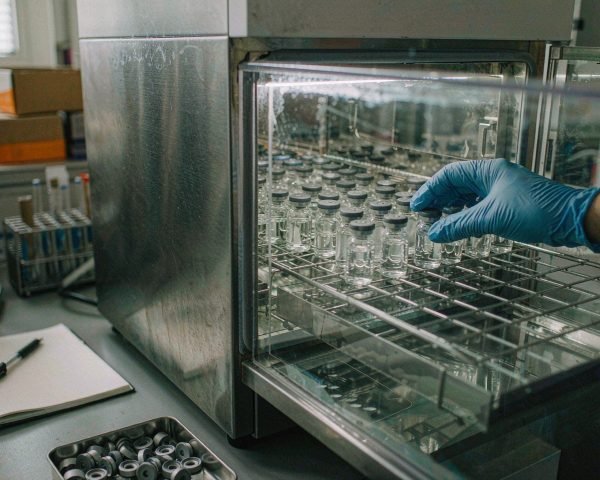
Lyophilization stoppers are not ordinary rubber plugs. They’re made from butyl rubber (chlorobutyl or bromobutyl formulations) because butyl has very low moisture transmission, and a lyo stopper carries legs or an “igloo” body with grooves cut into it. Those grooves are the vapor highway. In the loaded position the stopper sits half-seated in the vial neck, leaving the vent slots open so water vapor can escape past it during primary drying.
That half-seated position is the whole trick. You load your vials with stoppers resting loosely on top, run the full cycle, then the shelf collapses and pushes every stopper home while the chamber is still under vacuum or nitrogen. The FDA’s inspection guidance for lyophilized parenterals describes exactly this: stoppering happens inside the dryer, often after backfilling with inert gas, because the moment a dry cake meets room air it starts pulling moisture back in. For the spec side, the DWK Life Sciences lyophilization stopper page lists the details that matter: two-leg style to keep legs from sticking together, gray butyl compound, and a mouth OD match (13 mm or 20 mm) to your vial finish.
The vial matters just as much. Flat-bottom borosilicate vials are the default because they conduct heat evenly from the shelf into the cake. A rounded or footed bottom touches the shelf at one point, and that vial dries slower than its neighbors. I once walked a client through a collapse problem that turned out to be a mixed pallet of vials: two brands, slightly different base curvature, and the edge vials from one brand were consistently the failed ones. Same shelf, same cycle, different glass.
Flasks, Manifolds, and Ampoules for Benchtop Setups
If you’re not doing GMP vial work, you’re probably drying in flasks hooked to a manifold. Freeze dry flasks run from 25 mL up to 2 L, and the rule most people break is fill volume: keep liquid to a third or half of the flask, or you’ll get a thick frozen slab that takes forever to sublimate. Shell freezing the sample (rotating the flask in a dry ice bath or a mechanical shell freezer) spreads it into a thin layer and cuts cycle time dramatically.
The consumables here are the adapters and valves. Labconco’s freeze dryer accessories guide covers the ecosystem: neoprene-valve manifolds in 4 to 28 ports, 1/2″ and 3/4″ adapters, ampule valve adapters, and three-way adapters that let you hang three ampules per port. You can browse the Labconco manifold lineup to see the port configurations available for a given dryer.
Ampoules are the small-sample option, and they have their own consumable: a seal torch. Ampoules get flame-sealed under vacuum, which is why they’re favored for archival and reference material that has to stay dry for a decade. Pair them with dedicated lyo ampule stoppers or heat-seal them shut, and inspect every ampule for hairline cracks before it goes under vacuum, because a scratched ampoule under 0.05 mbar is an implosion waiting for an audience.
The Vacuum Side: Oil, Traps, and Filters
This is the unglamorous half, and it’s where instruments die early. Most rotary vane pumps that pull a freeze dryer use oil to seal, lubricate, and cool, and water vapor that slips past the condenser ends up in that oil. Emulsified oil means a pump that can’t reach its ultimate vacuum, which means a cycle that never quite finishes.
The BÜCHI laboratory freeze-drying guide recommends checking oil before and after every run and changing it at least every 2,000 working hours, sooner if solvents are in play. It also recommends running the gas ballast for 10 to 15 minutes after each run to purge dissolved vapor. Hybrid pumps (rotary vane plus diaphragm stage) can stretch oil life up to ten times, which is worth knowing before you buy your next pump.
Here’s my one story with stakes attached. A few years ago I helped a small biotech debug a protein standard that kept coming out with collapsed cakes and residual moisture readings way off spec. Instrument was fine, cycle was fine. The pump oil was the color of cold coffee and had water droplets sitting in the sight glass. One oil change and a properly sized secondary trap later, the next batch hit spec on the first try. Nobody had touched the oil in a year.
So stock what protects the pump: fresh pump oil, a secondary trap (dry ice or liquid nitrogen for solvent-heavy samples, an activated carbon or soda acid trap for trace amounts), inlet and exhaust filters, and vacuum grease for O-rings and manifold valves. Traps are consumables in the sense that they need consumable fill or defrosting attention every run.
Sealing After Drying: Aluminum Seals and Crimpers
Once stoppers are seated, the vial still needs a crimp seal. Aluminum crimp seals (flip-off or flip-top styles, 13 mm for standard serum vials, 20 mm for larger finishes) lock the stopper down and provide the tamper evidence auditors want. You’ll need a hand crimper or benchtop crimper to match the seal size, and decrimpers if you ever need to open sealed vials without shattering them.
Don’t skip the crimp just because the stopper feels snug. Stoppered-but-uncrimped vials can work loose in storage and transit, and a loose stopper on a hygroscopic cake is a slow leak toward ruin. Container closure integrity testing exists for exactly this reason, and it assumes the seal was applied correctly in the first place.
Proving It’s Dry: Moisture and Water Verification
The cycle isn’t done until someone measures what’s left. Residual moisture in lyophilized products is typically targeted at around 1% or lower, and Karl Fischer titration is the standard method, with coulometric KF preferred for small samples. That means stocking KF reagent, oven sample vials if you use the oven method, and dry nitrogen for sample handling, since KF has a real drift problem if the sample meets humid air on the way to the cell.
Water activity testing is the faster cousin: it gives you a stability-relevant number in minutes instead of a titration endpoint. If your QA team argues about which one to run, the honest answer is that they measure different things and serious labs run both. We’ve covered this in more depth in our guide on what consumables water activity testing needs.
What to Keep in Stock
| Consumable | Role | Replacement trigger |
|---|---|---|
| Lyo stoppers (butyl, two-leg) | Vent vapor during drying, seal under vacuum at end | Each new batch; autoclaved between uses |
| Flat-bottom borosilicate vials | Even heat transfer, uniform cake | Breakage, or any change of glass brand |
| Vacuum pump oil | Sealing and lubrication of rotary vane pump | Dark color, cloudiness, or ~2,000 hours |
| Cold trap fill / defrost attention | Protects pump from vapor and solvents | Every run (check level and ice) |
| Inlet and exhaust filters | Keep particulates and oil mist out of the line | Per manufacturer interval, typically annual |
| Aluminum crimp seals + crimper | Lock stoppers, tamper evidence | Every sealed vial gets a fresh seal |
| Karl Fischer reagent | Residual moisture verification | Per titration cell consumption / expiry |
Buying Tips Before You Order
Start with the neck finish. A 20 mm two-leg stopper is useless on a 13 mm neck, and “close enough” doesn’t exist under vacuum. Then decide your stopper geometry deliberately: two-leg is the workhorse, three-leg and igloo styles exist for specific vial geometries, so pull the manufacturer drawing rather than guessing from a photo.
If you can, buy stoppers and vials as a system, ideally from lines that document extractables and comply with USP/EP/JP requirements, the way the Wheaton ULTRA PURE bromobutyl stopper line does. And always order 20 to 30% more stoppers than your batch needs. They’re small, they roll under every bench in the building, and a batch short of clean stoppers at stoppering time is a batch you can’t finish.
Conclusion
Lyophilization looks like an equipment purchase, but the process is only as good as the consumables feeding it. Butyl lyo stoppers with vent grooves, flat-bottom borosilicate vials, correctly sized flasks and adapters, clean pump oil with working traps, proper crimp seals, and moisture verification supplies all sit between your product and a failed batch. None of them are expensive individually, and every one of them has ruined someone’s week. My advice: build the stock list above into your procurement routine, match stopper and vial specifications as a pair, and never let pump oil go a year unchecked. If you’re building out the cold side of the lab as well, our biobanking consumables guide covers the storage side, and our guide to what serum vials are and who uses them explains the vial format most lyo work ends up in.
Frequently Asked Questions
What are lyophilization stoppers?
They’re stoppers made from butyl rubber with legs or grooves that let water vapor escape past them during the drying cycle. They sit half-seated in the vial during lyophilization, then get pressed fully in under vacuum or nitrogen at the end. Butyl is used because it transmits very little moisture.
Can you freeze-dry in regular HPLC vials?
No, not for real lyo work. HPLC vials have thin walls, rounded or offset bases, and caps that can’t vent vapor or seal under vacuum. Freeze-drying needs flat-bottom borosilicate serum vials with a proper lyo stopper and crimp seal finish.
How often should vacuum pump oil be changed?
Check the color and level before and after every run, and change it roughly every 2,000 working hours for aqueous samples. Solvents and acids shorten that a lot, sometimes to every few runs. If the oil looks cloudy, milky, or dark, change it now regardless of the hours.
Why do lyo stoppers have a notch?
The notch or groove is the vent channel. During primary drying, sublimating water vapor has to travel from the cake, through the vial neck, and out past the stopper. Without the vent slot, a fully seated stopper would trap vapor inside and stall the cycle.