
# What Are Serum Vials and Who Uses Them?
A serum vial looks like nothing: a small glass bottle with a flat bottom and a plain crimp neck. Then someone hands you a product that has to stay sterile for two years, or an anaerobic culture that dies at the first whiff of oxygen, and that plain bottle becomes the most important thing on the bench.
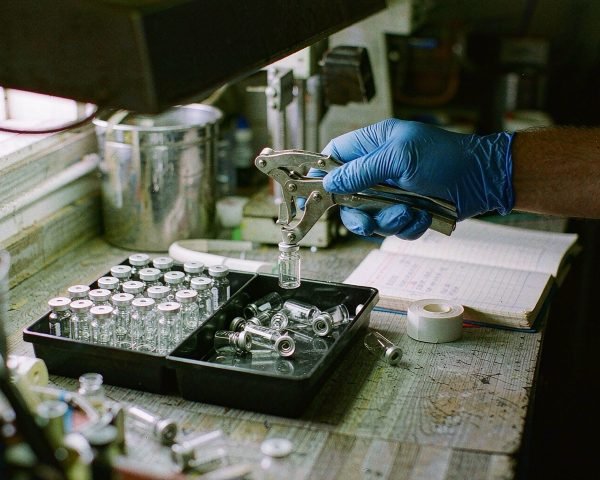
A serum vial is a small glass bottle, usually USP Type I borosilicate, closed with a rubber stopper held in place by an aluminum crimp seal. Sizes run from 2 mL up to about 125 mL, and users range from pharma fill-finish and vaccine manufacturing to anaerobic microbiology and everyday reagent storage.
Read on for what the vial is actually made of, who fills them for a living, and the closure details that decide whether yours leak.
The Anatomy of a Serum Vial
Three parts, and only three: the glass body, the rubber stopper, and the aluminum seal. What makes it a “serum” vial rather than any other bottle is the neck finish. The opening is sized for a stopper (commonly 13 mm or 20 mm outer diameter) and has a flat crimping lip that lets an aluminum seal be pressed over the flange and locked under the stopper flange. Done right, that seal is hermetic: no evaporation, no gas exchange, no microbial ingress.
The classic example is the Wheaton serum bottle line from DWK Life Sciences, which comes in molded borosilicate meeting USP Type I requirements, in clear and amber, from 2 mL up through 125 mL, all autoclavable and all built for lyophilization as well as liquid storage. The 20 mm crimp finish with a 13 mm internal opening is the configuration most people picture, and the same stopper-and-seal logic scales across the whole size range.
If you’re torn between closure styles for your own lab, the tradeoffs are the same as in chromatography: we break them down in our crimp vs. screw vs. snap vial comparison. Short version: crimp wins wherever a truly permanent, leak-proof closure is the point.
Type I Borosilicate, and Why the Glass Grade Matters
Serum vials are usually specified in USP Type I borosilicate glass, which is the most chemically resistant glass classification in the pharmacopeia. Low leachables, low alkali release, good thermal shock tolerance. For anything injectable, that grade isn’t a nice-to-have; the container is part of the drug product, and extractables from cheaper glass can shift pH or destabilize a formulation over shelf life.
Amber versions exist for light-sensitive contents, and plastic (HDPE or polypropylene) serum bottles exist for diluents and bulk liquids where glass breakage is the bigger risk. But for actual injectable or vaccine work, borosilicate remains the default. If you want the chemistry behind that choice, our Type I borosilicate vs. soda-lime glass guide walks through the hydrolytic resistance data.
One practical note from experience: check the mouth dimensions before ordering stoppers, not after. Mouth ID and mouth OD both appear on spec sheets, and ordering 20 mm stoppers for a vial with a 20 mm OD but 13 mm ID opening (or the reverse) is a return-shipping fee waiting to happen.
Who Actually Uses Serum Vials
The name is a clue to the history: these bottles were built for storing serum and biologicals, and that use never went away. Today the user base is broader than you might expect.
Pharma and vaccine manufacturing is the flagship. Serum vials are a standard primary container for injectable drugs, vaccine components, and especially lyophilized products, because the glass tolerates the freezing, vacuum, and stoppering-under-vacuum steps of freeze-drying, which is exactly the use case DWK’s product literature calls out. Many licensed vaccines ship as a lyophilized cake in exactly this format, reconstituted with a diluent vial at the point of care.
Anaerobic microbiology is the surprise for most chromatography people. The biochemical methane potential (BMP) assay, the standard way to measure how much methane a substrate can yield in anaerobic digestion, is run in serum bottles: one published methods study describes 200 mL glass serum bottles sealed with aluminum-crimped rubber septa, flushed with nitrogen, and sampled by syringe over 60 to 95 days. Butyl rubber stoppers and aluminum crimps are the standard pairing there, and comparable setups support fermentation and biogas monitoring over months of incubation.
Clinical and diagnostic labs use them too. The same properties that protect a vaccine, an autoclavable, gas-tight glass container with a resealable stopper, make serum bottles a natural fit for stored biologicals, culture media, standards, and oxygen-sensitive reagents. Add standards archiving and reagent storage, and you’ve covered most of the market.
Stopper and Seal Choices That Actually Matter
The glass is the boring half. The closure is where quality is won or lost. Stoppers come in different rubber formulations (butyl and bromobutyl dominate for injectables because of low gas permeability), and in shapes: plain serum stoppers for liquid products, and lyophilization stoppers with grooved legs that let vapor escape the freeze-dryer and then seat into the vial under vacuum.
Aluminum seals come as plain tear-off, flip-off, and flip-off with a center disc for needle access. The decision I’d frame for a procurement manager: if the vial will be pierced with a needle more than once, pay for flip-off seals and a stopper formulated for resealing, and verify coring behavior with your own needle, because this is exactly where no-name closures fall apart.
I once watched a batch of 100 mL fermentation bottles lose pressure overnight because someone reused aluminum seals from a previous crimp. The seal work-hardens on the first crimp; the second one looks fine and isn’t. New seals every time, no exceptions worth making.
Crimping and Leak Checks
A serum vial is only as good as its crimp. Under-crimp and the stopper can back out or admit air; over-crimp and you wrinkle the seal flange or crack the lip. Hand crimpers work fine for small batches, and the technique transfers directly from other crimp-top work; our headspace vial crimping walkthrough covers the same mechanics at a smaller size.
For anything regulatory, a leak test is worth the ten minutes. Pull the vials out of the lyophilizer, invert them over a vial of dye or water, and look for ingress. Ten minutes versus a failed stability time point is not a hard trade.
Conclusion
A serum vial is a simple object with a demanding job: keep a sterile, stable, or oxygen-free interior sealed for as long as the label says. The formula that delivers that is USP Type I borosilicate glass, a correctly sized 13 mm or 20 mm stopper in a formulation matched to the product, and a single-use aluminum crimp applied with a proper tool. The users are just as varied as the formats: fill-finish and vaccine teams, freeze-drying operations, anaerobic microbiologists running BMP assays, and clinical labs storing sensitive biologicals. If you buy these regularly, standardize on one or two neck sizes across the lab so stoppers and seals are interchangeable, and put the spec sheet’s mouth dimensions, not the catalog photo, at the center of your ordering checklist. For a related comparison on how this format differs from sealed single-dose glass, see our vial vs. ampoule explainer.
Frequently Asked Questions
What is the difference between a serum vial and a regular HPLC vial?
A serum vial is a storage and packaging container sealed with a rubber stopper and aluminum crimp, while an HPLC vial is an autosampler container sealed with a screw cap or a small crimp cap. Serum vials range from 2 mL to over 100 mL and are built for long-term, hermetic storage; HPLC vials are built for instrument compatibility.
Can serum vials be autoclaved?
Yes, borosilicate serum vials are autoclavable, and most manufacturers rate them for repeated steam sterilization cycles. Autoclave them with stoppers loosely seated or in a vented configuration so pressure can equalize, then crimp after filling.
What size stopper fits a 20 mm serum vial?
A vial with a 20 mm mouth outer diameter takes 20 mm aluminum seals and a stopper flange matched to that finish; the stopper plug diameter is matched to the smaller mouth ID, commonly 13 mm. Always check both the ID and OD on the spec sheet rather than ordering by the vial’s nominal size.
Why are serum bottles used in anaerobic digestion experiments?
The crimp-sealed stopper gives a gas-tight closure that holds an oxygen-free headspace for weeks, and the thick borosilicate wall tolerates pressure changes from biogas production. Samples are withdrawn by syringe through the septum, which keeps the culture anaerobic throughout the assay.
Are plastic serum bottles a reasonable substitute for glass?
For diluents, buffers, and bulk liquids where breakage matters more than gas impermeability, HDPE and polypropylene serum bottles are a sensible choice. For injectables, vaccines, oxygen-sensitive cultures, or anything going through lyophilization, glass remains the safer and more widely accepted option.