
If you’ve ever compared spec sheets for laboratory glassware, you’ve seen the same two phrases over and over: “Type 1 borosilicate glass” and “soda-lime glass.” They sound similar, but they sit at opposite ends of the chemical-durability spectrum. Pick the wrong one for your samples and you can end up with leaching, pH drift, or even visible flakes in your vial.
The Short Answer
Type 1 borosilicate glass is the highly resistant glass used for pharmaceutical and analytical containers; it shrugs off water attack and thermal shock. Soda-lime glass is the everyday, lower-cost glass with only moderate chemical resistance; when its inner surface is specially treated, it earns the “Type 2” label. For chromatography vials, reagent bottles, and anything holding solvents, Type 1 borosilicate is the standard.
Where the “Type 1” Label Comes From
The numbering isn’t a marketing gimmick. It comes from the United States Pharmacopeia, which classifies glass containers by how well they survive chemical attack. The official definition lives in USP General Chapter <660> Containers—Glass, and it’s refreshingly simple:
- Type I: highly resistant borosilicate (neutral) glass.
- Type II: soda-lime glass whose inner surface has been treated (dealkalized) to raise its hydrolytic resistance.
- Type III: plain soda-lime-silica glass with moderate resistance.
Here’s the neat part: the same chapter explains that borosilicate glass earns Type I because of its composition, not a coating. It contains significant boric oxide and aluminum oxide, which give it high hydrolytic resistance and high thermal shock resistance as a material property. Soda-lime glass, by contrast, relies on a surface treatment to climb from Type III to Type II, and that treated layer is a finite resource.
What Actually Differs in the Glass
When you put Type 1 borosilicate next to soda-lime, three differences drive almost every buying decision:
- Chemical durability. Type I glass releases far less alkali when it meets water or aqueous samples. That’s the entire basis of the USP classification, and it’s why Type I is the default for anything injectable or pH-sensitive.
- Thermal behavior. Borosilicate’s low thermal expansion lets it survive autoclaving and rapid temperature swings that would stress soda-lime glass. USP <660> specifically credits borosilicate with high thermal shock resistance *because of its chemical composition*, no surface trick involved.
- Cost. Soda-lime melts at lower temperatures and is cheaper to form, which is why it dominates commodity glassware like beverage bottles and many non-critical containers.
For a deep look at the glass grades used in pharma packaging, including why Type III soda-lime is generally ruled out for parenteral products without stability data; the official USP <660> text with its glass-type table is worth bookmarking.
Why Hydrolytic Resistance Matters for Your Samples
I’ll admit this took me a while to appreciate. “Hydrolytic resistance” sounds like a lab-exam term, but it’s really about one practical risk: the glass slowly releasing sodium and other ions into your sample.
Think about what that does in an autosampler vial. Your sample sits in that vial for hours, sometimes overnight in a cooled tray, before injection. If the glass bleeds alkali into a low-pH sample or a trace-metal analysis, your “stable” standard drifts. And in the extreme case, aggressive aqueous formulations can corrode the inner glass surface over time. The pharmaceutical industry calls this glass delamination, and researchers studying it describe how three factors control glass durability: the bulk chemistry, the processing history, and the formulation in contact with the container. That processing-history part is a quiet warning for buyers: two vials that both say “borosilicate” can behave differently if one was poorly annealed or harshly surface-treated.
For most analytical work you won’t hit delamination; that’s a drug-product-scale problem. But the ion-leaching part is very real at trace levels, and it’s exactly why Type 1 borosilicate became the material of record for autosampler vials.
Soda-Lime Glass Isn’t “Bad”, Just Different
Let me be fair to soda-lime. It’s one of the most successful materials in history: cheap, formable, and perfectly fine for dry powders, short-term aqueous storage, and thousands of non-critical uses. The USP even permits suitably treated soda-lime (Type II) for some acidic and neutral parenteral preparations.
The problem is when soda-lime sneaks into jobs that need Type I. A few tells that you’re looking at a soda-lime product:
- The spec sheet lists “Type III,” “Type II,” or says nothing at all.
- The price is dramatically below the borosilicate equivalent.
- The glass is noticeably heavier or thicker for the same volume; molded soda-lime containers often are.
If a container doesn’t state its glass type, ask. In regulated industries, that answer decides whether the product passes muster at all.
Tubular vs. Molded: A Quick Side Note
There’s one more fork in the road that confuses buyers: tubular glass and molded glass. Tubular vials are formed from drawn glass tubing, which gives thin, uniform walls. Molded vials are shaped in molds and tend to be thicker-walled. Both can be made from borosilicate or soda-lime.
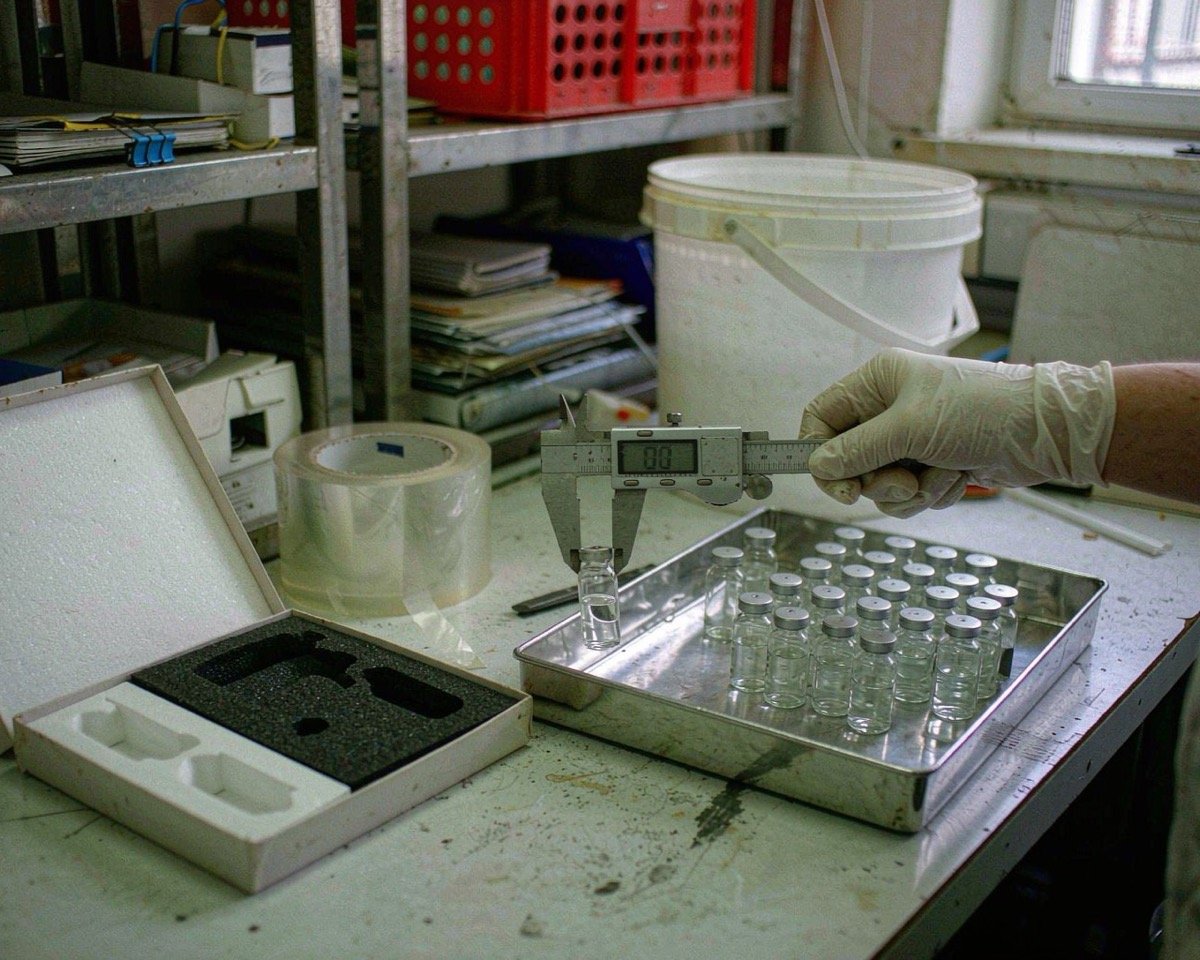
A packaging review in the literature shows how standards like ISO 8362-4 pin down dimensions for injection vials made of glass tubing, and how the industry produces tens of billions of these containers every year. For chromatography, thin-walled tubular Type I vials are the norm because they fit tight autosampler trays and give consistent needle penetration.
Type I Glass in the Chromatography World
Here’s where this becomes practical for you. Walk through any HPLC or GC lab and you’ll find that the vials, inserts, and bottles touching samples are overwhelmingly Type 1 borosilicate. It’s the same logic the biopharma industry uses: Type I glass is generally compatible with proteins, peptides, oligonucleotides, and small-molecule formulations, and it provides an excellent moisture and oxygen barrier. If that’s the standard for a $50,000 biologic, it’s a safe default for your $2 sample.
Two practical takeaways from all this:
1. Check the material line, not just the price. If a vial listing says “glass” without specifying Type 1 / borosilicate, ask the supplier for the glass composition before you commit. 2. Match the glass to the sample. Aqueous, trace, or pH-sensitive work deserves Type I. If you only ever store dry powders or non-aqueous solvents, you might get away with less, but the price difference rarely justifies the risk.
Conclusion
Type 1 borosilicate and soda-lime glass differ in chemical durability, thermal shock resistance, and cost, and the USP’s Type I/II/III system exists precisely so you can tell them apart on paper. Borosilicate resists hydrolysis through its composition, which is why it dominates pharmaceutical packaging and analytical vials; soda-lime only reaches Type II with a surface treatment that can be a weak point over time. For autosampler vials, inserts, and reagent bottles that touch your samples, Type 1 borosilicate is the safe, boring choice — and in chromatography, boring is good. If you’re weighing glass against plastic for your workflow, my comparison of HPLC vial materials: glass vs plastic walks through when each makes sense, and my clear vs. amber glass vial guide covers the color question once the material is settled. When you’re ready to verify what your supplier is actually shipping, the glass-quality inspection checklist is a solid next read.
Frequently Asked Questions
Is all borosilicate glass Type 1?
Not automatically. Under USP <660>, Type I is defined by hydrolytic-resistance testing, and high-borosilicate glass normally passes it, but the classification is based on measured performance, not just the name on the box. Low-borosilicate glass may not qualify, which is why reputable suppliers publish their glass type and test data.
Can soda-lime glass be used for HPLC vials?
Technically yes, and you’ll occasionally find cheap “soda-lime” autosampler vials on the market. The risk is ion leaching into aqueous or trace samples, which can shift pH and ruin low-level analyses. Most labs standardize on Type 1 borosilicate to remove that variable entirely.
What does “Type 2 glass” mean?
Type II is soda-lime glass whose inner surface has been treated to improve hydrolytic resistance. It’s acceptable for certain acidic and neutral parenteral products, but the improvement lives in a surface layer; the bulk glass remains soda-lime.
How can I tell what type of glass a vial is?
Read the spec sheet. Reliable manufacturers state the material (typically “Type 1 borosilicate glass” or “USP Type I”) and often reference the glass tubing grade. If the material line is vague, ask the supplier directly; if they can’t answer, that’s an answer.
Does glass type affect autosampler performance?
Glass type mostly affects chemical inertness, not fit. Fit depends on dimensions like the 12 x 32 mm footprint and the neck finish. But material matters for sample integrity, which is why the same 12 x 32 mm vial is sold in borosilicate for analytical work.