
If you’ve ever ordered vials that arrived the right size but wouldn’t seat in the tray, you already know that “2 mL vial” doesn’t tell the whole story. Body size gets you close; the neck finish decides whether the vial actually works in your autosampler. I’ll walk you through the numbers that matter.
Most autosampler vials measure 12 × 32 mm and hold 2 mL, with a 9 mm screw neck (9-425) as the default finish. The neck finish matters because the cap must match the thread exactly; the wrong one leaks, strips, or sits so high the needle misses the septum.
That’s the short version. The longer version includes a few formats that don’t follow the standard, one measurement most people skip, and a couple of expensive mistakes you can avoid in under a minute. Read on.
Why 12 × 32 mm became the default
The first number is the outer diameter in millimeters, the second is the height. A 12 × 32 mm vial is 12 mm wide and 32 mm tall, and it holds about 2 mL with 200 µL or so of headspace if you fill it to the shoulder. Nearly every instrument maker built their trays around this footprint, which is why it shows up on Agilent, Shimadzu, Thermo, and Waters systems alike.
Agilent’s own 2 mL screw top vials follow exactly this format, with a precision-formed neck so the robotic arm can grip them reliably. Once one major vendor standardized, everyone else had to follow, because labs weren’t going to stock five tray sizes for five instruments.
One caveat: “2 mL” on the label is the total volume. Usable volume runs closer to 1.5 mL once you account for the space the cap and septa occupy. If your method assumes 2 mL of working volume, you’ll find out the hard way during an overfill.
The common formats at a glance
Here’s the reference table I wish someone had handed me years ago. All values are typical; individual manufacturers vary slightly.
| Format | Volume range | Height | Diameter | Typical neck finishes | Typical instruments |
|---|---|---|---|---|---|
| Standard 2 mL | 1.5–2 mL | 32 mm | 12 mm (11.6 mm on some) | 8-425, 9-425, 10-425, 11 mm crimp/snap | Agilent 1260/1290, Shimadzu Nexera, Thermo Vanquish, Waters Alliance |
| Micro / low-volume | 0.3–0.6 mL | ~35 mm | ~8 mm | 8-425 or snap | Small-quantity injections, often with reduced-height trays |
| 4 mL screw | ~4 mL | 45 mm | 15 mm | 13-425 | Waters 48-position autosamplers and similar |
| Headspace | 10–20 mL | ~46–75 mm | 22–23 mm | 18 mm screw (18-400), 20 mm crimp | GC headspace systems |
| EPA / storage | 20–60 mL | 60–100 mm | 28–30 mm | 24-400 | Manual sampling, water analysis |
The 425 you see in thread codes refers to the GPI thread series used on lab vials; the first number is the thread diameter in millimeters. So a 9-425 neck is a 9 mm thread. Simple once someone says it out loud.
Neck finishes, decoded
The neck finish is the part your cap seals against, and it’s where most ordering mistakes happen. A 9-425 screw neck is today’s default: short thread, hand-tightened, works across most modern HPLC platforms. An 8-425 neck is the older narrow-opening style, still common on budget vials and older instruments.
Two details worth knowing. A 9 mm screw cap is dimensionally close to an 11 mm crimp cap, so 9-425 vials work in many autosamplers that were designed around 11 mm crimp vials. And the “ND” numbers (ND9, ND11, ND13, ND18, ND24) are just the same neck diameters written another way; ND9 and 9-425 mean the same thing.
If you want the full rabbit hole, we already have a complete guide to HPLC vial neck types and a separate breakdown of 9 mm vs 11 mm vs 13 mm closures that maps each finish to specific instruments.
Tolerances: the millimeters nobody checks
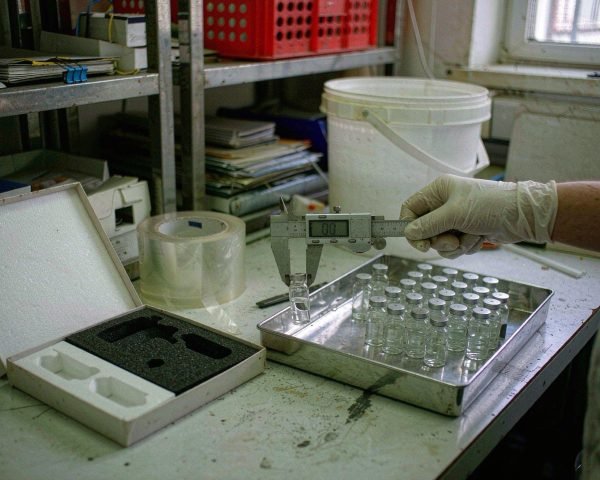
Here’s where I’ve seen labs get burned. Two vials can both say “2 mL, 12 × 32 mm” and still behave differently in the tray, because the body diameter isn’t always exactly 12 mm. Many are 11.6 mm, which fits a 12 mm holder with room to spare. A true 12.0 mm vial fits snugly. Push past that and the vial binds in the holder, and the pickup arm either can’t lift it or lifts it crooked.
I once watched an overnight sequence fail at injection 14 because a substitute vial batch was a fraction of a millimeter too tall. The needle caught the cap edge, bent, and the run stopped with 50 samples still queued. The vials were “the right size” on the box. They weren’t the right size in the tray.
Reputable manufacturers hold tight lot-to-lot dimensional tolerances precisely for this reason. Agilent states it openly for their screw vial line, and Thermo’s sample handling catalog lists dimensions to the decimal for every vial they sell. Cheap vials with loose tolerances are where the hidden cost lives.
Matching the vial to your instrument
Most of the time, the answer is easy: a 12 × 32 mm vial with a 9-425 neck fits Agilent 1100 through 1290, Shimadzu Prominence and Nexera, Thermo Vanquish and UltiMate 3000, and Waters Alliance systems. Check that sentence against your instrument before you buy anything in bulk, though.
The exceptions cluster around older or specialized hardware. Waters WISP-style samplers want shell vials with plug caps. Some GC setups still expect 11 mm crimp. Headspace systems need their own tall format entirely. When you’re unsure, the vendor’s chart beats guesswork; Agilent publishes an autosampler vials selection guide that sorts vial type by application, and we maintain an Agilent autosampler vial compatibility guide built from the same logic.
One more decision worth making early: if your samples regularly come in under 300 µL, don’t put them in a standard vial and hope the needle reaches. Use an insert or an integrated-insert vial. Thermo’s fixed insert microvials fuse the insert permanently so it can’t shift, and Restek’s wide-opening designs center inserts automatically for maximum withdrawal. We cover this trade-off in more detail in our article on choosing the right vial size for clean injections.
Conclusion
Autosampler vial dimensions boil down to three numbers and one habit. The numbers: 12 mm diameter, 32 mm height, and the neck finish, with 9-425 as the modern default. The habit: measure or verify before ordering a year’s supply, because a vial that’s 0.3 mm off in either direction can jam a tray or bend a needle, and it can quietly cost you 50 µL of a precious sample. In my experience, labs that keep one opened box of any new vial batch for a tray test before committing the rest rarely see injection errors. That one-vial test costs you nothing and catches almost everything. If you take this seriously, dimension checking becomes a two-minute routine rather than a post-mortem. For a deeper look at closures, revisit the neck-types guide above, then re-check which vial size fits your injection volume before your next order.
Frequently Asked Questions
What does 12 × 32 mm mean on an autosampler vial?
It’s the outer diameter and height in millimeters, in that order. A 12 × 32 mm vial is 12 mm wide and 32 mm tall, and this footprint holds roughly 2 mL, making it the global standard for HPLC and GC autosamplers.
Are 11.6 mm and 12 mm vials interchangeable?
Usually yes, since 11.6 mm vials fit loosely in 12 mm tray holders. Problems appear the other way around: a true 12.0 mm or wider vial can bind in trays designed with tight clearance, so check your autosampler’s specification before switching brands.
What neck finish do most HPLC vials use?
The 9 mm screw thread (9-425) is the current default on 2 mL vials. Older narrow-opening vials use 8-425, crimp systems use 11 mm, and 13-425 appears on 4 mL vials. The cap must match the finish exactly or the seal fails.
Can I use a 1.5 mL vial in place of a 2 mL vial?
Often yes, if the body dimensions and neck finish match, since many 1.5 mL vials share the 12 × 32 mm footprint. The risk is needle depth: some autosamplers bottom out in the shallower fill, so confirm your needle height specification first.
How much headspace does a 2 mL vial have?
A 12 × 32 mm vial filled to the shoulder leaves roughly 200 µL of headspace above the liquid. If your method needs more headspace for expansion or volatiles, fill less or move to a wider-headspace format.