
# What Is an Autosampler Syringe and When to Replace It?
Your autosampler syringe does one job thousands of times a month: pierce a septum, pull an exact volume, deliver it. It costs a fraction of what your column costs, yet it decides whether injection 1 and injection 60 mean the same thing. Treat it as a wear part and it will never surprise you.
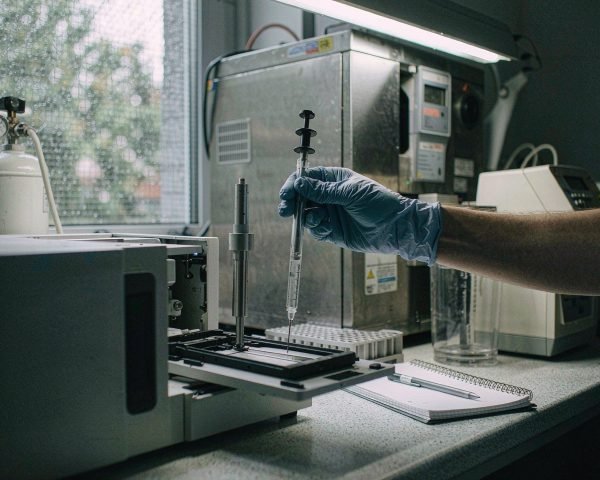
An autosampler syringe is a precision glass syringe that draws a set volume of sample from a vial and delivers it to the injection valve or inlet. Replace it when the needle is bent or burred, when repeatability or carryover gets worse, or on a fixed schedule (many labs use 12 months).
Below I’ll walk through what the syringe actually does, the failure signs that show up in your chromatogram first, and the replacement intervals the major vendors publish.
What an autosampler syringe actually does
The design is simple. A glass barrel, a plunger (PTFE-tipped or stainless steel), and a needle that’s either fixed to the barrel or screwed in as a separate part. That’s the whole assembly, and the whole assembly lives or dies by precision.
At 1 to 100 µL scales, small errors get big fast. A “10 µL” injection that actually delivers 9.4 µL shifts every calibration point, every response factor, every batch you compare against yesterday’s. Nobody notices a slow decline. They just notice the method “isn’t as good as it used to be.”
The needle also works with the needle seat as a pair. Agilent treats the two as a single functional unit in its maintenance docs, and for good reason: a damaged needle chews up the seat, and a chewed-up seat returns the favor to the next needle. If you replace one and ignore the other, you’re buying the new part a short life.
The failure signs show up in your chromatogram first
In my experience, the syringe never announces itself. It hints.
Replicate injections are the first place to look. If your standard RSDs drift from 0.8% to 2% or more, and you’ve ruled out the pump and the column, the syringe is a prime suspect. A plunger that no longer seals, or a needle with a partial blockage, delivers slightly different volumes every time.
Carryover is the second tell. Ghost peaks in your blanks that no wash step removes often mean residue is hiding in a scratched needle tip or a worn plunger seal.
Then come the physical signs: a hooked needle tip, burrs you can catch with a fingernail, corrosion pits along the barrel. Burrs matter more than they look, because a burred needle cores your septa, and those little septum plugs travel upstream and block the needle or the seat.
I once chased a drifting response for two days on a 60-injection sequence. At injection 47 of 60, the RSD on my standards jumped from 0.8% to 2.4%, and I re-injected, re-standardized, and blamed the column before I finally pulled the syringe. The needle was so slightly hooked you could only see it against a ruler. One new syringe fixed it, and I never got that Monday back.
If your sampler is punching through vial bottoms or breaking vials outright, that’s usually alignment rather than the syringe itself, but a bent needle can be the cause. We covered the rest of that story in our guide to why vials break in the autosampler and how to stop it.
So how often should you replace it?
Honest answer: there’s no universal number, because the sample decides.
Agilent’s own data for its PAL smart syringes gives you the clean-lab ceiling: needles are typically good for more than 10,000 septum penetrations, PTFE plungers top 70,000 strokes in pure non-halogenated solvents, and metal plungers manage around 30,000 strokes if you wipe them weekly with isopropanol. Those are best-case numbers.
Agilent’s preventive maintenance schedule for the 1260 bio-inert sampler lists needle and seat replacement at 60,000 injections, while the classic 1100/1200 schedule says every 12 months.
Real life is dirtier than the brochure. High-salt, protein-rich, or viscous samples will cut those lifetimes to a fraction. So will hard septa, fast injection speeds, and anyone who “temporarily” runs an unfiltered extract. My default, and I’d defend it in any lab meeting: inspect the syringe weekly, swap it yearly, and change it the moment you see damage, whichever comes first.
One more interval worth knowing: if you use exchangeable-needle syringes, Agilent recommends replacing the glass barrel after three to five needle changes, since the barrel wears too.
A bent needle is not a repair project
The temptation is to straighten a bent needle and send it back to work. The vendors are blunt on this point. Shimadzu’s smart syringe manual states that even a needle that has been “straightened” again cannot be operated safely unattended in the autosampler.
A needle that’s been bent once is weaker at that spot. It bends again, often mid-sequence, usually into a vial or the needle seat. The cost of the replacement syringe is small next to a failed overnight run, and our guide to the real cost of autosampler downtime puts numbers on that.
How to make each syringe last longer
A few habits buy you a lot of extra injections.
Rinse before you run. Agilent’s autosampler syringe maintenance guide recommends wetting the barrel and plunger with DI water or a compatible solvent before use, and flushing with cleaning agent, then water, then acetone before any overnight storage. A dry pump cycle wears the plunger for nothing.
Never force a blocked plunger. You’ll bend it or crack the glass barrel, and then the conversation is over. The right move is to pull the plunger, fill the barrel from a second syringe, and push gently.
Skip the grease entirely. Shimadzu’s manual links grease on the plunger to a long list of carryover problems. Metal plungers specifically should never run dry or with water; a weekly isopropanol wipe with a lint-free cloth is the whole maintenance routine.
Watch what you’re feeding it. Filtered samples (0.22 µm for most work) keep particles out of the barrel and the seat. Septa debris and vial cap fragments are the usual culprits when a seat blocks, and on a GC the needle’s other victim, the inlet seal, deserves the same scheduled attention we cover in our inlet seal replacement guide.
One sizing tip from Agilent that surprised me: for fast injections, don’t fill past half the barrel volume. If you’re injecting 10 µL at high speed, a 25 µL syringe outlasts a 10 µL one, because the plunger travels less and seals better.
Conclusion
An autosampler syringe is a small part with a big job, and it wears out on a schedule set by your samples, not your calendar. The needles handle 10,000-plus penetrations in clean conditions; dirty matrices cut that hard. So watch the chromatogram for drifting RSDs and unfixable carryover, check the needle against a ruler when anything looks off, and don’t try to nurse a bent one through another sequence. Replace the needle and seat as a pair, run a clean preventive schedule, and the syringe stops being a variable in your data. Most of the “mystery” reproducibility problems I’ve chased over the years turned out to be a consumable somebody didn’t want to change. If you only do one thing after reading this, put a standing syringe check on the monthly maintenance list. And when you’re ready for the next overlooked part, autosampler waste vials deserve exactly the same skepticism.
Frequently Asked Questions
How long does an autosampler syringe last?
There’s no fixed number. Agilent’s data shows needles lasting over 10,000 penetrations and PTFE plungers over 70,000 strokes in clean, non-halogenated conditions, but salty, protein-rich, or viscous samples shorten that considerably. Inspect weekly and replace on symptoms rather than hoping for the brochure number.
Can I unblock a clogged syringe needle instead of replacing it?
Sometimes. Remove the plunger, fill the barrel with solvent from a second syringe, and push gently; never force it, and skip the ultrasound and strong acids, which the vendors specifically warn against. If it won’t clear, swap the needle (or the whole syringe on fixed-needle models).
Why is my brand-new syringe giving smaller peaks?
Check the obvious things first: the syringe volume matches the method, there’s no air bubble in the barrel, and the plunger is fully seated. A needle that’s too short can also sit in the vial’s headspace instead of the liquid. Wrong physical dimensions, not wrong chemistry, cause most of these cases.
Do I have to buy OEM syringes, or are compatible ones okay?
Compatible syringes are fine as long as the volume, needle gauge and length, and mounting all match your instrument’s spec. I’d validate any new supplier with a side-by-side run against the OEM part before committing, which takes an afternoon and usually saves real money.
How should I store a spare autosampler syringe?
Clean it, let it dry, and keep it in its original packaging or on a syringe stand, dust-free. Store PTFE plungers separately from the barrel to protect the seal surface. Stored this way, syringes keep for two years or more.