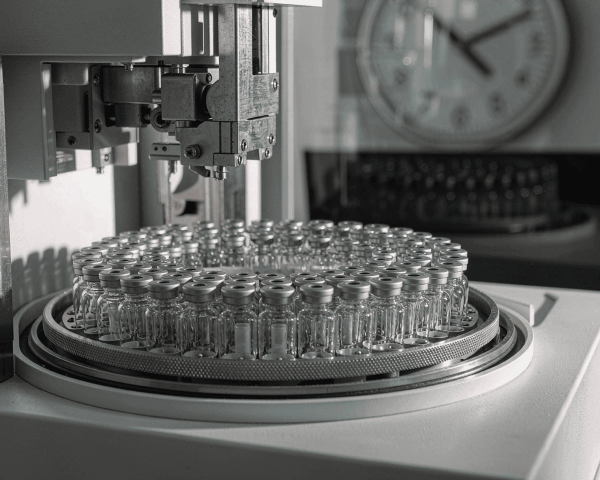

Ask most lab managers what their most expensive instrument problem is and they’ll point at the LC pump, the mass spec, or the column. They rarely mention the autosampler. But in my experience, the autosampler is the part most likely to stop your batch at 2 a.m., and the cost of that downtime is almost always bigger than the part that caused it. Let’s put real numbers on it.
The Short Answer
Autosampler downtime is expensive because it stops the *entire* analytical system, not just one component. Industry estimates put unplanned lab instrument downtime at anywhere from $1,000 to $10,000+ per hour, and a multi-day outage in a busy lab can easily wipe out six figures in lost throughput, wasted samples, and emergency repairs. The frustrating part: many autosampler failures trace back to consumables: vials, caps, septa that cost pennies.
Why the Autosampler Is the Weakest Link
Here’s what makes the autosampler different from every other module on your LC or GC system: it’s the only part that physically touches every single sample. The pump moves liquid, the column separates, the detector measures. But the autosampler has to grab a vial, pierce the septa, draw the sample, and inject it, hundreds of times a day, unattended.
That makes it a mechanical bottleneck. When it fails:
- The whole system stops. There’s no way to run a sequence without injections.
- The failure often happens unattended. Overnight and weekend runs are where autosamplers earn their keep, and where nobody notices a problem until morning.
- A small problem cascades. A bent needle, a jammed tray, or a broken vial costs more than the $50 part. The whole batch of samples has to be re-run.
That last point is the one labs underestimate. One contaminated or mis-injected sample can invalidate a whole sequence, and re-running it costs reagents, column time, and analyst hours on top of the machine hours.
Putting a Dollar Figure on Downtime
People hate this question because the answer is fuzzy, but the published estimates give you a ballpark, and the ballpark is sobering. According to a 2021 Lab Manager Magazine survey, 43 percent of labs experienced unplanned equipment downtime at least once every quarter, and more than 20 percent deal with it monthly. This isn’t a rare event; it’s a rhythm.
On cost, Thermo Fisher has estimated that unplanned downtime runs $1,000 to $10,000 per hour depending on the experiment and sample value at risk. More recent analyses in industrial life-science settings put the number between $30,000 and $50,000 per hour, with specialized applications exceeding $200,000 per hour. Even at the conservative end, a two-day outage in a mid-sized lab can cost over $100,000 in lost testing revenue alone, before you count the wasted reagents and the emergency service call.
If that feels abstract, consider the productivity angle: nearly 75 percent of laboratorians call unplanned downtime a critical killer of productivity, and medical labs have been measured losing about $7,900 per minute during outages. That’s $474,000 an hour in the worst case. It’s the kind of number that makes a preventive-maintenance budget look like a bargain.
The Hidden Costs Nobody Adds Up
The hourly figures only capture the visible damage. The real cost of an autosampler failure includes several layers that rarely make it into the post-incident report:
- Lost samples. If the autosampler crashed mid-sequence, the samples in the tray may be compromised. For irreplaceable biological or forensic samples, the loss is scientific, not just financial.
- Emergency service premiums. Unplanned repairs cost roughly 35 percent more per minute than scheduled maintenance because you’re paying for expedited parts, rush travel, and after-hours labor.
- Idle analyst time. Your chemists don’t go home when the instrument is down. They troubleshoot, document, and wait, at full salary, producing nothing.
- Requalification and compliance. In regulated labs, any instrument that fails needs investigation and often revalidation before it can release results again. That paperwork alone can outlast the repair.
- Reputation and turnaround. Every hour of downtime pushes client deadlines back, and chronically late labs lose contracts quietly.
A single missed-calibration or data-integrity event can dwarf all of it: a Mayo Clinic analysis of small analytical drift in one common test projected an economic impact of $60 million to $199 million per year across a patient population. Tiny, undetected instrument problems compound at scale, which is exactly why the “it’s just one vial” mindset is so dangerous.
How Consumables Cause Autosampler Failures
Here’s the part that should worry you if you buy vials on price alone. A shocking share of autosampler downtime starts with the consumables:
- A cracked or out-of-tolerance vial shatters in the tray or jams the gripper, stopping the run.
- A poorly molded cap or thick septa increases needle drag, leading to bent needles and failed injections.
- Septum coring drops particles into the needle path or the sample, contaminating injections and forcing reruns.
- Incompatible vial geometry (a slightly-too-tall vial, or the wrong neck style) causes pickup failures that abort sequences.
Every one of those is a pennies-per-vial problem with a dollars-per-hour consequence. That’s why I push buyers toward the total cost of ownership rather than unit price, a theme I’ve covered in depth in my article on HPLC vial pricing, where the math rarely favors the cheapest box.
What the Math Says About Prevention
Run the numbers yourself and prevention wins almost every time. If your lab runs one HPLC system for 2,000 hours a year, even a modest 1 percent unplanned downtime is 20 hours. At a conservative $1,000 per hour, that’s $20,000 a year vanishing. The preventive levers are cheap:
- Buy consumables that match the instrument spec. A vial that’s certified to the correct dimensions for your autosampler removes the biggest single variable. My Agilent autosampler vial compatibility guide shows how much geometry matters.
- Standardize on one reliable supplier. When every tray uses the same vials, caps, and septa, failures become predictable instead of mysterious.
- Schedule consumable replacement. Needles, septa, and seals wear out on a schedule, not on a whim. Replace them before they fail, not after.
- Keep critical spares. A spare tray, needle, and set of ferrules costs less than one emergency service call.
When you’re comparing suppliers, the questions that reveal risk are about dimensional tolerances, QC processes, and batch consistency, not just price. I put together a checklist in 10 questions to ask your vial supplier that’s designed to surface exactly those issues before you commit.
The OEM vs. Compatible Question
A lot of buyers assume OEM consumables are the only safe choice for an expensive autosampler. In practice, the real question isn’t brand. It’s whether the parts are manufactured to the right tolerances. Quality-compatible vials and caps from a reputable manufacturer perform identically in most autosamplers at a fraction of the OEM price, and the savings go straight to your consumables budget.
But “compatible” is a word you should verify, not assume. A genuine OEM-compatible vial should meet the same dimensional standards as the branded version, and the supplier should be able to show you their QC data. I weighed both sides in OEM vs. branded vials. The short version is that quality and documentation matter more than the logo on the box.
Conclusion
Autosampler downtime looks like an instrument problem, but it’s usually a system problem, and a large share of it is preventable with consumables that cost less than a coffee per vial. The published numbers are unambiguous: unplanned downtime runs from $1,000 to well over $30,000 per hour depending on your lab, and the hidden costs (lost samples, emergency service, idle analysts, requalification) routinely exceed the visible ones. The fix isn’t glamorous. Match your vials and caps to the autosampler specification, standardize on a supplier you trust, replace wear parts on a schedule, and treat consumables as risk management rather than a line item to minimize. Next time you’re tempted by the cheapest box of vials, remember: the vial isn’t the expensive part — the hour it costs you when it fails is. Start with the supplier checklist I linked above, and you’ll catch most of these problems before they ever reach your tray.
Frequently Asked Questions
How much does autosampler downtime actually cost?
Published estimates put unplanned lab instrument downtime at $1,000 to $10,000 per hour for typical analytical work, with industrial and specialized labs seeing $30,000–$50,000 per hour or more. A two-day outage in a busy lab can exceed $100,000 once lost throughput, wasted samples, and emergency repairs are counted.
What causes autosampler failures?
Mechanical wear (needles, septa, syringes), jammed or broken vials, incompatible vial geometry, and contamination from poor-quality consumables are the most common causes. Many failures trace back to out-of-tolerance vials or caps that cost pennies but stop the entire system.
Can cheap vials really damage an autosampler?
Yes. Vials with inconsistent dimensions can jam the gripper, shatter in the tray, or misalign with the needle, causing bent needles and aborted sequences. The repair and downtime costs almost always exceed the money saved on the cheaper vials.
How can I reduce autosampler downtime?
Use consumables that match your instrument’s specifications, standardize on one reliable supplier, replace wear parts (needles, septa, seals) on a fixed schedule, and keep critical spares on hand. Preventive consumable management is far cheaper than emergency service.
Is OEM consumables worth the extra cost?
Not always. Quality-compatible vials and caps manufactured to the correct tolerances perform the same in most autosamplers at a lower price. What matters is documented quality control and dimensional consistency; not the logo on the box.