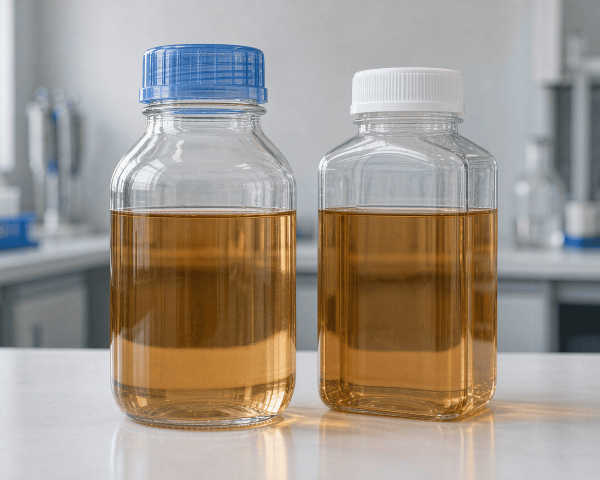

Walk into any cell culture lab and you’ll spot the same bottle on every bench: the 500 mL media bottle. It’s the quiet workhorse of the lab — media, buffers, reagents, samples, and waste all pass through it daily. But when it’s time to reorder, “just get more 500 mL bottles” turns out to hide a surprisingly long list of choices.
Here’s the short version: a 500 mL media bottle is a screw-neck laboratory bottle, almost always with a GL45 thread, made from either Type I borosilicate glass (reusable, autoclavable) or PETG plastic (sterile, single-use). Choose glass for autoclaving and reuse, choose PETG for certified sterile single-use work, and match the cap to how you pour.
Let me break down the sizes, the materials, the closure options, and the buying criteria that actually matter.
Why 500 mL Is the Workhorse Size
The 500 mL bottle hits a sweet spot in the lab. It’s big enough to hold a practical volume of media or buffer — a batch that keeps a bench running for a while — but small enough to handle comfortably, autoclave in standard loads, and store in standard fridge shelves.
The size family matters because media bottles scale predictably. Manufacturers produce the same bottle design across a range: Thermo Scientific’s Nalgene PETG media bottles, for instance, run from 30 mL up to 2 L in the same square-bottle format, with the 500 mL (16 oz) version as a mid-range option. If your lab standardizes on one closure and one footprint, you can mix sizes without changing your storage and filling systems.
Glass: The Reusable Standard
If you want bottles you can autoclave, reuse, and trust for long-term storage, borosilicate glass is the classic choice. The reference product here is DURAN’s GL45 laboratory bottle, which has defined the category since 1972. Sigma-Aldrich’s DURAN 500 mL GL45 bottles are molded from USP/EP Type I borosilicate glass 3.3 — the highest hydrolytic class — and are designed to ISO 4796-1, the international standard for screw-neck laboratory bottles that covers nominal volumes from 25 mL to 20,000 mL.
What does that buy you in practice?
- Thermal resistance: glass bottles and their caps autoclave at 121 or 134 °C, and the high-temperature PBT caps handle dry heat up to 180 °C.
- Chemical resistance: Type I borosilicate stands up to aggressive reagents that would attack soda-lime or plastic.
- Longevity: a well-treated glass media bottle lasts for years of autoclave cycles.
- Traceability: brands like DURAN print a permanent retrace code on each bottle for full lot traceability.
The trade-off is weight, breakage risk, and the labor cost of washing and sterilizing between uses. For labs running a few batches a day, that’s a non-issue. For high-throughput downstream work, it’s a real cost.
Plastic: The Sterile Single-Use Option
PETG media bottles flipped the economics for many labs. They arrive sterile, certified, and ready to use — no washing, no autoclaving, no depyrogenation validation. The Nalgene PETG square media bottles are a good example: certified sterile at a 10⁻⁶ sterility assurance level, tested to contain less than one-third of the USP particulate limits, and leakproof with their HDPE closures. They’re the default choice for pharmaceutical and biotech downstream work where washing and sterilization validation is the expensive part.
What PETG gives up: you can’t autoclave it, it’s single-use, and it’s not the right container for aggressive solvents. For media, buffers, and pH-sensitive liquids, though, it’s often the smarter buy — especially when you value the documented sterility and particulate data over the reusable economics of glass.
The Closure Matters as Much as the Bottle
The “GL45” in “GL45 media bottle” refers to the thread — a standardized 45 mm screw thread that defines the cap. Because GL45 is a global standard, caps, pouring rings, and even mobile-phase caps from different manufacturers interchange.
Cap materials differ in what they tolerate. The standard polypropylene (PP) cap with its pouring ring handles routine use and autoclaving up to about 140 °C. If you run higher-temperature sterilization, DURAN’s high-temperature PBT caps with ETFE pouring rings step up the thermal and chemical resistance while staying fully autoclavable.
Two details buyers overlook:
- Pouring rings: a drip-free pouring ring makes dispensing media clean and safe. Worth checking that the cap comes with one.
- Cap liner: for long-term storage of volatile or sensitive media, a cap with a PTFE-faced liner adds a barrier the plain PP cap doesn’t have.
I covered the GL45 system in depth in our GL45 media bottle guide — including the GL45 mobile-phase cap variant that plumbed HPLC lines use — if you want the full thread-and-cap picture.
What to Check Before You Buy
Here’s the checklist I give procurement people ordering 500 mL media bottles:
1. Glass or PETG? Match to your workflow — autoclave-and-reuse means glass; sterile single-use means PETG. Don’t mix the two in one SKU. 2. Thread standard: GL45 is the dominant standard; verify the cap and any accessories (pouring rings, adapters) are GL45 too. 3. Glass quality: for glass bottles, confirm Type I borosilicate (USP/EP Type I) and ISO 4796-1 design compliance. 4. Sterility and certifications: for plastic, check the sterility assurance level, USP particulate compliance, and whether the closure is included. 5. Graduations and marking field: graduation marks and a white marking field sound trivial until you’re labeling hundreds of bottles for a batch. 6. Autoclave compatibility of every component: bottle, cap, and ring all need to tolerate your sterilization cycle. 7. Quantity and packaging: 500 mL bottles ship in packs of 10 to 70; volume pricing changes the per-unit cost dramatically.
Conclusion
The 500 mL media bottle looks like a commodity until you line up the choices hiding inside it. Glass gives you a reusable, autoclavable workhorse built on Type I borosilicate and ISO 4796-1 design; PETG gives you certified sterile, single-use convenience for downstream and pharma work. The GL45 thread standard means caps and accessories interchange, but cap material — PP versus high-temperature PBT — determines what your sterilization cycle can do. Match the material to your workflow, verify the glass class and certifications, and check the cap before you commit. For a deeper look at how these bottles fit a complete lab workflow, our guides on borosilicate reagent bottles and how to sterilize reagent and media bottles are the natural next reads.
Frequently Asked Questions
What does GL45 mean on a 500 mL media bottle?
GL45 refers to the standardized 45 mm screw thread on the bottle neck. Because it’s an international standard, GL45 caps, pouring rings, and accessories from different manufacturers generally interchange.
Can I autoclave a 500 mL glass media bottle?
Yes, if it’s borosilicate glass with an autoclavable cap. Type I borosilicate bottles and their PP or PBT caps withstand autoclaving at 121 or 134 °C; PETG plastic bottles are not autoclavable.
What is the difference between a media bottle and a reagent bottle?
In practice, little — the terms overlap. Media bottles are usually the same Type I borosilicate or PETG screw-neck bottles used for cell culture media, buffers, and reagents. The main difference is marketing and intended use, not construction.
How many 500 mL bottles come in a case?
It depends on the supplier and format: DURAN glass bottles typically pack 10 per case, while Nalgene PETG bottles pack 40 to 70 per case. Case quantity strongly affects the per-unit price.
Are plastic media bottles better than glass?
Neither is universally better — they’re suited to different workflows. Glass is reusable, autoclavable, and chemically resistant, ideal for routine lab use. Sterile PETG is single-use with documented sterility and low particulates, ideal for pharma and biotech where washing and validation costs dominate.