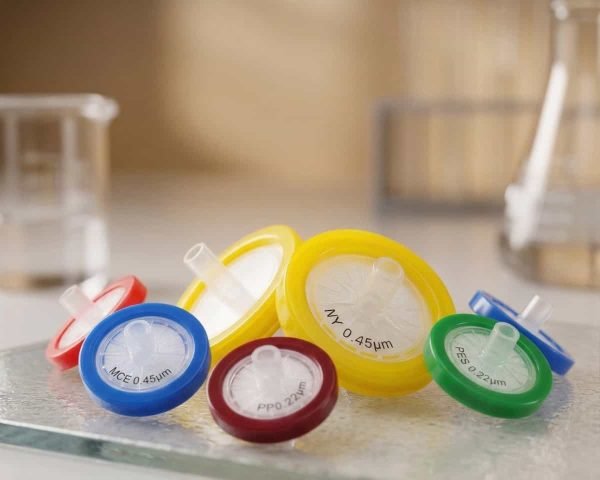

Most lab conversations about syringe filters start and end at 0.22 and 0.45 microns. But every so often you’ll hit a sample so dirty that a fine filter clogs in seconds, and that’s when someone pulls out a “coarse” filter rated at 5 or even 20 microns. When should you reach for those larger pore sizes, and how do you choose between them?
The Short Answer
Use a 5 micron filter to remove large particles, yeast, and visible debris from samples that would clog a finer filter, think clarification and prefiltration before a 0.45 or 0.22 micron step. Use a 20 micron filter only for the coarsest jobs: pulling very large debris or cells out of heavy suspensions where even a 5 micron filter would block almost immediately. In both cases, the coarse filter protects a downstream fine filter; it doesn’t replace it.
First, a Quick Refresher on Pore Size Ratings
A filter’s micron rating describes the size of particles it’s designed to retain: a 5 micron filter holds back most particles larger than about 5 micrometers (0.005 mm). A 20 micron filter holds back larger particles but lets everything smaller sail through.
That last point matters more than people think. Bigger pores mean three things:
- Higher flow rate: the liquid pushes through much faster.
- Higher dirt-holding capacity: the filter doesn’t block as quickly.
- Weaker retention: fines, bacteria, and small particulates pass straight through.
So you’re not “filtering harder” with a coarse grade. You’re filtering differently: removing the big stuff fast, without choking the filter. Filter makers map these grades to specific jobs. Sterlitech, for example, classifies 5.0 micron filters as particle filtration (including NIOSH air-sampling methods and retaining yeast cells), while its 20.0 micron grade is the largest standard pore size it offers, intended for coarse prefiltration of heavy suspensions.
Where 5 Micron Filters Earn Their Keep
A 5 micron filter is the workhorse of “medium dirty” samples. Typical jobs include:
- Clarifying turbid samples. If your sample looks cloudy or has visible precipitate, a 5 micron filter clears it quickly without clogging, so you can then pass it through a 0.45 micron filter for analysis.
- Prefiltering mobile phases and reagents. Solvent that sits in a carboy can pick up dust and fibers. A quick 5 micron pass protects the 0.45 micron filter you’d normally use.
- Removing yeast and large cells. At the 5 micron scale, you’re capturing cells and large particles while leaving smaller analytes and fines in the filtrate.
- Protecting downstream fine filters. This is the big one. Filtration specialists describe large-pore grades (roughly 0.8 to 5 microns) as the stage that handles clarification and protection of downstream equipment, with the fine filter doing the final polish.
Think of a 5 micron filter as a bouncer at the door: it stops the troublemakers so the fine filter inside doesn’t get overwhelmed.
When You’d Step Up to 20 Microns
A 20 micron filter is a specialist. It’s for samples that are *really* loaded with debris: suspensions, soil extracts, homogenized tissue, cell slurries, or process liquids with visible chunks. If you ran those through a 5 micron filter, it would block after a few milliliters.
At 20 microns you’re in “gross filtration” territory:
- Removing large debris only. Everything below 20 microns, including most cells and all fine particles, goes through. That’s the point: you want the liquid, fast, without the filter dying.
- First-stage treatment of heavy suspensions. Because it holds enormous amounts of coarse material, a 20 micron grade can act as the sacrificial first stage in a multi-step filtration train.
- Cell straining and coarse particle removal. Many 20 micron products aren’t conventional membranes at all; they’re woven mesh or screen devices, like the 20 µm syringe strainers used to pull cells and large particles out of biological samples.
In practice, 20 micron syringe filters are less common than 5 micron versions because most lab samples simply aren’t that dirty. But when you have one that is, the 20 micron grade is the difference between filtering 50 mL and filtering 2 mL before blockage.
5 Micron vs 20 Micron: How to Decide
When you’re standing in front of the storage cabinet with a murky sample, work through this checklist:
1. What must the filtrate be free of? Identify the smallest harmful particle. If it’s visible debris or large cells, either grade can work. If it’s fines or bacteria, neither will cut it. You need the fine filter afterward. 2. How dirty is the sample? Lightly cloudy → 5 microns. Chunky suspension → 20 microns (or a glass-fiber prefilter, which filter guides recommend for highly particle-laden samples). 3. What’s downstream? If the sample goes to HPLC, remember the coarse filter is only a prefilter; you still need the 0.45 or 0.22 micron step to protect the column and give you a clean injection. 4. Don’t over-filter. Use the largest pore size that reliably removes what you need to remove. Bigger pores mean faster filtration, less back-pressure, and fewer blocked filters.
One honest warning: because both grades let fines through, a 5 or 20 micron filter alone will *not* sterilize a sample, clarify it to analytical clarity, or protect a column. If you try to shortcut the fine step, you’ll trade a clogged filter for a clogged column, which is far more expensive. My guide to preventing syringe filter breakthrough covers what happens when filters get pushed past their limits.
Membrane Choice Still Matters at Coarse Pore Sizes
Don’t assume coarse filters are all the same. The membrane material determines chemical compatibility, and that doesn’t change just because the pores are bigger:
- PTFE for aggressive organic solvents and strong acids/bases.
- Nylon for general aqueous and mixed-solvent work, a solid default for HPLC sample prep.
- PES or cellulose acetate for biological samples where low protein binding matters.
If you’re filtering solvent, a nylon or PTFE coarse filter is usually right; if you’re filtering a cell suspension, a low-binding hydrophilic membrane or a dedicated screen device makes more sense. For the full material comparison, my article on nylon vs PTFE vs PVDF vs PES filters goes deep on the trade-offs.
Putting It Together: A Two-Stage Workflow
Here’s the pattern I use when samples are genuinely dirty:
- Stage 1: coarse clarification. Pass the sample through a 5 micron (or 20 micron, for heavy suspensions) filter to strip the bulk debris.
- Stage 2: final filtration. Run the clarified liquid through a 0.45 or 0.22 micron filter for the actual analysis step.
That two-stage approach is standard practice in labs that handle environmental, food, or biological samples with high particle loads. Sartorius’s syringe filter family, for example, positions its larger-pore grades for particle removal, clarification, and prefiltration, with glass-fiber prefilters as the answer for samples carrying an extreme particle load.
If your samples are usually clean (most HPLC samples are), you might never need a coarse filter at all. But when that one dirty batch shows up, knowing the difference between 5 and 20 microns saves you an afternoon of fighting clogged filters. For the routine end of the spectrum, my explainer on 0.22 vs 0.45 micron pore sizes covers the fine-filter choices you’ll make far more often.
Conclusion
The micron rating isn’t about “stronger” versus “weaker” filtering — it’s about matching the filter to the particle load. A 5 micron filter removes large particles, yeast, and visible debris while keeping flow fast and blockage low, which makes it the right choice for clarifying turbid samples and protecting a downstream 0.45 or 0.22 micron filter. A 20 micron filter is the extreme-duty option for heavy suspensions where even 5 microns would clog almost immediately. Whichever you choose, remember the golden rule: coarse filters are prefilters, not replacements. Keep the fine-filtration step for anything that goes into an HPLC or GC system, match the membrane material to your solvent, and always pick the largest pore size that does the job. Done that way, a 5 or 20 micron filter becomes a cheap insurance policy that keeps your real filters and your column running for far longer.
Frequently Asked Questions
What is a 5 micron filter used for?
A 5 micron filter removes large particles, yeast cells, and visible debris from liquids. Labs use it to clarify turbid samples, prefilter solvents and reagents, and protect finer 0.45 or 0.22 micron filters from clogging.
What is a 20 micron filter used for?
A 20 micron filter is a coarse grade used for gross particle removal from heavy suspensions: soil extracts, cell slurries, or process liquids with visible chunks. It’s often the first stage in a multi-step filtration train because it holds a huge amount of debris before blocking.
Can a 5 or 20 micron filter sterilize a sample?
No. Sterile filtration requires a 0.2 micron (0.22 micron) rated filter that retains bacteria. A 5 or 20 micron filter lets bacteria and fine particles pass through, so it’s only suitable for clarification or prefiltration, never sterilization.
Why would I use a coarse filter before a 0.45 micron filter?
Because a dirty sample will clog a 0.45 micron filter in seconds, slowing you down and risking breakthrough. A 5 or 20 micron prefilter strips the bulk debris first, so the fine filter only has to handle the remaining particles and lasts much longer.
Is 5 micron or 20 micron better for filtering mobile phase?
For routine mobile-phase filtration, a 0.45 micron filter is the standard; 5 microns is a reasonable prefilter only if your solvent is visibly dirty. A 20 micron grade is overkill for mobile phases and would let particles through that could still damage the system.