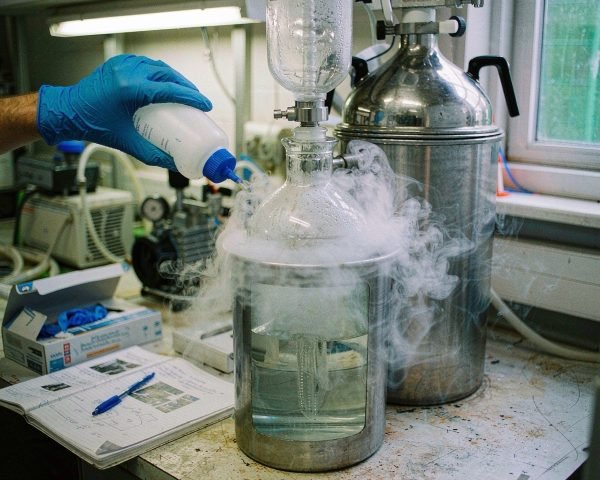

If you run a rotary evaporator, a freeze dryer, or any vacuum line in your lab, you already own the most expensive consumable in the room: your vacuum pump. A cold trap is the cheap insurance policy that keeps it alive. This article explains what one is, what it catches, and the consumables you should keep stocked beside it.
A cold trap is a vessel chilled to very low temperatures (typically -78 to -196 °C) that sits between your apparatus and the vacuum pump. It condenses solvent vapors, water, and corrosive gases before they can reach and damage the pump.
Read on if you want the full picture: which trap type fits which job, what to buy for it, and the safety mistakes I see people make with liquid nitrogen.
What a Cold Trap Actually Does
A vacuum pump does not “suck” liquids. It moves vapor. When you evaporate solvent under vacuum, that solvent leaves your flask as gas, and it will condense somewhere. Without a trap, that somewhere is inside your pump. Solvent vapors contaminate pump oil, corrode internal parts, and can even vent back into the lab air through the exhaust. A cold trap gives those vapors a much colder surface to condense on first, so they freeze or liquefy in the trap instead of in the pump.
The same logic applies to water vapor and aggressive vapors like TFA or dichloromethane. Water vapor is sneaky. Even a small amount reaching an oil-sealed rotary vane pump will emulsify the oil into a white mayo-like sludge, and once that happens the pump loses vacuum and needs a full oil change or worse.
Where do labs use cold traps? More places than most people realize:
• Rotary evaporation is the classic case. Every bump and every splash sends solvent vapor toward the pump.
• Freeze dryers (lyophilization) pull water vapor off frozen product for hours at a stretch. The condenser in a lyophilizer is itself a cold trap, and a secondary trap often protects the pump behind it. The process physics are covered well in this review of freeze-drying fundamentals.
• Vacuum ovens bake solvent out of samples, and that vapor has to go somewhere.
• GC-MS roughing lines see solvent contamination and pump oil backstreaming of their own; inlet traps and filters are standard protection there, as Agilent documents for its rotary vane pumps.
• Schlenk lines in synthetic chemistry labs catch vapors before they hit the oil pump, and protect the line from pump oil backstreaming.
The Three Types of Cold Trap
Dry ice and solvent slurry. Dry ice in isopropanol gives you about -78 °C. It is cheap, it needs no electricity, and it handles most organic solvents. The downsides are real though: someone has to refresh the slurry every few hours during long runs, and the bath is a cryogenic hazard sitting on your bench.
Liquid nitrogen (LN2). At about -196 °C, liquid nitrogen will condense almost anything, including, unfortunately, oxygen from air if your line leaks. It is the standard for demanding applications like Schlenk work and low-vapor-pressure solvents. It is also the most hazardous option, and I will get to that later.
The third type is electromechanical: Peltier or compressor-cooled units that hit roughly -50 to -105 °C with no cryogen at all. Thermo Fisher’s SpeedVac guidance on solvent trapping is blunt about the payoff: trapping solvent keeps it out of the pump oil, and a colder trap or two traps in series condenses more vapor and protects the pump better. My honest opinion: for routine rotavap work, a dry ice slurry does the job fine, but if your team runs vacuum concentrators all day, a refrigerated trap pays for itself in labor and pump oil you stop buying.
Which Consumables a Cold Trap Needs
A cold trap is a simple device, but it drags a whole shopping list behind it. Coolant is the obvious one. A dry ice trap needs dry ice plus isopropanol (some labs use acetone; isopropanol is less flammable and easier on plastics), and you will want a standing weekly delivery if you trap daily. For LN2 traps, budget for dewar refills and a transfer method.
If liquid nitrogen is involved, add proper cryogloves, a face shield over safety glasses, and closed shoes as a hard rule. These are consumables in the sense that cryogloves get stiff, cracked, and contaminated; inspect them monthly and replace them when they do.
Vacuum pump oil and exhaust mist filters come next. The trap reduces how much junk reaches the pump, but it does not make the pump maintenance-free. Oil-sealed rotary vane pumps still need regular oil changes, and a mist eliminator on the exhaust keeps oil vapor out of the room air. Lab Manager’s vacuum pump maintenance guidance makes the point well: even with an inlet trap, trace contamination builds up in the oil, and oil that has turned from the color of honey to the color of maple syrup is overdue for a change.
Then the hardware: thick-walled vacuum tubing, KF clamps and centering rings, and the adapters that mate the trap to the pump. Cheap tubing collapses under vacuum and kills your pumping speed. Check it for cracks whenever you defrost the trap; cracked tubing is the leak you smell before you see.
Glassware rounds out the list. A transparent borosilicate trap flask lets you see ice buildup at a glance, so keep a spare on the shelf, and add a collection flask with a drain valve so you can empty the trap without disassembling the line. Use borosilicate only; soda-lime glass cracks under thermal shock, and a vacuum line is no place for imploding glassware.
One internal note on the GC side: if your vacuum work connects to GC-MS, consumable hygiene matters there too, and our guide on GC inlet liners covers the part people forget until they see ghost peaks.
Maintenance Habits That Actually Protect the Pump
How often should you empty or check a cold trap? It depends on the solvent load, but a good baseline: for rotavap work, check it every run and empty when condensate reaches roughly half the trap volume. For freeze drying, where water vapor streams for 24 to 48 hours, plan defrost cycles between batches, not mid-batch. Labconco puts the threshold at about half the trap volume before emptying or defrosting, which matches what I do in practice.
What happens if you let it fill with ice? The trap loses capacity. Ice is a decent insulator and less of a condenser, so vapors start passing through to the pump. Worse, a fully blocked trap can plug your line entirely, and you will notice it as a vacuum that will not pull. That is your twelve-second warning. Defrost, drain, wipe, restart.
The economics here are boringly one-sided. A replacement rotary vane pump costs several hundred dollars to well over a thousand. Pump oil is cheap. Dry ice is cheap. Every hour of vacuum work you do without an adequately cold trap, you are slowly dissolving solvent into oil that costs money to replace. I have no data to prove this, but I once inherited a lab where the rotavap pump oil was black and smelled like dichloromethane, and the pump pulled nothing better than 100 mbar. One trap, one oil change, one afternoon: the vacuum came back. That afternoon convinced me more than any manual ever has.
If you take vacuum work seriously, treat the whole setup as a system, pump and consumables together. For what that means on the sample-prep side, our article on what residual solvent testing needs walks through the consumables for the concentration step that usually sits upstream of the pump.
Cold Trap Safety: The Part You Should Not Skip
Liquid nitrogen and dry ice are the two hazards in this article, and both are underrated.
LN2 expands roughly 700 times in volume when it warms to gas. In a small room or a poorly ventilated space, evaporating nitrogen displaces oxygen and can asphyxiate someone with little warning. OSHA’s hazard alert on cryogen releases describes fatal incidents where workers were killed in seconds and rescuers died entering the same room. For a lab-scale cold trap the volumes are small, but the rule stands: use LN2 traps in ventilated areas, never in a cold room or a closed instrument closet.
Then there is the sealing problem, and this is the mistake that scares me most. If you fill a cold trap with LN2 and close every valve on it, any condensate inside (or oxygen condensed from a small air leak) will vaporize as the trap warms. Pressure builds. A sealed glass trap under those conditions can explode, and glass shrapnel plus cryogenic liquid is a bad combination. Never seal a cold trap. Leave a vent path or a pressure relief, always. Dry ice behaves the same way: a slurry warming in a closed container builds CO2 pressure just the same.
Handling rules are the usual cryogen rules: cryogloves and face shield, pour slowly to avoid splashing, and never let liquid cryogen touch skin. Frostbite from LN2 looks deceptively mild at first and then is not.
Conclusion
A cold trap is a simple idea doing an expensive job: it gives solvent vapors, water, and corrosives a cold surface to condense on so your vacuum pump never sees them. The consumable list is short and affordable: coolant (dry ice plus isopropanol, or LN2), cryogenic handling gear, fresh pump oil and a mist filter, decent vacuum tubing and clamps, a dewar, and a collection flask with a vent. Check the trap at the halfway mark, defrost before ice chokes the line, and never seal the vessel. Do those things and your pump, the most expensive piece in the chain, quietly lasts years longer. If freeze drying is your main application, start with our guide to lyophilization and freeze-drying consumables, then build the maintenance habits above into a schedule your whole team follows.
Frequently Asked Questions
How cold does a cold trap need to be?
Cold enough to condense the vapors you are generating, which depends on their vapor pressures. About -78 °C (a dry ice and isopropanol slurry) catches most organic solvents and water. Demanding applications such as Schlenk work or low-vapor-pressure solvents call for liquid nitrogen at about -196 °C.
Can I use dry ice instead of liquid nitrogen?
Usually, yes. A dry ice and isopropanol slurry at about -78 °C handles typical rotary evaporation and vacuum oven work, and it is cheaper and safer than LN2. Liquid nitrogen earns its cost only when you need to condense solvents that still have meaningful vapor pressure at -78 °C.
How often should I empty a cold trap?
Empty or defrost when condensate reaches about half the trap volume, and always between long runs. For daily rotavap work that means a visual check every run; for multi-day freeze-drying cycles, schedule defrost windows between batches.
What solvent should I mix with dry ice for a cold trap?
Isopropanol is the common and sensible choice, giving a stable bath near -78 °C. Acetone works too and cools faster, but it is more flammable and attacks more plastics and coatings than isopropanol does.
Why is a sealed cold trap dangerous?
Anything condensed inside a trap, whether solvent, water, or oxygen from an air leak, vaporizes as the trap warms and can build enough pressure to rupture the vessel. Always leave a vent or relief path on a cold trap, and open the line before the coolant melts.