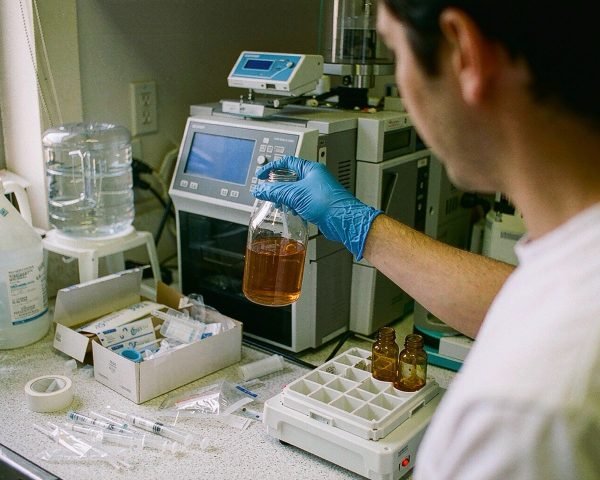

The autosampler clicked, strained, and drew half a loop of ointment extract. The chromatogram that followed had a peak shape I still describe to new hires as “a landslide.”
Viscous samples fail quietly at first. The draw is slow, the injection volume drifts, and the filters clog two at a time. Then one day the sequence aborts at 2 a.m. and nobody knows why. The good news: four practical fixes, used together, handle almost every thick sample I have met in fifteen years of HPLC work.
Why Viscosity Wrecks Injections
A liquid chromatography system assumes your sample flows like a solvent. Thick samples break that assumption in three places.
At the needle, a viscous liquid resists being drawn. The autosampler may pull a partial or inconsistent volume, so your 10 µL injection becomes 7 µL, then 9 µL, then something nobody can predict. Retention-time precision survives but your peak areas scatter, and if you have never audited how your method picked its injection size, our injection volume guide is a useful sanity check.
In the loop and tubing, high viscosity slows the fill and leaves air pockets. Restek’s troubleshooting guidance for syringes puts it plainly: when a sample is too viscous, slow the plunger draw speed, and if that is not enough, dilute the sample. Most modern autosamplers let you set draw speed in the method, and it is the free fix nobody uses.
In the column, concentrated polymers and gums spread out instead of eluting as a tight band. The Shodex column operating manual documents the consequence for polymer analysis directly: high-viscosity samples cause peak broadening and elution delay, which makes molecular weight distributions unreliable.
Fix One: Dilute, But Choose the Diluent Carefully
Dilution is the most reliable tool, and the one people get wrong most often.
Cut the sample with a solvent as close to your initial mobile phase as possible. If you dilute a reversed-phase sample with strong solvent, you create solvent mismatch at injection: broad early peaks, split peaks, baselines that wander for the first minute. When the sample will not dissolve in weak solvent, dissolve it in strong solvent first, then dilute with the starting mobile phase until it flows.
Watch your sensitivity budget. A 5-fold dilution raises your detection limit 5-fold. For main-assay work that is irrelevant. For impurity quantitation at 0.05%, it can put your reportable range in the gutter. Dilute only as much as the viscosity demands, and if you need a refresher on matching prep to the method, our HPLC sample preparation guide covers the full workflow.
Fix Two: Warm the Sample, Gently
Viscosity drops with temperature, and the effect is larger than most people expect. Warming a thick extract from room temperature to 30 or 35 °C can roughly halve its resistance to flow. Biotage’s injection troubleshooting guide recommends warming viscous samples to 30-35 °C for exactly this reason, with the obvious caveat that this only applies to temperature-stable analytes.
Two ways to do it: a heating block at 35 °C for ten minutes before loading, or an autosampler set to hold vials at a mild temperature. What I would not do is heat aggressively to force a stubborn sample through a filter. One 40 °C shortcut cost a colleague a week of stability-indicating work when the analyte quietly degraded. Check your analyte’s thermal limits first.
Fix Three: Filter Without Destroying the Filter
Viscous samples are hard on membranes. Push gum through a 0.22 µm filter and you will watch the housing swell and the membrane fail, sometimes visibly, sometimes worse, invisibly into your filtrate.
Three tactics that work:
- Step up in pore size first. Filter a thick, particulate-heavy sample through 0.45 µm before reaching for 0.22. If the column is a standard 3-5 µm packing, 0.45 µm protection is usually enough. Our pore size explainer covers when the tighter membrane is actually required.
- Use a prefilter. A glass fiber prefilter in front of the membrane takes the coarse load and spares the fine filter. For samples that fight back, combination filters with a built-in prefilter save both membranes and patience.
- Push slowly. Gorilla pressure on a viscous sample just ruptures membranes and sheds housing particles. Slow, even force, and accept that some filters are single-use by design.
Fix Four: Tune the Autosampler for Thick Liquids
If the method allows dilution, do it and most autosampler problems vanish. When it does not, adjust the hardware side.
Set a slower draw and dispense speed. Use a larger internal diameter needle if your system supports it. Gas-tight syringes handle viscous liquids better than standard liquid syringes because the PTFE-tipped plunger glides instead of seizing. Restek notes that gas-tight syringes work better for drawing viscous liquids specifically.
One more habit worth stealing: leave an air gap between the sample and the plunger when you aspirate manually. It keeps thick liquid out of the plunger seal, which is where slow death of syringes begins.
A Note on Polymer Samples Specifically
If your viscosity problem is a polymer in solution, concentration is the lever. The Shodex manual’s guidance table is worth taping to the bench: samples above roughly 200,000 molecular weight should run at 0.1% w/v or less, and the biggest polymers at 0.05%. Higher concentrations do not just thicken the sample. They broaden peaks and distort the very molecular weight distribution you are trying to measure. Cutting concentration is not a compromise there; it is the method done correctly.
Conclusion
Viscous samples punish shortcuts, but they yield to a short list of habits. Dilute with a mobile-phase-matched solvent and only as far as sensitivity allows. Warm to 30 or 35 °C when the analyte tolerates it. Filter in stages, with a prefilter taking the coarse load and a slow push protecting the membrane. Then give the autosampler a fighting chance with slower draw speeds and, where possible, gas-tight syringes. Polymer samples have their own rule: lower the concentration until the viscosity stops fighting the column. If you only change one thing this week, slow the autosampler draw speed in your thick-sample methods; it is free and it works immediately. For the filtration half of the problem, our guide to filtering HPLC samples picks up where this one ends.
Frequently Asked Questions
How do you reduce the viscosity of a sample for HPLC?
The safest options are dilution with a mobile-phase-compatible solvent and gentle warming to 30 or 35 °C. Both reduce resistance to drawing and filtration. For polymer solutions, lowering the concentration is the correct fix, not a workaround.
Can I heat an HPLC sample before injection?
Yes, within the analyte’s stability limits. Many labs warm viscous extracts to 35 °C for ten minutes before loading. Always confirm thermal stability first, because a degraded sample gives you a beautiful chromatogram of the wrong compounds.
What pore size filter should I use for viscous samples?
Start with 0.45 µm unless your column or method demands 0.22 µm. Thick samples blind fine membranes quickly. A glass fiber prefilter ahead of the membrane extends filter life further on particulate-heavy matrices like ointments, creams, and food homogenates.
Why are my autosampler injections inconsistent with thick samples?
The draw is likely partial or variable because the liquid resists being pulled through the needle. Slow the autosampler draw speed, use a gas-tight syringe with a PTFE-tipped plunger, and dilute the sample if the method allows. All three together usually restore injection precision.
Does dilution affect quantitation?
It raises your detection limit by the dilution factor, so a 10-fold dilution makes trace work 10 times harder to see. For main component assays, dilute freely. For impurity or trace analysis, dilute the minimum amount needed and consider concentration-focused prep instead.