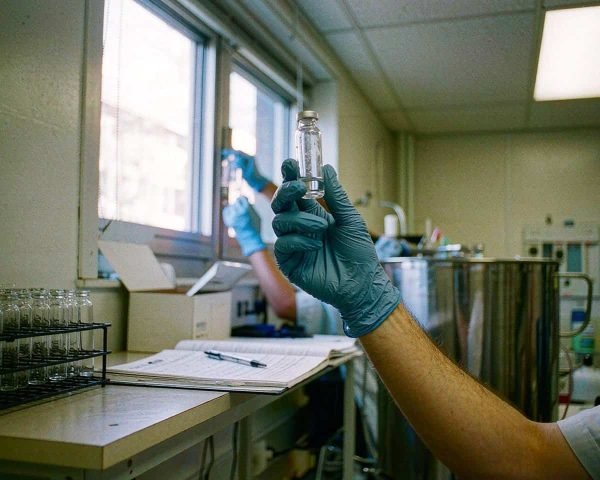

A vial catalog says “Type I borosilicate glass” on almost every page. I once asked a buyer what that meant and got a shrug: “the good glass, right?” It is the good glass, but there’s a real standard behind the claim, and knowing it makes you a much sharper purchaser.
USP <660> is the United States Pharmacopeia general chapter titled Containers—Glass. It defines how pharmaceutical glass is classified and exactly how it gets tested, so “Type I” means the same thing from every serious manufacturer.
What USP <660> Actually Covers
The chapter governs glass containers that touch pharmaceutical products: vials, ampoules, bottles, and similar packaging. Its core job is to classify glass by hydrolytic resistance, which is a fancy way of saying how much alkali the glass releases when water attacks it.
That number matters because glass isn’t chemically inert. Water and buffered solutions slowly leach ions from the glass surface. In a pH-sensitive method or a protein formulation, that leaching shows up as drifting pH, adsorbed analyte, or visible flakes in bad cases.
The current chapter was made official on October 1, 2023, and it shifted the classification from a pure composition-based definition to a performance-based one. In plain terms: what the glass does under test matters more than what it’s made of.
The Three Glass Types
USP <660> sorts pharmaceutical glass into three types.
Type I is borosilicate glass, with significant boric oxide and aluminum oxide in the mix. It has the highest hydrolytic resistance and handles thermal shock well. Nearly every HPLC vial worth buying is Type I.
Type II is soda-lime glass with a treated inner surface. The treatment, typically ammonium sulfate, raises the surface resistance so it performs close to Type I. It suits acidic and neutral aqueous products.
Type III is untreated soda-lime glass with only moderate resistance. It’s generally not used for parenteral products unless stability data prove it works.
The practical takeaway for a chromatography lab: Type I is the default, Type II is a cost option for benign aqueous work, and Type III doesn’t belong near your autosampler.
The Tests Behind the Label
Three tests do the classification, and all three lean on an autoclave. The USP <660> test procedures describe them in detail, and equipment vendors have documented how the cycle runs in practice, including the ramp from 100°C to a 121°C hold and back down at a controlled rate (the autoclave process for USP 660 glassware testing is a good plain-language walkthrough).
Glass Grains Test. Crushed glass is heated in purified water, and the released alkali gets titrated. This characterizes the bulk glass material itself.
The second test works on whole containers. Each one gets filled with water and autoclaved, so the actual contact surface is what gets challenged, treatment included. This is the test that reflects what your sample touches, and it matters most for small vials, since a 2 mL vial has a large surface area relative to the volume it holds.
The third, used less often, is the Surface Etching Test. It answers a specific question: did the high resistance come from the glass chemistry itself, or from a surface treatment? That distinction separates Type I from treated Type II.
One thing that surprised me early in my career: the autoclave step is so sensitive to technique that an international ring trial found the heating and cooling ramps themselves explain most of the variation in results. Labs that rush the cycle get flattering numbers.
Why It Matters for HPLC Vials
Strictly, USP <660> was written for pharmaceutical packaging, not chromatography consumables. So why should an HPLC lab care?
Because the chemistry is identical. A 2 mL autosampler vial holds your sample under the same leaching dynamics as a pharmaceutical vial, just at smaller scale. Three failure modes trace straight back to glass quality.
First, pH drift. At high pH, soda-lime glass releases sodium fast enough to move a buffer’s pH during a long sequence. I’ve seen retention times walk upward across a 90-vial run before anyone connected it to the vials. On a low-pH method you’d never notice; on an amine analysis at pH 10 it’s the first suspect.
Second, adsorption and delamination. Poor glass surfaces interact with analytes, and in extreme cases corroded glass sheds lamellae. The leaching behavior also explains a small but annoying artifact: methods at neutral pH that drift by a few hundredths across a sequence. Each vial contributes a tiny amount of alkali, and over a hundred injections the buffer can’t fully absorb it. For trace work this is why certified vial kits specify low extractables and background with paperwork to back it.
Third, light protection for amber vials. The chapter includes a spectral transmission test for colored glass, and a recent Ph. Eur. revision moved to wall-thickness-based transmission limits for the same reason, since amber performance depends on the glass wall, not the bottle volume (the Ph. Eur. 3.2.1 revision notes summarize the change). If light protection matters in your method, the amber claim should be more than a color. Our comparison of clear vs amber vials covers when the switch pays off.
How to Use This When You Buy
Ask suppliers one question: can you show the glass type and the test method behind it?
A serious manufacturer answers with a Type I borosilicate claim, a hydrolytic resistance classification, and a CoA per lot. If you want to go deeper on what that paperwork looks like, our glass quality inspection guide walks through the checks that matter at receiving. One nuance when you read the paperwork: chromatography vials sometimes carry a hydrolytic class notation from the European or Japanese pharmacopoeias instead of a USP type. The classes map roughly onto each other, and a vendor who can state the class in either system is telling you they actually tested the glass. When you’re matching vials to a specific instrument, the Agilent autosampler vial lineup shows how the major vendors document materials and dimensions side by side.
Conclusion
USP <660> is the reason “Type I borosilicate” is a specification instead of a slogan. It defines three glass types, the grains, surface, and etching tests that sort them, and the autoclave conditions that make results comparable between labs. For a chromatography lab, the standard is a ready-made purchasing filter: demand a Type I claim with per-lot documentation, and treat vague glass descriptions as a cost signal rather than a bargain. Type II can save money on gentle aqueous methods if the data supports it. Type III doesn’t belong in a sample vial at all. The next time a catalog says “Type I,” you’ll know exactly what was tested, and what to ask the supplier who doesn’t want to show you.
Frequently Asked Questions
Is USP <660> mandatory for HPLC vials?
Not directly. The chapter regulates pharmaceutical glass containers, and HPLC vials fall outside its formal scope. It’s still the reference most manufacturers use to back a Type I borosilicate claim, which is why it matters when you compare suppliers.
What’s the difference between Type I and Type II glass?
Type I is borosilicate with high hydrolytic resistance built into the glass chemistry. Type II is soda-lime glass whose surface has been treated to resist water. Type II suits acidic and neutral aqueous products but shouldn’t be assumed equivalent for high-pH work.
Does USP <660> cover amber vials?
Yes. The chapter includes a spectral transmission test for colored glass containers, which is how light-protective performance is verified rather than assumed from the color.
Where does glass delamination fit in?
Delamination, where glass sheds thin flakes into the solution, is a corrosion failure of the inner surface. USP addresses it through related informational guidance on glass delamination, and the surface tests in <660> are the first line of evidence about surface quality.