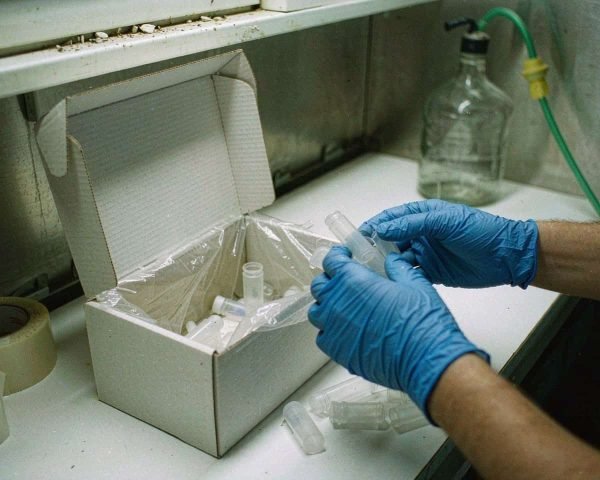

Last quarter I walked past a bench where someone had balanced a full tray of used acetonitrile vials next to the sink “for a minute”. Nothing bad happened that day, which is exactly the problem: bad disposal habits get reinforced by lucky outcomes. This article is the checklist I wish that bench had pinned above the sink.
Used HPLC vials, septa, filters, and solvent waste fall into different disposal streams depending on what touched them. Sort them correctly and disposal becomes routine. Sort them wrong and you can turn an ordinary trash pickup into a hazardous waste violation.
The Short Answer
Contaminated vials (any vial that held solvent, sample, or reagent) go into hazardous chemical waste, either as liquids after emptying or as contaminated solids in a compatible container. Clean, intact, empty glass vials can often go into a designated broken-glass or rigid container for regular trash once labels are defaced, per your institution’s rules. Never put any used vial into general recycling, and never pour chromatography solvents down the drain. Local regulations and your organization’s waste plan always override general guidance, so check yours before you change any procedure.
Why Vials Are Usually “Contaminated”, Not “Empty”
The instinct is to think a 2 mL vial with 50 µL of residue is empty. Regulators disagree. Under the EPA’s rules for hazardous waste, an “empty” container means emptied by normal methods with residues under about 3% by weight; for most solvents, a rinsed vial qualifies, but the rinsate is then waste you must collect. The EPA’s hazardous waste basics page is the right starting point for understanding why the definitions work this way.
For practical purposes I sort used vials into three buckets:
- Solvent or sample contaminated: held acetonitrile, methanol, standards, biological samples. Hazardous chemical waste stream (or regulated medical waste if biological).
- Aqueous buffer only: often still hazardous because buffers can carry toxic analytes or fall outside pH 6-10 discharge limits. Treat as chemical waste unless your EHS office clears otherwise.
- Genuinely clean, never used (breakage from a fresh box, over-ordered stock you are discarding): broken-glass stream.
When in doubt, bucket 1. Nobody gets cited for over-classifying; people get cited for the reverse.
What the Institutional Rules Actually Say
The University of Chicago EHS guide spells out the pattern most US institutions follow.
Empty chemical containers get triple-rinsed and defaced before regular disposal, while broken laboratory glass free of chemical, biohazard, or radioactive contamination goes into puncture-proof broken-glass boxes that get taped shut and labeled. Their hazardous waste disposal procedures also cover a detail labs miss: never put sharps or biohazard items into a glass box, even if the glass box is right there and the sharps container is down the hall.
Setting Up Your Bench for Correct Disposal
Good disposal is a furniture problem before it is a knowledge problem. If the right container is not within arm’s reach, the wrong one gets used.
What I keep at every HPLC bench:
- A rigid, puncture-proof container labeled for contaminated glass. A cardboard glass box lined with a plastic bag works; keep it under 20 pounds when full.
- A closed waste carboy for liquid HPLC waste, with a cap that accepts the instrument’s waste lines. The UNC Laboratory Safety Manual waste chapter has the detail that matters here: LC waste containers must stay closed during operation, open waste containers and foil-capped bottles fail inspection, and vented caps solve the pressure problem properly.
- A sharps container if needles are ever used, and a biohazard stream if samples are biological.
- Labels on everything, with contents written as they are added, not reconstructed later.
One habit worth building: decant vials into the liquid waste carboy at the bench, then let the emptied vials drain dry in a fume hood before they go into the glass box. The University of Tennessee Health Science Center’s chemical waste guidance allows air-drying of volatile-solvent containers in a ventilated area, and it removes the drip problem that makes glass boxes unpleasant to handle.
Special Cases: Septa, Filters, and Biological Samples
Septa and caps that touched solvent-containing vials go with the solid chemical waste, bagged and labeled. Syringe filters are the same: a filter that pushed acetonitrile is chemical solid waste, while a filter used on cell culture medium may belong in biohazard waste. Look at what went through it, not what it is made of.
Biological samples change the stream entirely. Vials or plates with human-derived material are regulated medical waste regardless of the solvent used, and they usually need autoclaving (see our article on whether you can autoclave HPLC vials and septa) or a licensed medical waste route. If your lab straddles chemistry and biology, this is the single most common sorting mistake I see: the stream is chosen by habit (chemical) instead of by content (biological).
Storage Before Pickup
Accumulation areas have rules too, and inspectors check them. Keep waste containers closed except when adding waste, use secondary containment for glass liquid containers, segregate halogenated from non-halogenated solvents if your facility requires it, and never store liquid waste glass on the floor without a carrier. Full containers get dated at the moment they fill; many rules start a clock at that date.
Conclusion
Disposal goes wrong when it is treated as an afterthought at the end of a run, so the fix is structural: put the right containers at the bench, decide the sorting rules once, and write them down where the tray lands. Contaminated vials are chemical waste, biological samples are medical waste, and genuinely clean glass goes in a taped, labeled glass box. Keep liquid waste closed, labeled, and contained, and hand the complicated calls (mixed biological-chemical waste, unknown residues) to your EHS office rather than guessing. Set this up once and it runs itself for years. While you are tightening up the bench, our guide on proper storage for HPLC vials and our article on how to store lab consumables for maximum shelf life cover the front end of the same discipline: what sits on the shelf before the vial ever gets used.
Frequently Asked Questions
Can I throw used HPLC vials in the regular trash?
Only if they are genuinely empty and clean per your institution’s rules, and even then usually into a designated broken-glass or rigid container, not loose in the trash. Vials with solvent, sample, or buffer residue are contaminated and go into the chemical waste stream. Deface labels first, and follow your local EHS guidance over any general article.
Is HPLC solvent waste hazardous waste?
Usually yes. Organic solvents like acetonitrile and methanol are regulated as hazardous waste in most jurisdictions, and aqueous mobile phases often qualify too because of pH or dissolved analytes. Collect it in closed, labeled containers and let your licensed waste contractor handle the final treatment.
What do I do with broken HPLC vials?
Uncontaminated breakage goes into a puncture-proof glass box, taped and labeled. Broken vials that held samples are decontaminated or handled as chemical waste, and anything with biological content goes into the sharps or medical waste stream, never the glass box.
How full can a hazardous waste container be?
Keep headspace of roughly 10 to 20 percent for liquids so thermal expansion during transport cannot force a leak, and never overfill solid containers past their rated weight. Fill before a container is a hazard, date it when full, and schedule the pickup promptly.
Do empty reagent bottles need triple rinsing?
It depends on the chemical. Most empty containers just need normal emptying and defacing, but containers of EPA P-listed acutely toxic chemicals must be triple-rinsed with the rinsate collected as hazardous waste, or discarded as hazardous waste themselves. Your EHS office keeps the list; ask before you assume.