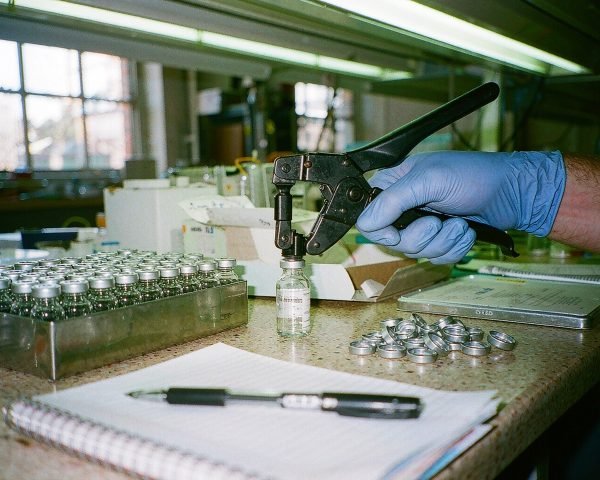

Both are aluminum caps. Both get squeezed onto a glass flange with a crimper. And that’s roughly where the similarity ends. Using an 11mm cap where a 20mm belongs is like putting a motorcycle helmet on a construction site: the principle is right, the physics are not.
Answer: 11mm crimp caps seal standard 1.5-2 mL autosampler vials for HPLC and liquid GC injection. 20mm crimp caps seal 6-20 mL headspace vials, where samples get heated and build pressure, so the caps are larger, the septa are thicker (typically 3 mm vs 1 mm), and the crimp must hold much greater force. The tools, vials, and applications are not interchangeable.
The Short Version
| Feature | 11mm crimp cap | 20mm crimp cap |
|---|---|---|
| Fits | 1.5-2 mL crimp vials (12 × 32 mm) | 6, 10, 20 mL headspace vials |
| Typical use | HPLC / GC liquid injection | GC headspace, KF, high-temp work |
| Septa thickness | ~1 mm (PTFE/silicone) | ~3 mm (PTFE/silicone or PTFE/butyl) |
| Crimp force needed | Lower, precise depth control | Higher, thicker skirt and septa |
| Crimper head | 11mm | 20mm (often swappable on one tool body) |
| Failure mode if wrong | Won’t seat on the wide neck | Won’t compress on the narrow neck |
Why Headspace Needs the Bigger Cap
Headspace analysis heats sealed vials, often to 80°C or higher, and the volatiles you’re measuring pressurize the headspace inside. The seal has to survive that pressure for the whole equilibration without creeping or venting, because any loss of the very compounds you’re quantifying wrecks the result.
That’s why the 20mm system is built heavier in every dimension. The glass flange is wider, the aluminum skirt is taller, and the septum runs about 3 mm thick, typically PTFE-faced silicone or PTFE-faced butyl rubber. Aijiren’s 20mm crimp cap overview describes the 3 mm septa stack and the 9.5 mm center hole that headspace needles pierce through.
An 11mm cap with its ~1 mm septum would seal a headspace vial flange at room temperature, sort of. Under heat and pressure it creeps, and you get pressure loss and evaporative loss of analytes. The numbers that matter most, residual solvents at ppm levels, are exactly the ones a leaky seal corrupts.
Why the 11mm Cap Owns the Autosampler Bench
Standard 12 × 32 mm autosampler vials, the 1.5-2 mL workhorses of HPLC, use an 11mm crimp flange. The smaller cap brings advantages that matter for liquid injection:
- Less metal and less septum, so lower cost per vial at scale
- Lower crimp force, faster manual sealing
- A small puncture footprint that suits liquid autosampler needles
The trade-off is precision. Because the glass neck is thin, an over-enthusiastic crimp can crack it. Vialclosures’ crimper guide notes that 11mm caps feature “thinner aluminum skirts, requiring lower squeeze force and highly precise depth control.” Good news: if you’re deciding between closure styles altogether, our comparison of crimp, screw, and snap vials covers when crimping earns its extra step.
For a broader catalog view of how the two formats divide the analytical workload, HPLC Vials’ crimp cap overview walks through the 11mm and 20mm vial families side by side.
The Tooling Difference
Crimpers are head-specific. An 11mm head can’t compress a 20mm cap evenly, and a 20mm head will simply slide over an 11mm flange without seating anything.
Many labs solve this with interchangeable-head tools: one handle, quick-release heads in 11mm and 20mm. If your bench runs both standard vials and headspace work, that’s the version worth buying. If you only ever run one format, a fixed-head tool is cheaper and one less thing to lose.
Adjustment matters too. Ratcheting crimpers let you tune jaw travel; test on a sacrificial vial until the spin test passes (cap won’t rotate) and the septum sits flat with no bulge. Our walkthrough of crimping technique covers the adjustment process in detail.
Septa: The Quiet Spec That Matters Most
The septum does the actual sealing and takes the needle. The differences between the two formats run deeper than thickness:
- 11mm caps: PTFE/silicone laminates around 1 mm, designed for single or few punctures by liquid autosampler needles
- 20mm caps: 3 mm laminates, often PTFE/butyl for high-temperature headspace, designed to hold pressure and survive repeated headspace needle passes
Thickness changes puncture behavior too. A 3 mm butyl septum needs more needle force and coring discipline than a 1 mm silicone laminate. If your headspace blanks show septum fragments, septa thickness and needle condition are the first two suspects. Our headspace septa selection guide goes deeper on polymer choice.
Common Mistakes Between the Two Formats
- Wrong head on the tool. The classic. The cap looks crimped but spins freely. Always match head size to cap size, no exceptions.
- Mixing cap brands with vial brands without a check. Flange dimensions are standardized enough that it usually works, but “usually” isn’t a QC plan. Seat one sacrificial vial first.
- Assuming 20mm means 20 mL. The cap size is the flange diameter, not the vial volume. 6, 10, and 20 mL headspace vials share the same 20mm neck; a 20 mL vial is a volume spec, not a closure spec.
- Reusing crimped caps. Once the skirt is folded, the seal memory is gone. Crimp caps are single-use; screw caps are the format if you need resealability.
For the vial side of the headspace decision, our headspace vials guide covers the 10/20 mL and flat/round bottom choices.
Which One Should You Order?
Simple decision path:
- Sealing 1.5-2 mL vials for HPLC or liquid GC injection: 11mm crimp caps, PTFE/silicone septa
- Running headspace, Karl Fischer, or any heated sealed-vial work: 20mm crimp caps, 3 mm PTFE/silicone or PTFE/butyl septa
- Running both: buy interchangeable heads and standardize septa suppliers so your blank profiles stay consistent
Conclusion
The 11mm versus 20mm question is really a question about what the seal must survive. Liquid injection needs a small, precise, economical seal; heated headspace needs a thick septum and a heavy skirt that hold pressure for the whole equilibration. Match the cap to the job, match the crimper head to the cap, and replace both formats after every use. For the tool itself, read our crimping technique guide, and for the vials the big caps belong to, start with our headspace vials guide. Get the format right once and the crimper becomes the only part of the system that ever needs thinking about.
Frequently Asked Questions
Can I use an 11mm crimper on 20mm headspace caps?
No. The jaw geometry is sized to the cap diameter, so an 11mm head cannot compress a 20mm skirt evenly. The result is an under-crimped cap that rotates and leaks under heat.
Are 20mm crimp caps only for 20 mL vials?
No. The 20mm refers to the neck flange diameter. Most 6, 10, and 20 mL headspace vials share the same 20mm crimp neck, so one cap size covers all three volumes.
Why are headspace septa so much thicker?
Because the vial is heated and pressurized. A 3 mm PTFE/silicone or PTFE/butyl laminate holds pressure through equilibration and resists creep, where a 1 mm laminate would deform and vent your volatile analytes.
Can I reuse a crimped cap?
No. Crimping permanently deforms the aluminum skirt, so the seal can’t be restored. If you need resealable vials, use a screw-cap format instead.