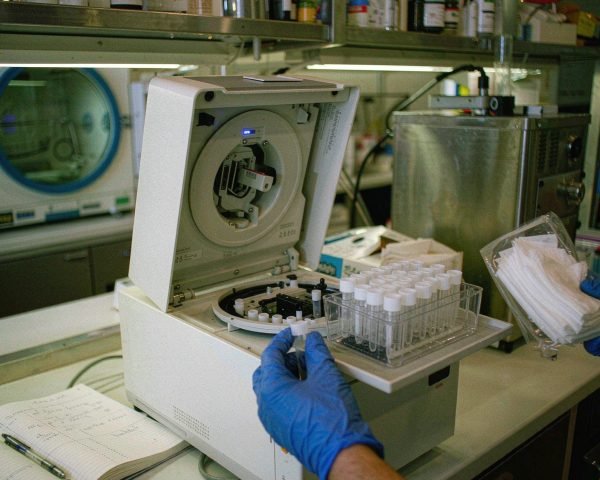

UV-Vis looks like the simplest instrument in the lab: put the cuvette in, press run, read the number. But the number is only as good as what you put in the beam, and most bad UV-Vis data traces back to consumable choices made before the instrument was touched.
Answer: UV-Vis sample prep needs four consumable groups: the right cuvette material for your wavelength (quartz below 340 nm, glass or plastic for visible), clean diluent and matched blank solutions, particle-free samples (filtration or centrifugation), and clean, non-scratching handling supplies. Miss one and the absorbance drifts for reasons the instrument can’t show you.
The Cuvette Is Part of the Optical Path
The most consequential choice is also the most routine purchase: what the sample sits in.
Material determines your wavelength window. One UV-Vis sample prep guide’s cuvette table sums up the standard assignments: quartz transmits from ~190 nm up, optical glass from ~340 nm, and disposable plastics generally only above 330-340 nm. Put a plastic cuvette in the UV region and the plastic absorbs before your analyte does.
Practical matching:
- Quartz (fused silica): nucleic acids at 260 nm, proteins at 280 nm, anything below 340 nm
- Optical glass: visible-range colorimetry and formulation QC
- Disposable plastic (PMMA, PS): high-throughput visible work, teaching labs, assays where cross-contamination matters more than UV reach
Path length is the second dimension. The 10 mm standard suits absorbances from about 0.2 to 1.0, the range where Beer-Lambert quantification stays linear. Concentrated samples want a 1 mm cell instead of a tenfold dilution; micro-volume cells save material in early development. Matched pairs matter for comparative work: two unmatched cuvettes add a constant offset to every difference you measure.
The Blank: Your Most Important “Consumable”
The blank isn’t purchased, but it’s prepared, and its quality sets the floor for everything else. A blank is everything except the analyte: solvent, buffer, reagents, at the concentrations your samples see.
Rules that separate good blanks from lazy ones:
- Match the matrix, not only the solvent. If your samples contain excipients or buffer salts, the blank should too.
- Use the same cuvette for blank and sample when precision matters, or matched cuvettes if you must use two.
- Measure the blank immediately before the sample run; lamp drift is real, especially on single-beam instruments.
The blank correction workflow in this UV-Vis guide details the solvent, matrix, and reagent blank variants and when each applies.
Clean Liquid: Filtration and Centrifugation
Anything suspended in your sample scatters light, and scattering adds apparent absorbance across every wavelength. Turbid samples, protein solutions, and extracts from dirty matrices all need clarification before the beam.
Options, in order of preference for UV-Vis:
- Centrifugation when the analyte stays in solution and you can pipette the supernatant
- Syringe filtration at 0.45 µm for general clarification, 0.22 µm when you also want the sample clean enough for a downstream LC run
Watch the filter itself, because filters can bind or leach. The same care you’d give an HPLC sample applies; our guide to filtering samples before injection covers membrane selection, and our LC-MS grade consumables article covers what “clean” claims actually mean when background matters. For UV-Vis at low wavelengths, a filter that sheds extractables can add absorbance exactly where you’re measuring.
Degas volatile or temperature-sensitive solutions if bubble formation is plausible; a bubble on the optical window reads as a scatter event.
Handling Supplies: Where Good Data Goes to Die
Cuvette handling is consumables work too, and it’s where most preventable error lives:
- Lint-free wipes for the optical windows; a lab tissue leaves fibers and scratches
- Gloves, because fingerprints on an optical face absorb and scatter in your measurement range
- Soft plastic-tipped forceps, since metal tweezers chip quartz corners
- Appropriate cleaning agents: dilute nitric acid or a dedicated cuvette cleaning concentrate for stubborn residue, never abrasive scrubbing. Avoid ultrasonic baths for quartz cells; cavitation attacks polished surfaces.
One practical guide’s contaminant-specific cleaning table matches cleaning protocols to residue types, and the common thread is gentle contact with optical surfaces only by liquid and lint-free materials.
Storage counts as consumable care: cleaned cuvettes go back in their cases, dry, never parked on the bench collecting a film.
Matching Consumables to the Measurement Type
Different UV-Vis jobs lean on different consumables, and naming the job sharpens the shopping list.
Nucleic acid and protein quantification lives at 260 and 280 nm, so it is a quartz-cuvette job with UV-grade water and filtration clean enough for low background. Colorimetric assays like Bradford and BCA sit in the visible, where disposable plastic cuvettes are both acceptable and hygienic. Kinetics work wants temperature-controlled cuvette holders and matched pairs so the baseline doesn’t drift between time points. Teaching labs buy plastic by the sleeve and accept the wavelength limit as the price of survivability.
Name the dominant measurement on your bench, and three of the four consumable groups practically choose themselves.
Reagents and Diluent
Two quiet items worth standardizing:
- Water and solvent grade. UV grade or HPLC-grade water and solvents have low UV absorbance and low particulates. Tap water in a blank is a baseline that wanders.
- Consistent lots for a study. Solvent lots differ in trace UV absorbers. If a study spans months, hold one lot or re-baseline when you change it.
A Compact Bench Checklist
- Cuvette material matched to wavelength; matched pairs for comparative work
- Path length appropriate to expected absorbance (0.2-1.0 target)
- Matrix-matched blank, measured on the same instrument session
- Samples clarified: centrifuged or 0.45 µm filtered, no visible turbidity
- Lint-free wipes, gloves, plastic-tipped forceps at the bench
- UV-grade diluent, one lot per study
- Cleaning concentrate and a drying rack for reusable cells
Conclusion
UV-Vis accuracy is mostly decided before the sample reaches the instrument. Match the cuvette material and path length to the measurement, build a blank that mirrors your matrix, clarify every sample that isn’t visually clear, and handle optical surfaces like the optical surfaces they are. None of it is expensive; all of it shows up in the number. Ten minutes of prep discipline is cheaper than any re-run. For the filtration half of the prep, read our guide to filtering samples before injection, and for what clean claims on solvents and consumables actually guarantee, our LC-MS grade explainer applies just as well to UV work.
Frequently Asked Questions
Can I use plastic cuvettes for UV measurements?
Generally no. Most disposable plastic cuvettes absorb below roughly 330-340 nm, which is exactly where UV work happens. Use quartz below 340 nm; save plastic for visible-range assays.
Why is my sample reading higher than expected?
Turbidity is the usual suspect: suspended particles scatter light and inflate absorbance at all wavelengths. Centrifuge or filter the sample, then re-read. Fingerprints and scratches on the optical window are the next suspects.
Do I need to filter every sample?
Every sample that isn’t optically clear. Clean standards and filtered mobile phases don’t need it; anything from a real matrix usually does. A 0.45 µm filtration takes seconds and removes the most common source of drifting baselines.
How do I clean quartz cuvettes without damaging them?
Rinse with the sample solvent, then purified water, then ethanol, and air-dry on a lint-free surface. For stubborn residue, soak in dilute nitric acid or a dedicated cleaning concentrate. Never scrub with abrasives or use metal tweezers.